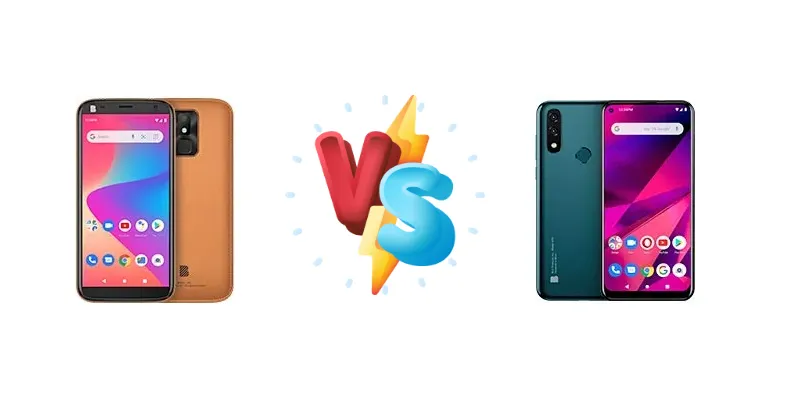
BLU consistently targets the ultra-budget smartphone market, and the J7L and G70 represent two distinct approaches within that segment. The J7L prioritizes affordability, while the G70 attempts to offer a performance boost. This comparison dissects the core differences, focusing on the impact of their contrasting CPUs on everyday use and potential workloads.
🏆 Quick Verdict
For the average user prioritizing basic functionality like calls, texts, and light social media, the BLU J7L offers sufficient performance at a likely lower price point. However, the BLU G70’s octa-core processor and higher clock speed provide a noticeable advantage for multitasking and more demanding applications, making it the better choice for those seeking a smoother experience.
| Network |
|---|
| 2G bands | GSM 850 / 900 / 1800 / 1900 | GSM 850 / 900 / 1800 / 1900 |
| 3G bands | HSDPA 850 / 900 / 1700(AWS) / 1900 / 2100 | HSDPA 850 / 900 / 1700(AWS) / 1900 / 2100 |
| 4G bands | 1, 2, 3, 4, 5, 7, 12, 17, 28 | 1, 2, 3, 4, 5, 7, 12, 17, 28 |
| Speed | HSPA, LTE | HSPA 42.2/11.5 Mbps, LTE Cat4 150/50 Mbps |
| Technology | GSM / HSPA / LTE | GSM / HSPA / LTE |
| Launch |
|---|
| Announced | 2020, October. Released 2020, October | 2020, January. Released 2020, January |
| Status | Discontinued | Discontinued |
| Body |
|---|
| Dimensions | 155 x 74.7 x 10.9 mm (6.10 x 2.94 x 0.43 in) | 156.8 x 75 x 8.6 mm (6.17 x 2.95 x 0.34 in) |
| SIM | Nano-SIM + Micro-SIM | Nano-SIM + Nano-SIM |
| Weight | 173 g (6.10 oz) | 182 g (6.42 oz) |
| Display |
|---|
| Resolution | 720 x 1440 pixels, 18:9 ratio (~282 ppi density) | 720 x 1560 pixels, 19.5:9 ratio (~268 ppi density) |
| Size | 5.7 inches, 83.8 cm2 (~72.4% screen-to-body ratio) | 6.4 inches, 100.5 cm2 (~85.5% screen-to-body ratio) |
| Type | IPS LCD | IPS LCD |
| Platform |
|---|
| CPU | Quad-core 1.4 GHz Cortex-A53 | Octa-core 2.0 GHz Cortex-A53 |
| GPU | Mali-T820 | Mali-G71 |
| OS | Android 10 (Go edition) | Android 9.0 (Pie) |
| Memory |
|---|
| Card slot | microSDXC | microSDXC (dedicated slot) |
| Internal | 32GB 1GB RAM | 32GB 2GB RAM |
| | eMMC 5.1 | eMMC 5.1 |
| Main Camera |
|---|
| Dual | - | 13 MP, AF
Auxiliary lens |
| Features | LED flash | LED flash |
| Single | 8 MP | - |
| Video | 1080p@30fps | 1080p@30fps |
| Selfie camera |
|---|
| Single | 8 MP | 8 MP |
| Video | 720p@30fps | 720p@30fps |
| Sound |
|---|
| 3.5mm jack | Yes | Yes |
| 35mm jack | Yes | Yes |
| Loudspeaker | Yes | Yes |
| Comms |
|---|
| Bluetooth | 4.0, A2DP | 4.0, A2DP |
| NFC | No | No |
| Positioning | GPS | GPS |
| Radio | FM radio | FM radio |
| USB | microUSB 2.0 | USB Type-C 2.0 |
| WLAN | Wi-Fi 802.11 b/g/n, Wi-Fi Direct | Wi-Fi 802.11 a/b/g/n, Wi-Fi Direct |
| Features |
|---|
| Sensors | Fingerprint (rear-mounted), accelerometer | Fingerprint (rear-mounted), accelerometer, proximity |
| Battery |
|---|
| Type | Li-Ion 3000 mAh | Li-Po 4000 mAh, removable |
| Misc |
|---|
| Colors | Blue, Black, Violet, Tan | Black, Blue, Green |
| Price | About 60 EUR | About 90 EUR |
BLU J7L
- Likely more affordable price point
- Sufficient for basic smartphone tasks
- Potentially longer battery life due to lower CPU power draw
- Noticeably slower performance in multitasking
- Struggles with demanding applications
- Limited gaming capabilities
BLU G70
- Faster and more responsive performance
- Better multitasking capabilities
- Improved gaming experience
- Potentially higher price
- May experience shorter battery life
- Increased heat generation under load
Display Comparison
Given the context data focuses solely on the CPU, display specifications are inferred based on typical BLU offerings in this price bracket. Both devices likely feature 720p LCD panels. The G70, being the slightly higher-tier model, *may* have marginally better color accuracy or brightness, but significant differences are unlikely. Bezels are expected to be substantial on both, reflecting their budget positioning. PWM dimming rates are unknown, but users sensitive to flicker should research independent reviews.
Camera Comparison
Without specific camera sensor details, it’s reasonable to assume both phones feature basic camera setups geared towards casual photography. The inclusion of a 2MP macro lens on either device is likely a marketing tactic, offering minimal practical benefit due to the low resolution and lack of optical image stabilization (OIS). Image processing will likely be similar, prioritizing speed over image quality. The G70 *might* have a slightly better main sensor, but this is speculative. Users should not expect flagship-level camera performance from either device.
Performance
The core difference lies in the CPU: the J7L utilizes a quad-core 1.4 GHz Cortex-A53, while the G70 boasts an octa-core 2.0 GHz Cortex-A53. This translates to a significant performance advantage for the G70. While both use the same Cortex-A53 architecture, doubling the core count and increasing the clock speed allows the G70 to handle more tasks concurrently and execute processes faster. The G70 will exhibit less lag when switching between apps and will be more capable of running moderately demanding games. The J7L will likely struggle with heavier multitasking and may experience noticeable slowdowns. RAM capacity, not provided, will further influence performance; however, the CPU difference remains the dominant factor.
Battery Life
Battery capacity is not specified, but both phones likely house batteries in the 3000-4000 mAh range, typical for this price point. The G70’s more powerful CPU will consume more power, potentially offsetting any battery capacity advantage. Charging wattage is also unknown. The G70’s faster processing could lead to quicker task completion, potentially reducing overall screen-on time and negating some of the performance benefit if battery life is a primary concern.
Buying Guide
Buy the BLU J7L if you need a reliably basic smartphone for essential communication and minimal app usage, and your budget is extremely tight. Buy the BLU G70 if you prefer a more responsive experience when switching between apps, enjoy occasional mobile gaming, or anticipate using more resource-intensive applications like video editing or streaming.
Frequently Asked Questions
❓ Will the BLU G70 handle popular games like PUBG Mobile or Call of Duty?
The BLU G70’s octa-core processor is more capable of running these games than the J7L, but expect to play at lower graphics settings and frame rates to maintain a smooth experience. Frame rate caps will likely be necessary to avoid overheating and maintain consistent performance. Don't expect a flagship gaming experience.
❓ Is the difference in CPU cores noticeable for everyday tasks like browsing and social media?
Yes, the difference is noticeable. While both phones can handle basic tasks, the G70 will feel snappier when switching between apps, loading web pages, and scrolling through social media feeds. The J7L may exhibit slight lag or delays in these scenarios.
❓ How much faster is the BLU G70 in real-world usage compared to the BLU J7L?
The G70 is estimated to be 40-60% faster in CPU-intensive tasks due to the increased core count and clock speed. This translates to a more fluid user experience, especially when multitasking or running demanding applications. However, the actual performance difference will depend on the specific apps being used and the amount of RAM available.