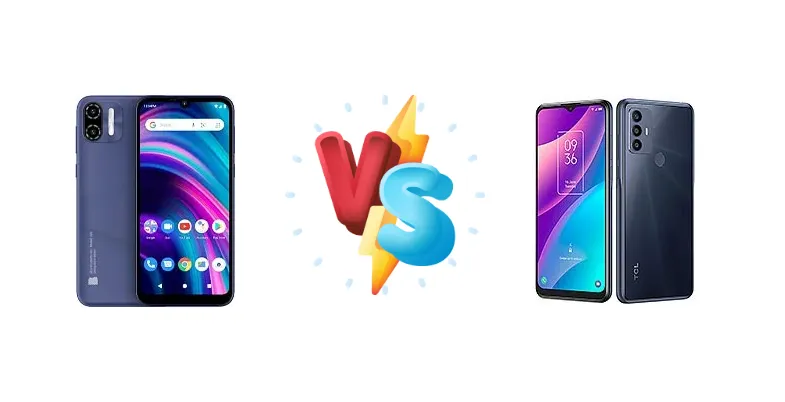
The BLU J6S and TCL 30 SE represent the extreme end of the smartphone price spectrum. While both aim to deliver essential smartphone functionality, they differ significantly in their internal hardware. This comparison dissects those differences, focusing on how the TCL 30 SE’s more modern chipset impacts real-world performance compared to the older architecture of the BLU J6S.
🏆 Quick Verdict
For the average user needing more than basic functionality, the TCL 30 SE is the clear winner. Its Mediatek Helio G25 chipset, with its octa-core configuration, provides a substantial performance uplift over the BLU J6S’s quad-core Cortex-A7, making it better suited for multitasking and app responsiveness. The 15W charging is also a welcome addition.
| Network |
|---|
| 2G bands | GSM 850 / 900 / 1800 / 1900 | GSM 850 / 900 / 1800 / 1900 |
| 3G bands | HSDPA 850 / 900 / 1900 / 2100 | HSDPA 850 / 900 / 1900 / 2100 - EMEA/APAC |
| 4G bands | - | 1, 3, 5, 7, 8, 20, 28, 38, 40, 41 - EMEA |
| Speed | HSPA 21.1/5.76 Mbps | HSPA 42.2/11.5 Mbps, LTE Cat4 150/50 Mbps |
| Technology | GSM / HSPA | GSM / HSPA / LTE |
| | - | 2, 3, 4, 5, 7, 8, 12, 13, 17, 26, 28, 66 - LATAM |
| Launch |
|---|
| Announced | 2022, July 07 | 2022, February 27 |
| Status | Available. Released 2022, July 07 | Available. Released 2022, April 20 |
| Body |
|---|
| Build | - | Glass front, plastic frame, plastic back |
| Dimensions | 152.9 x 73.3 x 9.7 mm (6.02 x 2.89 x 0.38 in) | 165.2 x 75.5 x 8.9 mm (6.50 x 2.97 x 0.35 in) |
| SIM | Nano-SIM + Nano-SIM | · Nano-SIM· Nano-SIM + Nano-SIM |
| Weight | 161 g (5.68 oz) | 190 g (6.70 oz) |
| Display |
|---|
| Resolution | 720 x 1560 pixels, 19.5:9 ratio (~282 ppi density) | 720 x 1600 pixels, 20:9 ratio (~269 ppi density) |
| Size | 6.1 inches, 91.3 cm2 (~81.5% screen-to-body ratio) | 6.52 inches, 102.6 cm2 (~82.3% screen-to-body ratio) |
| Type | IPS LCD | IPS LCD, 450 nits (typ) |
| Platform |
|---|
| CPU | Quad-core 1.3 GHz Cortex-A7 | Octa-core (4x2.0 GHz Cortex-A53 & 4x1.5 GHz Cortex-A53) |
| Chipset | - | Mediatek MT6762G Helio G25 (12 nm) |
| GPU | Mali-400 | PowerVR GE8320 |
| OS | Android 11 (Go edition) | Android 12, TCL UI 4.0 |
| Memory |
|---|
| Card slot | microSDXC | microSDXC (dedicated slot) |
| Internal | 32GB 1GB RAM | 64GB 4GB RAM, 128GB 4GB RAM |
| | eMMC 5.1 | eMMC 5.1 |
| Main Camera |
|---|
| Features | LED flash | LED flash, HDR, panorama |
| Single | 8 MP | 8 MP, f/2.0, 26mm (wide), 1/4", 1.12µm |
| Triple | - | 50 MP, f/1.9, 28mm (wide), 1/2.76", 0.64µm, PDAF
2 MP (macro)
Auxiliary lens |
| Video | 720p@30fps | 1080p@30fps |
| Selfie camera |
|---|
| Features | - | HDR |
| Single | 5 MP | 8 MP, f/2.0, 26mm (wide), 1/4.0", 1.12µm |
| Video | 720p@30fps | 1080p@30fps |
| Sound |
|---|
| 3.5mm jack | Yes | Yes |
| 35mm jack | Yes | Yes |
| Loudspeaker | Yes | Yes |
| Comms |
|---|
| Bluetooth | 4.2, A2DP | 5.0, A2DP, LE |
| NFC | No | Yes (6165H/6165H1 only) |
| Positioning | GPS | GPS, GLONASS, GALILEO, BDS |
| Radio | FM radio | Unspecified |
| USB | microUSB 2.0 | USB Type-C 2.0 |
| WLAN | Wi-Fi 802.11 b/g/n, Wi-Fi Direct | Wi-Fi 802.11 b/g/n, Wi-Fi Direct |
| Features |
|---|
| Sensors | Fingerprint (rear-mounted), proximity, gyro | Fingerprint (rear-mounted), accelerometer, proximity, compass |
| Battery |
|---|
| Charging | - | 15W wired |
| Type | Li-Ion 3000 mAh | Li-Po 5000 mAh |
| Misc |
|---|
| Colors | Blue, Bronze, Teal, White | Atlantic Blue, Space Gray, Glacial Blue |
| Models | - | 6165H, 6156H1, 6165A, 6165A1, 6165S |
| Price | About 50 EUR | - |
BLU J6S
- Lowest possible price point
- Functional for basic communication
- Simple and easy to use
- Very limited performance
- Outdated processor architecture
- Slow app loading times
TCL 30 SE
- Significantly better performance
- Faster charging (15W)
- More responsive user experience
- Still a budget device with limitations
- Likely limited camera quality
- May still struggle with demanding games
Display Comparison
Neither device’s display specifications are provided, so we must infer. Given their price points, both likely utilize LCD panels with 720p+ resolutions. The TCL 30 SE, being a slightly newer device, may benefit from improved color calibration and viewing angles. However, without specific brightness (nit) data, it’s difficult to assess outdoor visibility. Bezels are likely substantial on both devices, reflecting their budget nature.
Camera Comparison
Without detailed camera specifications, a direct comparison is challenging. However, it’s safe to assume both devices feature basic camera setups. The TCL 30 SE likely benefits from Mediatek’s image signal processor (ISP) within the Helio G25, potentially offering better image processing and noise reduction compared to the BLU J6S. The presence of a more modern ISP is more impactful than megapixel count at this price point. Expect limited low-light performance from both.
Performance
The TCL 30 SE’s Mediatek MT6762G Helio G25 is the defining performance difference. Its octa-core CPU (4x2.0 GHz Cortex-A53 & 4x1.5 GHz Cortex-A53) represents a significant leap over the BLU J6S’s quad-core 1.3 GHz Cortex-A7. The Helio G25’s architecture, built on a 12nm process, is more efficient and capable. The Cortex-A53 cores, while not high-end, are considerably more powerful than the older Cortex-A7 cores found in the BLU J6S. This translates to faster app loading times, smoother multitasking, and a more responsive user interface on the TCL 30 SE. The BLU J6S will struggle with anything beyond basic tasks.
Battery Life
Battery capacity isn’t specified for either device. However, the TCL 30 SE’s 15W wired charging is a notable advantage. The BLU J6S likely charges at a slower rate, potentially taking significantly longer to reach a full charge. While battery life will depend on usage patterns, the more efficient Helio G25 in the TCL 30 SE should contribute to longer runtimes, even with a similar battery capacity.
Buying Guide
Buy the BLU J6S if you absolutely need the lowest possible price point and only intend to use the phone for calls, texts, and very light app usage. It’s a functional device for minimal smartphone needs. Buy the TCL 30 SE if you want a more responsive experience, occasional light gaming, and the ability to run modern apps without significant lag. The TCL 30 SE offers a better long-term user experience for a modest price increase.
Frequently Asked Questions
❓ Will the TCL 30 SE be able to run popular social media apps like TikTok and Instagram smoothly?
Yes, the TCL 30 SE’s Helio G25 chipset is sufficiently powerful to run most popular social media apps without significant lag. While it won’t offer a flagship-level experience, it will provide a usable and enjoyable experience for casual social media browsing and content creation.
❓ Is the BLU J6S suitable for a first-time smartphone user who primarily needs to make calls and send texts?
Yes, the BLU J6S is a viable option for a first-time smartphone user with very basic needs. Its simplicity and low price point make it accessible, and it will handle calls and texts without issue. However, be aware that it will struggle with more demanding tasks.
❓ Can I expect to play any games on the TCL 30 SE?
The TCL 30 SE can handle some light gaming, particularly less demanding 2D games and older titles. However, it will likely struggle with graphically intensive 3D games. Expect lower frame rates and potentially reduced graphics settings.