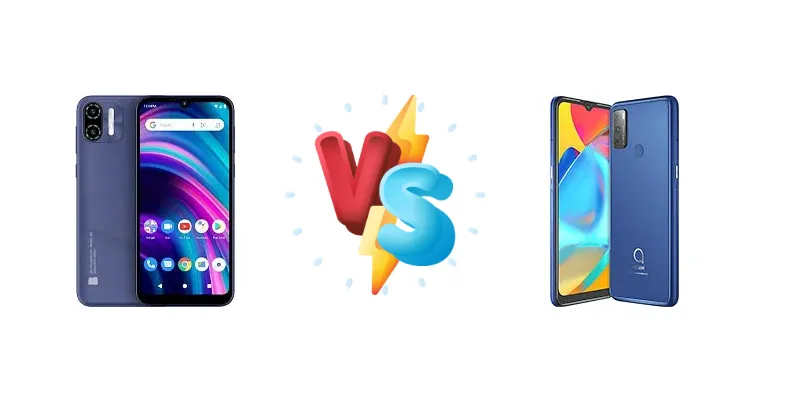
The sub-$150 smartphone market is fiercely competitive. Both the BLU J6S and the alcatel 3L (2021) aim to deliver essential smartphone functionality at an accessible price. However, they take drastically different approaches to achieving this, with the alcatel 3L leveraging a more modern chipset architecture. This comparison will dissect the key differences to help you determine which device best suits your needs.
🏆 Quick Verdict
For the average user prioritizing responsiveness and multitasking, the alcatel 3L (2021) is the clear winner. Its Mediatek Helio P22 chipset, with its octa-core configuration, provides a significantly more fluid experience than the BLU J6S’s quad-core Cortex-A7. While the J6S may offer slightly better standby battery life due to its simpler processor, the performance gap is too large to ignore.
| Network |
|---|
| 2G bands | GSM 850 / 900 / 1800 / 1900 | GSM 850 / 900 / 1800 / 1900 |
| 3G bands | HSDPA 850 / 900 / 1900 / 2100 | HSDPA 850 / 900 / 1900 / 2100 |
| 4G bands | - | 1, 3, 7, 8, 20, 28 |
| Speed | HSPA 21.1/5.76 Mbps | HSPA 42.2/5.76 Mbps, LTE Cat4 150/50 Mbps |
| Technology | GSM / HSPA | GSM / HSPA / LTE |
| Launch |
|---|
| Announced | 2022, July 07 | 2021, January 12 |
| Status | Available. Released 2022, July 07 | Available. Released 2021, April 26 |
| Body |
|---|
| Build | - | Glass front, plastic back, plastic frame |
| Dimensions | 152.9 x 73.3 x 9.7 mm (6.02 x 2.89 x 0.38 in) | 165.6 x 75.6 x 8.7 mm (6.52 x 2.98 x 0.34 in) |
| SIM | Nano-SIM + Nano-SIM | · Nano-SIM· Nano-SIM + Nano-SIM |
| Weight | 161 g (5.68 oz) | 194 g (6.84 oz) |
| Display |
|---|
| Resolution | 720 x 1560 pixels, 19.5:9 ratio (~282 ppi density) | 720 x 1600 pixels, 20:9 ratio (~269 ppi density) |
| Size | 6.1 inches, 91.3 cm2 (~81.5% screen-to-body ratio) | 6.52 inches, 102.6 cm2 (~82.0% screen-to-body ratio) |
| Type | IPS LCD | IPS LCD |
| Platform |
|---|
| CPU | Quad-core 1.3 GHz Cortex-A7 | Octa-core (4x1.8 GHz Cortex-A53 & 4x1.5 GHz Cortex-A53) |
| Chipset | - | Mediatek MT6762D Helio P22 (12 nm) |
| GPU | Mali-400 | PowerVR GE8320 |
| OS | Android 11 (Go edition) | Android 11 |
| Memory |
|---|
| Card slot | microSDXC | microSDXC (only single sim model) |
| Internal | 32GB 1GB RAM | 64GB 4GB RAM |
| | eMMC 5.1 | eMMC 5.1 |
| Main Camera |
|---|
| Features | LED flash | LED flash, HDR, panorama |
| Single | 8 MP | - |
| Triple | - | 48 MP, f/1.8, 26mm (wide), 1/2.0", 0.8µm, PDAF
2 MP (macro)
Auxiliary lens |
| Video | 720p@30fps | 1080p@30fps |
| Selfie camera |
|---|
| Features | - | HDR |
| Single | 5 MP | 8 MP, f/2.0, 26mm (wide), 1/4.0", 1.12µm |
| Video | 720p@30fps | 1080p@30fps |
| Sound |
|---|
| 3.5mm jack | Yes | Yes |
| 35mm jack | Yes | Yes |
| Loudspeaker | Yes | Yes |
| Comms |
|---|
| Bluetooth | 4.2, A2DP | 5.0, A2DP, LE |
| NFC | No | Yes |
| Positioning | GPS | GPS, GLONASS, GALILEO, BDS |
| Radio | FM radio | FM radio |
| USB | microUSB 2.0 | microUSB 2.0, OTG |
| WLAN | Wi-Fi 802.11 b/g/n, Wi-Fi Direct | Wi-Fi 802.11 b/g/n, Wi-Fi Direct |
| Features |
|---|
| Sensors | Fingerprint (rear-mounted), proximity, gyro | Fingerprint (rear-mounted), accelerometer, proximity, compass |
| Battery |
|---|
| Charging | - | 10W wired |
| Type | Li-Ion 3000 mAh | Li-Po 4000 mAh |
| Misc |
|---|
| Colors | Blue, Bronze, Teal, White | Jewelry Blue, Jewelry Black |
| Models | - | 6056D |
| Price | About 50 EUR | About 330 EUR |
BLU J6S
- Potentially longer standby time due to simpler processor.
- Extremely affordable price point.
- Basic functionality for essential tasks.
- Significantly slower performance compared to the alcatel 3L.
- Likely struggles with multitasking and demanding apps.
- Outdated processor architecture.
alcatel 3L (2021)
- Faster and more responsive performance thanks to the Helio P22.
- Octa-core processor enables smoother multitasking.
- More efficient 12nm manufacturing process.
- May have slightly shorter battery life during active use.
- 10W charging is relatively slow.
- Still a budget device with inherent limitations.
Display Comparison
Neither device boasts a standout display. Given the context data, we can assume both utilize LCD panels, typical for this price bracket. The alcatel 3L’s chipset allows for potentially better image processing, which *could* translate to slightly more vibrant colors, but this is speculative. Bezels are likely substantial on both devices. Without specific resolution or brightness data, it’s safe to assume both offer a functional, but not exceptional, viewing experience.
Camera Comparison
Without detailed camera specifications, a direct comparison is difficult. However, it’s highly probable both devices feature basic camera setups. Given the market segment, expect a primary sensor on both, likely around 8-13MP, and potentially a secondary depth or macro sensor. The alcatel 3L’s more powerful chipset *could* enable slightly better image processing, resulting in marginally improved image quality, but don’t expect flagship-level results. The presence of a 2MP macro camera on either device is largely a marketing gimmick and offers limited practical benefit.
Performance
The performance disparity is the most significant difference. The BLU J6S’s quad-core 1.3 GHz Cortex-A7 processor is based on an older architecture. In contrast, the alcatel 3L (2021) features the Mediatek MT6762D Helio P22, an octa-core chip with a mix of 1.8 GHz and 1.5 GHz Cortex-A53 cores, fabricated on a more efficient 12nm process. This means the alcatel 3L will handle app switching, web browsing, and even light gaming with considerably less lag. The Cortex-A53 cores, while not high-end, represent a substantial architectural improvement over the Cortex-A7, offering better instructions per clock cycle.
Battery Life
Battery capacity is not specified for either device. However, the alcatel 3L’s 10W charging suggests a focus on conservative power management. The BLU J6S, with its simpler processor, may achieve slightly longer standby times. However, the Helio P22’s 12nm process and potentially more efficient power management features could mitigate this difference. Real-world usage will be the deciding factor, but the alcatel 3L’s faster processor will likely consume more power during active use.
Buying Guide
Buy the BLU J6S if you need a basic, extremely affordable phone primarily for calls, texts, and light app usage, and long standby time is paramount. Buy the alcatel 3L (2021) if you prefer a more responsive user experience, enjoy occasional multitasking, and want a phone capable of handling more demanding apps, even if it means slightly faster battery drain.
Frequently Asked Questions
❓ Will the alcatel 3L (2021) struggle with popular social media apps like TikTok or Instagram?
While the Helio P22 isn't a powerhouse, it's capable of running TikTok and Instagram without significant issues. Expect some occasional lag during intensive tasks like video editing or applying filters, but the overall experience should be usable. The BLU J6S, with its older processor, will likely exhibit more noticeable slowdowns.
❓ Is the 10W charging on the alcatel 3L (2021) painfully slow?
10W charging is indeed slow by modern standards. Expect a full charge to take around 2.5 to 3.5 hours. However, given the likely smaller battery capacity of both devices, it's a reasonable trade-off for affordability. Overnight charging is recommended.
❓ Can either of these phones handle basic mobile games like Candy Crush or Subway Surfers?
Both phones can handle casual games like Candy Crush or Subway Surfers. However, the alcatel 3L (2021) will provide a smoother and more consistent gaming experience due to its more powerful processor. The BLU J6S may experience noticeable frame drops and lag during gameplay.