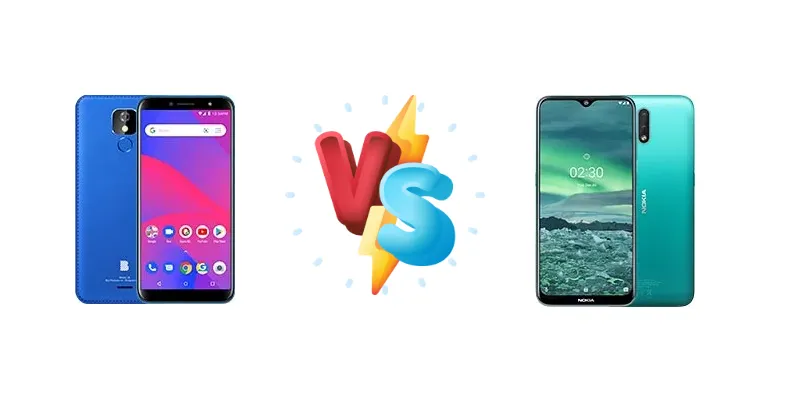
The BLU J6 and Nokia 2.3 represent the extreme end of the smartphone price spectrum, targeting users who prioritize affordability above all else. Both devices aim to deliver a functional Android experience without breaking the bank, but they achieve this with significantly different hardware. This comparison dissects their key specifications to determine which offers the best value for the money.
🏆 Quick Verdict
For the average user seeking a slightly smoother and more future-proof experience, the Nokia 2.3 emerges as the better choice. Its newer Mediatek Helio A22 chipset, built on a 12nm process, provides a noticeable performance uplift over the BLU J6’s older MT6580, despite both featuring quad-core CPUs. While neither phone excels, the Nokia 2.3 offers a more responsive user experience.
| Network |
|---|
| 2G bands | GSM 850 / 900 / 1800 / 1900 | GSM 850 / 900 / 1800 / 1900 |
| 3G bands | HSDPA 850 / 900 / 1900 / 2100 | HSDPA 850 / 900 / 2100 - Global |
| 4G bands | - | 1, 3, 5, 7, 8, 20, 28, 38, 40, 41 - Global |
| Speed | HSPA 21.1/5.76 Mbps | HSPA 42.2/5.76 Mbps, LTE Cat4 150/50 Mbps |
| Technology | GSM / HSPA | GSM / HSPA / LTE |
| | - | 1, 3, 5, 8, 40, 41 - India |
| Launch |
|---|
| Announced | 2019, December. Released 2019, December | 2019, December 05. Released 2019, December 19 |
| Status | Discontinued | Discontinued |
| Body |
|---|
| Build | - | Glass front, plastic back, plastic frame |
| Dimensions | 159.6 x 76.6 x 9.1 mm (6.28 x 3.02 x 0.36 in) | 157.7 x 75.4 x 8.7 mm (6.21 x 2.97 x 0.34 in) |
| SIM | Nano-SIM + Nano-SIM | · Nano-SIM· Nano-SIM + Nano-SIM |
| Weight | 185 g (6.53 oz) | 183 g (6.46 oz) |
| Display |
|---|
| Resolution | 720 x 1440 pixels, 18:9 ratio (~268 ppi density) | 720 x 1520 pixels, 19:9 ratio (~271 ppi density) |
| Size | 6.0 inches, 92.9 cm2 (~76.0% screen-to-body ratio) | 6.2 inches, 95.9 cm2 (~80.7% screen-to-body ratio) |
| Type | IPS LCD | IPS LCD |
| | - | Always-on display |
| Platform |
|---|
| CPU | Quad-core 1.3 GHz Cortex-A7 | Quad-core 2.0 GHz Cortex-A53 |
| Chipset | Mediatek MT6580 (28 nm) | Mediatek MT6761 Helio A22 (12 nm) |
| GPU | Mali-400 | PowerVR GE8320 |
| OS | Android 8.1 Oreo (Go edition) | Android 9.0 (Pie), upgradable to Android 11, Android One |
| Memory |
|---|
| Card slot | microSDXC | microSDXC (uses shared SIM slot) |
| Internal | 32GB 1GB RAM | 32GB 2GB RAM |
| | eMMC 5.1 | eMMC 5.1 |
| Main Camera |
|---|
| Features | LED flash | LED flash, HDR, panorama |
| Single | 8 MP, (wide), 1/5.0", 1.12µm, AF | 13 MP, f/2.2, 1/3.1", 1.12µm, AF
Auxiliary lens |
| Video | 720p@30fps | 1080p@30fps |
| Selfie camera |
|---|
| Features | LED flash | - |
| Single | 8 MP | 5 MP, f/2.4 |
| Video | 720p@30fps | - |
| Sound |
|---|
| 3.5mm jack | Yes | Yes |
| 35mm jack | Yes | Yes |
| Loudspeaker | Yes | Yes |
| Comms |
|---|
| Bluetooth | 4.1, A2DP, LE | 5.0, A2DP, LE |
| NFC | No | No |
| Positioning | GPS | GPS, GLONASS, BDS |
| Radio | FM radio | FM radio |
| USB | microUSB 2.0 | microUSB 2.0, OTG |
| WLAN | Wi-Fi 802.11 b/g/n, Wi-Fi Direct | Wi-Fi 802.11 b/g/n |
| Features |
|---|
| Sensors | Fingerprint (rear-mounted), accelerometer, proximity | Accelerometer, proximity |
| Battery |
|---|
| Type | Li-Po 2800 mAh, removable | Li-Po 4000 mAh, non-removable |
| Misc |
|---|
| Colors | Blue, Black, Brown | Cyan Green, Sand, Charcoal |
| Models | - | TA-1211, TA-1214, TA-1206, TA-1209 |
| Price | About 80 EUR | About 120 EUR |
| SAR | - | 0.81 W/kg (head) 0.86 W/kg (body) |
| SAR EU | - | 0.41 W/kg (head) 1.40 W/kg (body) |
BLU J6
- Potentially lower price point
- Simple and straightforward Android experience
- May be readily available in certain markets
- Outdated chipset and architecture
- Poor performance compared to newer devices
- Less efficient power consumption
Nokia 2.3
- More modern and efficient chipset
- Improved CPU architecture (Cortex-A53)
- Potential for better software support from Nokia
- Still a very basic smartphone
- Camera performance will be limited
- May be slightly more expensive than the BLU J6
Display Comparison
Neither BLU nor Nokia provide detailed display specifications. However, given the price point, both likely utilize LCD panels with resolutions around 720p+. The Nokia 2.3 benefits from a more modern chipset that *could* allow for slightly better image processing, but the difference will be minimal. Bezels are expected to be substantial on both devices, reflecting their budget nature. Color accuracy is unlikely to be a strong point on either.
Camera Comparison
Camera performance on both devices will be limited. Details are sparse, but both likely feature a primary camera alongside basic auxiliary sensors. The Nokia 2.3 *may* benefit from slightly better image signal processing (ISP) capabilities within the Helio A22 chipset, potentially resulting in marginally improved image quality in good lighting conditions. However, low-light performance will be poor on both. Any 2MP macro or depth sensors present on either device should be considered marketing features rather than genuine photographic tools.
Performance
The core difference lies in the chipsets. The BLU J6’s Mediatek MT6580, fabricated on a 28nm process, is a significantly older design. Its quad-core Cortex-A7 CPU operates at 1.3 GHz. In contrast, the Nokia 2.3 boasts the Mediatek MT6761 Helio A22, built on a more efficient 12nm process, with a quad-core Cortex-A53 CPU clocked at 2.0 GHz. The A53 architecture is a substantial improvement over the A7, offering better performance per clock cycle. This translates to snappier app launches and smoother multitasking on the Nokia 2.3. While neither phone is a gaming powerhouse, the Nokia 2.3 will handle less demanding titles with greater ease.
Battery Life
Battery capacity is not specified for either device. However, the Nokia 2.3’s more efficient 12nm Helio A22 chipset will likely result in better battery life compared to the BLU J6’s power-hungry 28nm MT6580. While both will likely offer a full day of light use, the Nokia 2.3 will be less affected by demanding tasks. Charging speeds are also unknown, but are likely to be slow on both devices, relying on micro-USB connectivity.
Buying Guide
Buy the BLU J6 if you absolutely need the lowest possible price and are comfortable with a very basic smartphone experience. It's suitable for calls, texts, and light app usage. Buy the Nokia 2.3 if you prioritize a slightly more responsive interface, better potential for software updates (thanks to Nokia’s cleaner Android implementation), and a more efficient processor that may translate to slightly better battery life during sustained use.
Frequently Asked Questions
❓ Will the Nokia 2.3 struggle with popular social media apps like Facebook and Instagram?
While the Nokia 2.3 won't offer a blazing-fast experience, its Helio A22 chipset and Cortex-A53 cores are sufficient to run these apps reasonably well. Expect some loading times and occasional lag, but it should be usable for basic browsing and interaction. The BLU J6 will likely exhibit more noticeable slowdowns.
❓ Is the Nokia 2.3 a good choice for someone switching from an older feature phone?
Yes, the Nokia 2.3 is an excellent entry point for users upgrading from a feature phone. It provides a full smartphone experience with access to apps, internet browsing, and modern communication tools, all at a very affordable price. The simpler Android Go edition software can also be less overwhelming for first-time smartphone users.
❓ Can I play PUBG Mobile on either of these phones?
Playing PUBG Mobile on either the BLU J6 or Nokia 2.3 is not recommended. The chipsets lack the processing power and graphics capabilities to run the game smoothly, even at the lowest settings. You may be able to launch the game, but expect extremely low frame rates and significant lag.