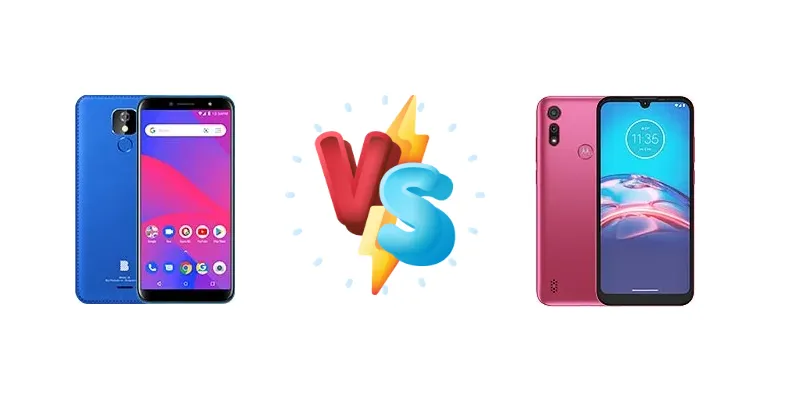
The BLU J6 and Motorola Moto E6i represent the extreme end of the smartphone price spectrum. Both aim to deliver essential smartphone functionality at a minimal cost, but they achieve this with significantly different hardware approaches. This comparison dissects those differences, focusing on real-world performance implications for the budget-conscious user.
🏆 Quick Verdict
For most users, the Motorola Moto E6i is the better choice. Its octa-core Unisoc SC9863A processor provides a noticeable performance uplift over the BLU J6’s quad-core Mediatek MT6580, making it more responsive for everyday tasks and light multitasking. While neither phone excels, the E6i offers a smoother experience.
| Network |
|---|
| 2G bands | GSM 850 / 900 / 1800 / 1900 | GSM 850 / 900 / 1800 / 1900 |
| 3G bands | HSDPA 850 / 900 / 1900 / 2100 | HSDPA 850 / 900 / 1700(AWS) / 1900 / 2100 |
| 4G bands | - | 1, 2, 3, 4, 5, 7, 8, 19, 28, 66 |
| Speed | HSPA 21.1/5.76 Mbps | HSPA, LTE |
| Technology | GSM / HSPA | GSM / HSPA / LTE |
| Launch |
|---|
| Announced | 2019, December. Released 2019, December | 2021, February 11 |
| Status | Discontinued | Available. Released 2021, February 11 |
| Body |
|---|
| Build | - | Glass front, plastic back, plastic frame |
| Dimensions | 159.6 x 76.6 x 9.1 mm (6.28 x 3.02 x 0.36 in) | 155.6 x 73 x 8.5 mm (6.13 x 2.87 x 0.33 in) |
| SIM | Nano-SIM + Nano-SIM | Nano-SIM + Nano-SIM |
| Weight | 185 g (6.53 oz) | 160 g (5.64 oz) |
| Display |
|---|
| Resolution | 720 x 1440 pixels, 18:9 ratio (~268 ppi density) | 720 x 1560 pixels, 19.5:9 ratio (~282 ppi density) |
| Size | 6.0 inches, 92.9 cm2 (~76.0% screen-to-body ratio) | 6.1 inches, 91.3 cm2 (~80.4% screen-to-body ratio) |
| Type | IPS LCD | IPS LCD |
| Platform |
|---|
| CPU | Quad-core 1.3 GHz Cortex-A7 | Octa-core (4x1.6 GHz Cortex-A55 & 4x1.2 GHz Cortex-A55) |
| Chipset | Mediatek MT6580 (28 nm) | Unisoc SC9863A (28 nm) |
| GPU | Mali-400 | IMG8322 |
| OS | Android 8.1 Oreo (Go edition) | Android 10 (Go edition) |
| Memory |
|---|
| Card slot | microSDXC | microSDXC (uses shared SIM slot) |
| Internal | 32GB 1GB RAM | 32GB 2GB RAM |
| | eMMC 5.1 | eMMC 5.1 |
| Main Camera |
|---|
| Dual | - | 13 MP, f/2.2, 26mm (wide), 1/3.1", 1.12µm, PDAF
Auxiliary lens |
| Features | LED flash | LED flash, HDR, panorama |
| Single | 8 MP, (wide), 1/5.0", 1.12µm, AF | - |
| Video | 720p@30fps | 1080p@30fps |
| Selfie camera |
|---|
| Features | LED flash | - |
| Single | 8 MP | 5 MP, f/2.2, 27mm (wide), 1.12µm |
| Video | 720p@30fps | 1080p@30fps |
| Sound |
|---|
| 3.5mm jack | Yes | Yes |
| 35mm jack | Yes | Yes |
| Loudspeaker | Yes | Yes |
| Comms |
|---|
| Bluetooth | 4.1, A2DP, LE | 4.2, A2DP, LE |
| NFC | No | No |
| Positioning | GPS | GPS, GLONASS |
| Radio | FM radio | Unspecified |
| USB | microUSB 2.0 | microUSB 2.0, OTG |
| WLAN | Wi-Fi 802.11 b/g/n, Wi-Fi Direct | Wi-Fi 802.11 b/g/n |
| Features |
|---|
| Sensors | Fingerprint (rear-mounted), accelerometer, proximity | Fingerprint (rear-mounted), accelerometer, proximity |
| Battery |
|---|
| Charging | - | 10W wired |
| Type | Li-Po 2800 mAh, removable | Li-Ion 3000 mAh |
| Misc |
|---|
| Colors | Blue, Black, Brown | Titanium Gray, Pink |
| Models | - | XT2053-5 |
| Price | About 80 EUR | About 170 EUR |
BLU J6
- Lowest possible price point
- Compact and lightweight design
- Simple and easy-to-use interface
- Very slow performance
- Limited multitasking capabilities
- Outdated processor architecture
Motorola Moto E6i
- Octa-core processor for smoother performance
- 10W wired charging support
- More responsive user experience
- Still limited by budget components
- Camera performance is basic
- May run Android Go to optimize performance
Display Comparison
Neither BLU nor Motorola provide detailed display specifications for these models. Given their price point, it's safe to assume both utilize LCD panels with modest resolutions (likely 720p+). The absence of information suggests neither phone prioritizes display quality. Expect similar levels of color accuracy and brightness, with neither offering features like high refresh rates or HDR support. Bezels are likely to be substantial on both devices, maximizing screen real estate within a compact form factor.
Camera Comparison
Camera performance on both devices is expected to be minimal. Detailed camera specs are unavailable, but given the target market, both likely feature basic sensors. Focusing on megapixel counts would be misleading; image quality will be heavily reliant on software processing, which is unlikely to be sophisticated on either phone. The absence of Optical Image Stabilization (OIS) on both models suggests low-light performance will be poor. Users should manage expectations and consider these cameras primarily for casual snapshots in good lighting conditions.
Performance
The core difference lies in the chipset. The BLU J6’s Mediatek MT6580 is a quad-core processor built on a 28nm process. This architecture dates back several years and is geared towards extremely basic tasks. Conversely, the Motorola Moto E6i features the Unisoc SC9863A, an octa-core processor (4x1.6 GHz Cortex-A55 & 4x1.2 GHz Cortex-A55) also on a 28nm node. The octa-core configuration, even with the split core speeds, provides a significant advantage in multitasking and handling more demanding applications. The Cortex-A55 cores in the Unisoc chip are also more efficient than the Cortex-A7 cores in the Mediatek, potentially leading to slightly better battery life under load. The E6i will demonstrably outperform the J6 in app launch times and general system responsiveness.
Battery Life
Battery capacity is not specified for either device. However, given their similar size and target market, they likely house batteries in the 2500-3000 mAh range. The Motorola Moto E6i benefits from 10W wired charging, which, while slow by modern standards, is a feature absent on the BLU J6 (charging speed is unspecified). The more efficient Unisoc processor in the E6i may also contribute to slightly longer battery life, even with a similar capacity battery, due to reduced power consumption during typical usage.
Buying Guide
Buy the BLU J6 if you absolutely need the lowest possible price and are willing to accept significantly slower performance and limited multitasking capabilities. It's suitable for users who primarily make calls, send texts, and occasionally browse the web. Buy the Motorola Moto E6i if you prioritize a more responsive user experience, even for basic tasks, and appreciate the benefit of an octa-core processor for smoother app switching and slightly better performance with social media applications.
Frequently Asked Questions
❓ Will the Motorola Moto E6i struggle with popular social media apps like Facebook and Instagram?
While the Moto E6i won't offer a flagship-level experience, its octa-core processor should handle Facebook and Instagram reasonably well. Expect some loading times and occasional lag, especially with multiple apps open, but it's significantly better equipped than the BLU J6 for these tasks. Using the 'Lite' versions of these apps can further improve performance.
❓ Is the Unisoc SC9863A processor known for overheating or throttling under load?
The Unisoc SC9863A is a low-power processor designed for basic tasks. Overheating and significant throttling are unlikely, even during prolonged use. However, demanding games or intensive applications will likely result in noticeable performance slowdowns due to the processor's limitations, not necessarily overheating.
❓ Does either phone support software updates beyond the initial Android version?
Given the price point and target market, long-term software support is unlikely for either device. Expect a single major Android update at best, and security patches may be infrequent or non-existent. Both phones likely ship with Android Go Edition to optimize performance on limited hardware.