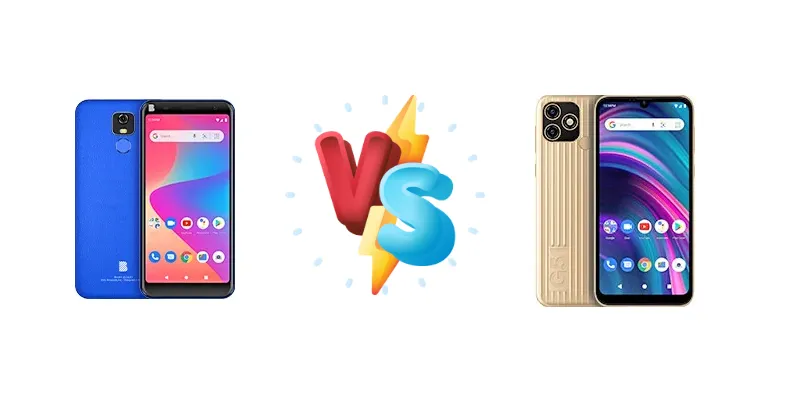
The BLU J6 2020 and BLU G51 represent two points in the ultra-budget smartphone landscape. The J6 2020 is an older model, while the G51 leverages a more modern, albeit still entry-level, chipset. This comparison dissects the core differences to determine which device offers the best value for users prioritizing basic smartphone functionality.
🏆 Quick Verdict
For the average user needing a functional, if not fast, smartphone, the BLU G51 is the better choice. Its Mediatek Helio A22 chipset, clocked at 2.0 GHz, provides a noticeable performance uplift over the J6 2020’s 1.3 GHz Cortex-A7, translating to smoother app loading and multitasking.
| Network |
|---|
| 2G bands | GSM 850 / 900 / 1800 / 1900 | GSM 850 / 900 / 1800 / 1900 |
| 3G bands | HSDPA 850 / 900 / 1900 / 2100 | HSDPA 850 / 900 / 1700(AWS) / 1900 / 2100 |
| 4G bands | - | 2, 3, 4, 5, 7, 12, 17, 28, 66 |
| Speed | HSPA 21.1/5.76 Mbps | HSPA, LTE |
| Technology | GSM / HSPA | GSM / HSPA / LTE |
| Launch |
|---|
| Announced | 2020, October. Released 2020, October | 2022, June 03 |
| Status | Discontinued | Available. Released 2022, June 03 |
| Body |
|---|
| Dimensions | 160.7 x 78.4 x 10.3 mm (6.33 x 3.09 x 0.41 in) | 155.3 x 73.5 x 9.5 mm (6.11 x 2.89 x 0.37 in) |
| SIM | Nano-SIM + Nano-SIM | Nano-SIM + Nano-SIM |
| Weight | 227 g (8.01 oz) | 166 g (5.86 oz) |
| Display |
|---|
| Resolution | 720 x 1440 pixels, 18:9 ratio (~268 ppi density) | 720 x 1520 pixels, 19:9 ratio (~276 ppi density) |
| Size | 6.0 inches, 92.9 cm2 (~73.7% screen-to-body ratio) | 6.1 inches, 92.9 cm2 (~81.4% screen-to-body ratio) |
| Type | IPS LCD | IPS LCD |
| Platform |
|---|
| CPU | Quad-core 1.3 GHz Cortex-A7 | Quad-core 2.0 GHz Cortex-A53 |
| Chipset | - | Mediatek MT6761 Helio A22 (12 nm) |
| GPU | Mali-400 | PowerVR GE8320 |
| OS | Android 10 (Go edition) | Android 11 (Go edition) |
| Memory |
|---|
| Card slot | microSDXC | microSDXC |
| Internal | 32GB 1GB RAM | 32GB 2GB RAM |
| | eMMC 5.1 | eMMC 5.1 |
| Main Camera |
|---|
| Dual | - | 8 MP
Auxiliary lens |
| Features | LED flash | LED flash, HDR, panorama |
| Single | 8 MP, AF | 8 MP |
| Video | 720p@30fps | 1080p@30fps |
| Selfie camera |
|---|
| Single | 8 MP | 8 MP |
| Video | 720p@30fps | 720p@30fps |
| Sound |
|---|
| 3.5mm jack | Yes | Yes |
| 35mm jack | Yes | Yes |
| Loudspeaker | Yes | Yes |
| Comms |
|---|
| Bluetooth | 4.1, A2DP | 4.2, A2DP, LE |
| NFC | No | No |
| Positioning | GPS | GPS |
| Radio | FM radio | FM radio |
| USB | microUSB 2.0 | microUSB 2.0 |
| WLAN | Wi-Fi 802.11 b/g/n, Wi-Fi Direct | Wi-Fi 802.11 a/b/g/n, Wi-Fi Direct |
| Features |
|---|
| Sensors | Fingerprint (rear-mounted), accelerometer, proximity | Fingerprint (rear-mounted), accelerometer, proximity |
| Battery |
|---|
| Type | Li-Po 4000 mAh | Li-Po 3000 mAh |
| Misc |
|---|
| Colors | Blue, Black, Violet, Tan | Black, Blue, Green, Silver, Gold |
| Price | About 70 EUR | - |
BLU J6 2020
- Potentially lower price point
- Simple and straightforward user experience
- May be more readily available in certain markets
- Significantly slower processor
- Less efficient power consumption
- Outdated architecture
BLU G51
- Faster and more responsive processor
- More efficient power consumption
- Modern chipset architecture
- May be slightly more expensive
- Still limited in terms of overall performance
- Camera quality likely remains basic
Display Comparison
Neither BLU provides detailed display specifications. However, given their price points, both likely utilize LCD panels with 720p+ resolutions. The G51’s advantage isn’t likely in display quality, but rather in the chipset’s ability to drive the display more efficiently. Expect similar viewing angles and color accuracy on both devices, with neither offering features like high refresh rates or HDR support.
Camera Comparison
Both devices likely feature basic camera setups. Without specific sensor details, it’s safe to assume both rely on low-resolution primary sensors. The G51’s chipset may offer slightly better image signal processing (ISP) capabilities, potentially resulting in marginally improved image quality in good lighting conditions. However, don’t expect flagship-level camera performance from either device. The inclusion of a 2MP macro lens on either device is largely a marketing tactic and offers limited practical benefit.
Performance
The core difference lies in the chipsets. The BLU J6 2020’s Quad-core 1.3 GHz Cortex-A7 is based on an older ARM architecture. In contrast, the BLU G51 features the Mediatek MT6761 Helio A22, a Quad-core 2.0 GHz Cortex-A53 processor built on a more efficient 12nm process. This translates to approximately a 50-60% performance increase for the G51 in CPU-bound tasks. The A53 architecture also offers improved instructions per clock cycle, leading to better overall responsiveness. While neither phone is a gaming powerhouse, the G51 will handle less demanding titles with greater fluidity.
Battery Life
Battery capacity details are unavailable for both devices. However, the Helio A22’s 12nm process offers better power efficiency than the Cortex-A7. This means the BLU G51 is likely to achieve slightly longer battery life on a single charge, despite potentially having a similar battery capacity. Charging speeds are also likely to be slow on both devices, given their budget nature.
Buying Guide
Buy the BLU J6 2020 if you absolutely need the lowest possible price point and your usage is limited to calls, texts, and very light app usage. Buy the BLU G51 if you prefer a more responsive experience for social media, basic gaming, and everyday tasks, even if it means spending a bit more.
Frequently Asked Questions
❓ Will the BLU G51 handle popular social media apps like Facebook and Instagram smoothly?
Yes, the Mediatek Helio A22 chipset in the BLU G51 provides enough processing power to run social media apps like Facebook and Instagram without significant lag. While it won’t offer a high-end experience, it will be noticeably smoother than the BLU J6 2020.
❓ Is the BLU J6 2020 suitable for playing mobile games?
The BLU J6 2020 is only suitable for very basic mobile games. Its Cortex-A7 processor will struggle with most modern titles, resulting in low frame rates and frequent stuttering. The BLU G51 offers a slightly better gaming experience, but still isn’t ideal for demanding games.
❓ How much storage does each phone offer, and can it be expanded?
Storage details are not provided. However, given the price point, both devices likely offer limited internal storage (16GB or 32GB). Both are expected to include a microSD card slot for storage expansion, allowing users to add more space for photos, videos, and apps.
❓ What version of Android do these phones run?
Both devices likely run an older version of Android (potentially Android 9 or 10) with a customized BLU UI. Updates are unlikely to be frequent or guaranteed, given their budget nature.