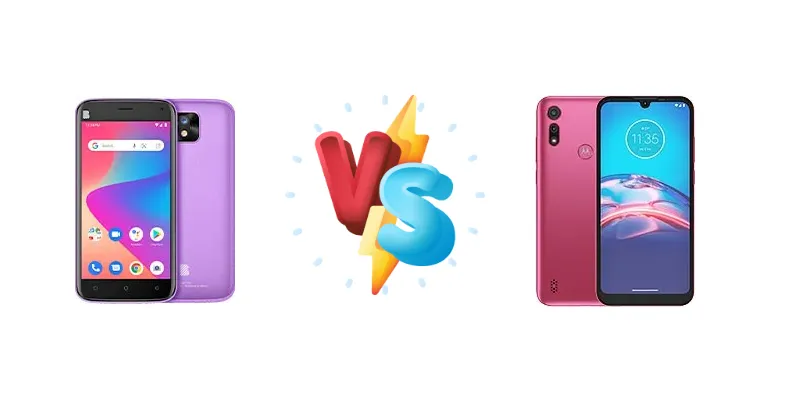
The BLU J5L and Motorola Moto E6i represent the extreme end of the smartphone price spectrum. Both aim to deliver essential functionality at a minimal cost, but they take different approaches to achieving this. The J5L relies on a simpler, older CPU architecture, while the Moto E6i leverages a more modern, octa-core Unisoc chipset. This comparison will dissect the key differences to determine which device offers the best value for budget-conscious consumers.
🏆 Quick Verdict
For the average user prioritizing multitasking and a smoother overall experience, the Motorola Moto E6i is the better choice. Its octa-core Unisoc SC9863A chipset, featuring Cortex-A55 cores, provides a significant performance advantage over the BLU J5L’s quad-core Cortex-A53, despite the J5L’s lower price point.
| Network |
|---|
| 2G bands | GSM 850 / 900 / 1800 / 1900 | GSM 850 / 900 / 1800 / 1900 |
| 3G bands | HSDPA 850 / 900 / 1700(AWS) / 1900 / 2100 | HSDPA 850 / 900 / 1700(AWS) / 1900 / 2100 |
| 4G bands | 1, 2, 3, 4, 5, 7, 12, 17, 28 | 1, 2, 3, 4, 5, 7, 8, 19, 28, 66 |
| Speed | HSPA, LTE | HSPA, LTE |
| Technology | GSM / HSPA / LTE | GSM / HSPA / LTE |
| Launch |
|---|
| Announced | 2020, October. Released 2020, October | 2021, February 11 |
| Status | Discontinued | Available. Released 2021, February 11 |
| Body |
|---|
| Build | - | Glass front, plastic back, plastic frame |
| Dimensions | 144 x 72.3 x 11.2 mm (5.67 x 2.85 x 0.44 in) | 155.6 x 73 x 8.5 mm (6.13 x 2.87 x 0.33 in) |
| SIM | Nano-SIM + Micro-SIM | Nano-SIM + Nano-SIM |
| Weight | 155 g (5.47 oz) | 160 g (5.64 oz) |
| Display |
|---|
| Resolution | 720 x 1280 pixels, 16:9 ratio (~294 ppi density) | 720 x 1560 pixels, 19.5:9 ratio (~282 ppi density) |
| Size | 5.0 inches, 68.9 cm2 (~66.2% screen-to-body ratio) | 6.1 inches, 91.3 cm2 (~80.4% screen-to-body ratio) |
| Type | IPS LCD | IPS LCD |
| Platform |
|---|
| CPU | Quad-core 1.4 GHz Cortex-A53 | Octa-core (4x1.6 GHz Cortex-A55 & 4x1.2 GHz Cortex-A55) |
| Chipset | - | Unisoc SC9863A (28 nm) |
| GPU | Mali-T820 | IMG8322 |
| OS | Android 10 (Go edition) | Android 10 (Go edition) |
| Memory |
|---|
| Card slot | microSDXC | microSDXC (uses shared SIM slot) |
| Internal | 32GB 1GB RAM | 32GB 2GB RAM |
| | eMMC 5.1 | eMMC 5.1 |
| Main Camera |
|---|
| Dual | - | 13 MP, f/2.2, 26mm (wide), 1/3.1", 1.12µm, PDAF
Auxiliary lens |
| Features | LED flash | LED flash, HDR, panorama |
| Single | 8 MP | - |
| Video | 1080p@30fps | 1080p@30fps |
| Selfie camera |
|---|
| Single | 8 MP | 5 MP, f/2.2, 27mm (wide), 1.12µm |
| Video | 720p@30fps | 1080p@30fps |
| Sound |
|---|
| 3.5mm jack | Yes | Yes |
| 35mm jack | Yes | Yes |
| Loudspeaker | Yes | Yes |
| Comms |
|---|
| Bluetooth | 4.0, A2DP | 4.2, A2DP, LE |
| NFC | No | No |
| Positioning | GPS | GPS, GLONASS |
| Radio | FM radio | Unspecified |
| USB | microUSB 2.0 | microUSB 2.0, OTG |
| WLAN | Wi-Fi 802.11 b/g/n, Wi-Fi Direct | Wi-Fi 802.11 b/g/n |
| Features |
|---|
| Sensors | Accelerometer | Fingerprint (rear-mounted), accelerometer, proximity |
| Battery |
|---|
| Charging | - | 10W wired |
| Type | Li-Ion 2200 mAh | Li-Ion 3000 mAh |
| Misc |
|---|
| Colors | Blue, Black, Violet, Tan | Titanium Gray, Pink |
| Models | - | XT2053-5 |
| Price | - | About 170 EUR |
BLU J5L
- Potentially lower price point
- Simple and straightforward user experience
- Compact form factor
- Outdated CPU architecture
- Limited multitasking capabilities
- Likely slower app loading times
Motorola Moto E6i
- Octa-core processor for smoother performance
- More modern CPU architecture (Cortex-A55)
- Better multitasking capabilities
- May be slightly more expensive
- 10W charging is relatively slow
- Camera performance likely remains basic
Display Comparison
Neither device boasts a standout display. Given the context data, we can assume both utilize LCD panels typical of this price range. The lack of specified resolution or refresh rate suggests both are 720p or lower, with a standard 60Hz refresh rate. Bezels are likely substantial on both, maximizing screen real estate within a compact form factor. Color accuracy will be basic, prioritizing power efficiency over fidelity.
Camera Comparison
Camera performance is likely to be similar on both devices, leaning towards basic functionality. Without sensor size or aperture information, it’s safe to assume both feature low-resolution primary sensors. The Moto E6i may benefit from slightly better image processing capabilities inherent in the Unisoc chipset, but don’t expect flagship-level results. Any secondary cameras (likely 2MP macro lenses) on either device will offer limited utility due to their low resolution.
Performance
The core difference lies in the chipset. The BLU J5L’s quad-core 1.4 GHz Cortex-A53 CPU is an older architecture, designed for efficiency but lacking in raw processing power. The Motorola Moto E6i’s Unisoc SC9863A, built on a 28nm process, features an octa-core configuration – four cores clocked at 1.6 GHz and four at 1.2 GHz, all Cortex-A55. The Cortex-A55 is a more efficient and capable architecture than the A53, meaning the Moto E6i will handle multitasking, app loading, and general navigation with noticeably less lag. The 28nm process node, while not cutting-edge, allows for a reasonable balance between performance and power consumption. The J5L will struggle with more demanding applications.
Battery Life
Battery capacity isn’t specified for either device, but given their market segment, we can estimate both fall in the 3000-4000 mAh range. The Moto E6i’s 10W wired charging is a standard offering for this price point. The J5L’s charging speed is unknown, but likely similar. Real-world battery life will depend heavily on usage, but the more efficient Unisoc chipset in the Moto E6i may translate to slightly longer screen-on time, even with a similar battery capacity.
Buying Guide
Buy the BLU J5L if you need a functional smartphone for extremely basic tasks like calls, texts, and light web browsing, and your budget is absolutely the primary concern. Buy the Motorola Moto E6i if you prefer a more responsive user experience, occasional light gaming, and a chipset built on a more modern architecture, even if it means spending slightly more.
Frequently Asked Questions
❓ Will the Motorola Moto E6i handle popular social media apps like Facebook and Instagram without significant lag?
Yes, the Unisoc SC9863A chipset with its octa-core Cortex-A55 cores is sufficiently powerful to run social media apps smoothly. While it won't offer a high-end experience, you should expect acceptable performance for browsing feeds, posting updates, and viewing photos and videos.
❓ Is the BLU J5L suitable for playing mobile games?
The BLU J5L is not ideal for gaming. Its quad-core Cortex-A53 processor will struggle with most modern mobile games, resulting in low frame rates and potential stuttering. It may be able to handle very simple, older games, but don't expect a playable experience with demanding titles.
❓ How does the Unisoc SC9863A chipset compare to Qualcomm's Snapdragon 400 series in terms of performance?
The Unisoc SC9863A generally performs similarly to, or slightly below, older Snapdragon 400 series chipsets. It offers a reasonable level of performance for basic tasks, but it won't match the speed or efficiency of newer Snapdragon 400 or 600 series chips.