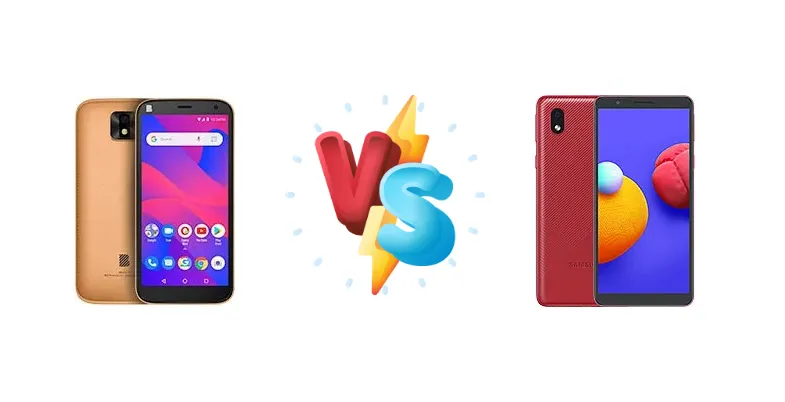
The BLU J4 and Samsung Galaxy A01 Core represent the extreme end of the smartphone price spectrum. Both aim to deliver basic smartphone functionality at the lowest possible cost, but they achieve this with different chipsets and approaches. This comparison dissects their strengths and weaknesses to help you determine which offers the best value for your money.
🏆 Quick Verdict
For the average user prioritizing slightly better processing power and potential for smoother multitasking, the BLU J4 emerges as the winner. Its Qualcomm Snapdragon 615, while older, offers a more capable CPU architecture than the Mediatek MT6739 in the A01 Core, making it better suited for running multiple apps or slightly more demanding tasks.
| Network |
|---|
| 2G bands | GSM 850 / 900 / 1800 / 1900 | GSM 850 / 900 / 1800 / 1900 |
| 3G bands | HSDPA 850 / 900 / 1900 / 2100 | HSDPA 850 / 900 / 2100 |
| 4G bands | 3, 40 | 1, 3, 5, 7, 8, 20, 28, 38, 40, 41 |
| Speed | HSPA 21.1/5.76 Mbps | HSPA 21.1/5.76 Mbps, LTE |
| Technology | GSM / HSPA | GSM / HSPA / LTE |
| Launch |
|---|
| Announced | 2019, October. Released 2019, October | 2020, July 21. Released 2020, August 06 |
| Status | Discontinued | Discontinued |
| Body |
|---|
| Build | - | Plastic back, plastic frame |
| Dimensions | 151 x 72.3 x 10 mm (5.94 x 2.85 x 0.39 in) | 141.7 x 67.5 x 8.6 mm (5.58 x 2.66 x 0.34 in) |
| SIM | Nano-SIM + Nano-SIM | · Nano-SIM· Nano-SIM + Nano-SIM |
| Weight | 158 g (5.57 oz) | 150 g (5.29 oz) |
| Display |
|---|
| Protection | Corning Gorilla Glass 3 | - |
| Resolution | 720 x 1440 pixels, 18:9 ratio (~293 ppi density) | 720 x 1480 pixels, 18.5:9 ratio (~311 ppi density) |
| Size | 5.5 inches, 78.1 cm2 (~71.5% screen-to-body ratio) | 5.3 inches, 71.3 cm2 (~74.5% screen-to-body ratio) |
| Type | IPS LCD | PLS LCD |
| Platform |
|---|
| CPU | Quad-core 1.3 GHz Cortex-A7 | Quad-core 1.5 GHz Cortex-A53 |
| Chipset | Qualcomm MSM8939 Snapdragon 615 (28 nm) | Mediatek MT6739 (28 nm) |
| GPU | Mali-400 | PowerVR GE8100 |
| OS | Android 8.1 Oreo (Go edition) | Android 10 (Go edition) |
| Memory |
|---|
| Card slot | microSDXC | microSDXC (dedicated slot) |
| Internal | 32GB 1GB RAM | 16GB 1GB RAM, 16GB 2GB RAM, 32GB 2GB RAM |
| | eMMC 5.1 | eMMC 5.1 |
| Main Camera |
|---|
| Features | LED flash | LED flash |
| Single | 8 MP, AF | 8 MP, f/2.2, AF |
| Video | 720p@30fps | 1080p@30fps |
| Selfie camera |
|---|
| Single | 8 MP | 5 MP, f/2.4 |
| Video | 720p@30fps | - |
| Sound |
|---|
| 3.5mm jack | Yes | Yes |
| 35mm jack | Yes | Yes |
| Loudspeaker | Yes | Yes |
| Comms |
|---|
| Bluetooth | 4.1, A2DP, LE | 5.0, A2DP, LE |
| NFC | No | No |
| Positioning | GPS | GPS |
| Radio | FM radio | FM radio |
| USB | microUSB 2.0 | microUSB 2.0 |
| WLAN | Wi-Fi 802.11 b/g/n, Wi-Fi Direct | Wi-Fi 802.11 b/g/n, Wi-Fi Direct |
| Features |
|---|
| Sensors | Accelerometer | Accelerometer |
| Battery |
|---|
| Stand-by | Up to 210 h | - |
| Talk time | Up to 8 h | - |
| Type | Li-Po 2200 mAh, removable | Li-Ion 3000 mAh |
| Misc |
|---|
| Colors | Blue, Black, Brown | Black, Blue, Red |
| Models | YU5510A, YU5510 | SM-A013F, SM-A013F/DS, SM-A013G, SM-A013G/DS, SM-A013M |
| Price | About 70 EUR | About 150 EUR |
| SAR EU | - | 0.64 W/kg (head) 1.18 W/kg (body) |
BLU J4
- Potentially smoother multitasking due to Snapdragon 615’s CPU architecture.
- Qualcomm’s optimized software and GPU drivers.
- Likely better sustained performance due to thermal efficiency.
- Older chipset technology.
- Brand recognition is lower than Samsung.
Samsung Galaxy A01 Core
- Samsung brand recognition and potential software support.
- Slightly higher CPU clock speed (on paper).
- Potentially better color accuracy from Samsung's display tuning (speculative).
- Less efficient CPU architecture (Cortex-A53).
- Mediatek chipset may exhibit more thermal throttling.
Display Comparison
Neither device boasts a standout display. Both utilize 28nm chipsets, suggesting a focus on cost reduction over display quality. Specific display specs (resolution, panel type) are unavailable, but given the price point, expect basic LCD panels. The A01 Core likely benefits from Samsung's display tuning, potentially offering slightly better color accuracy, but this is speculative. Bezels are expected to be substantial on both devices, maximizing screen real estate within a compact form factor.
Camera Comparison
Camera performance on both devices will be limited. Without specific sensor details, it’s safe to assume both feature basic sensors. The market segment suggests both will rely heavily on software processing to enhance image quality. Any claims of advanced features (HDR, night mode) should be viewed skeptically. The absence of Optical Image Stabilization (OIS) on either device means low-light photography will be particularly challenging. Focusing on the chipset, the Snapdragon 615’s ISP (Image Signal Processor) is likely more capable than the Mediatek MT6739’s, potentially resulting in slightly better image processing.
Performance
The core difference lies in the chipsets. The BLU J4’s Qualcomm MSM8939 Snapdragon 615 features a quad-core 1.3 GHz Cortex-A7 CPU, while the Samsung Galaxy A01 Core utilizes a Mediatek MT6739 with a quad-core 1.5 GHz Cortex-A53 CPU. While the A01 Core’s CPU has a higher clock speed, the Cortex-A53 architecture is less efficient than the Cortex-A7 found in the Snapdragon 615. This means the Snapdragon 615, despite the lower clock speed, can sustain performance for longer periods without thermal throttling. The Snapdragon 615 also benefits from Qualcomm’s optimized software and GPU drivers, potentially offering a smoother experience in graphically intensive tasks.
Battery Life
Battery capacity is not specified for either device. However, given the low-power chipsets and likely small displays, both should offer at least a full day of light usage. Charging wattage is also unknown, but expect slow charging speeds. The Snapdragon 615’s power efficiency, despite the Cortex-A7 architecture, could translate to slightly longer battery life under similar usage scenarios, offsetting any potential capacity differences.
Buying Guide
Buy the BLU J4 if you need a phone capable of handling a few more apps simultaneously without significant slowdown, or if you anticipate using slightly more demanding applications. Buy the Samsung Galaxy A01 Core if you prioritize brand recognition and a potentially simpler, more streamlined software experience, and your usage is limited to basic calling, texting, and light social media.
Frequently Asked Questions
❓ Will the Mediatek MT6739 in the Galaxy A01 Core struggle with multiple apps open?
Yes, the Mediatek MT6739, paired with the Cortex-A53 architecture, is less efficient at multitasking than the Snapdragon 615. Expect noticeable slowdowns when running several apps simultaneously, especially those demanding more resources like social media or web browsers.
❓ Is the Snapdragon 615 in the BLU J4 still a viable option in 2024?
While an older chipset, the Snapdragon 615 remains capable of handling basic smartphone tasks like calling, texting, and light social media. It offers a more robust CPU architecture than the Mediatek MT6739, making it a better choice for users who occasionally need to run multiple apps or slightly more demanding applications.
❓ Can either of these phones handle popular mobile games like PUBG Mobile or Call of Duty Mobile?
Both phones will struggle with demanding games like PUBG Mobile or Call of Duty Mobile. Frame rates will likely be low, even on the lowest settings, and you may experience significant lag and stuttering. These phones are not designed for gaming.
❓ Which phone is likely to receive more software updates?
The Samsung Galaxy A01 Core is more likely to receive at least some basic software updates, even if they are infrequent. BLU devices historically have limited software support, so don't expect major Android version upgrades.