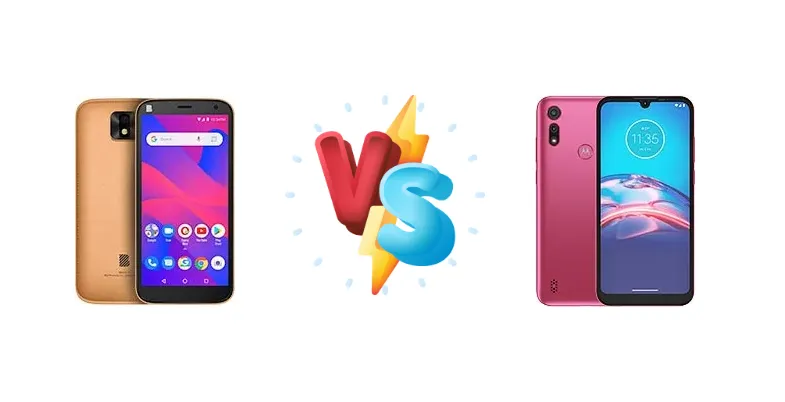
The BLU J4 and Motorola Moto E6i represent the extreme end of the smartphone price spectrum. Both aim to deliver essential functionality at a minimal cost, but they achieve this with vastly different approaches to processing power. The J4 relies on Qualcomm’s older Snapdragon 615, while the E6i opts for the newer, but less-renowned, Unisoc SC9863A. This comparison dissects these choices to determine which device provides the better user experience.
🏆 Quick Verdict
For the average user prioritizing multitasking and responsiveness, the Motorola Moto E6i is the better choice. Its octa-core Unisoc SC9863A, despite being built on the same 28nm process as the Snapdragon 615, offers a significant advantage in multi-threaded tasks, making everyday use smoother. The BLU J4’s legacy Qualcomm chip struggles to keep pace.
| Network |
|---|
| 2G bands | GSM 850 / 900 / 1800 / 1900 | GSM 850 / 900 / 1800 / 1900 |
| 3G bands | HSDPA 850 / 900 / 1900 / 2100 | HSDPA 850 / 900 / 1700(AWS) / 1900 / 2100 |
| 4G bands | 3, 40 | 1, 2, 3, 4, 5, 7, 8, 19, 28, 66 |
| Speed | HSPA 21.1/5.76 Mbps | HSPA, LTE |
| Technology | GSM / HSPA | GSM / HSPA / LTE |
| Launch |
|---|
| Announced | 2019, October. Released 2019, October | 2021, February 11 |
| Status | Discontinued | Available. Released 2021, February 11 |
| Body |
|---|
| Build | - | Glass front, plastic back, plastic frame |
| Dimensions | 151 x 72.3 x 10 mm (5.94 x 2.85 x 0.39 in) | 155.6 x 73 x 8.5 mm (6.13 x 2.87 x 0.33 in) |
| SIM | Nano-SIM + Nano-SIM | Nano-SIM + Nano-SIM |
| Weight | 158 g (5.57 oz) | 160 g (5.64 oz) |
| Display |
|---|
| Protection | Corning Gorilla Glass 3 | - |
| Resolution | 720 x 1440 pixels, 18:9 ratio (~293 ppi density) | 720 x 1560 pixels, 19.5:9 ratio (~282 ppi density) |
| Size | 5.5 inches, 78.1 cm2 (~71.5% screen-to-body ratio) | 6.1 inches, 91.3 cm2 (~80.4% screen-to-body ratio) |
| Type | IPS LCD | IPS LCD |
| Platform |
|---|
| CPU | Quad-core 1.3 GHz Cortex-A7 | Octa-core (4x1.6 GHz Cortex-A55 & 4x1.2 GHz Cortex-A55) |
| Chipset | Qualcomm MSM8939 Snapdragon 615 (28 nm) | Unisoc SC9863A (28 nm) |
| GPU | Mali-400 | IMG8322 |
| OS | Android 8.1 Oreo (Go edition) | Android 10 (Go edition) |
| Memory |
|---|
| Card slot | microSDXC | microSDXC (uses shared SIM slot) |
| Internal | 32GB 1GB RAM | 32GB 2GB RAM |
| | eMMC 5.1 | eMMC 5.1 |
| Main Camera |
|---|
| Dual | - | 13 MP, f/2.2, 26mm (wide), 1/3.1", 1.12µm, PDAF
Auxiliary lens |
| Features | LED flash | LED flash, HDR, panorama |
| Single | 8 MP, AF | - |
| Video | 720p@30fps | 1080p@30fps |
| Selfie camera |
|---|
| Single | 8 MP | 5 MP, f/2.2, 27mm (wide), 1.12µm |
| Video | 720p@30fps | 1080p@30fps |
| Sound |
|---|
| 3.5mm jack | Yes | Yes |
| 35mm jack | Yes | Yes |
| Loudspeaker | Yes | Yes |
| Comms |
|---|
| Bluetooth | 4.1, A2DP, LE | 4.2, A2DP, LE |
| NFC | No | No |
| Positioning | GPS | GPS, GLONASS |
| Radio | FM radio | Unspecified |
| USB | microUSB 2.0 | microUSB 2.0, OTG |
| WLAN | Wi-Fi 802.11 b/g/n, Wi-Fi Direct | Wi-Fi 802.11 b/g/n |
| Features |
|---|
| Sensors | Accelerometer | Fingerprint (rear-mounted), accelerometer, proximity |
| Battery |
|---|
| Charging | - | 10W wired |
| Stand-by | Up to 210 h | - |
| Talk time | Up to 8 h | - |
| Type | Li-Po 2200 mAh, removable | Li-Ion 3000 mAh |
| Misc |
|---|
| Colors | Blue, Black, Brown | Titanium Gray, Pink |
| Models | YU5510A, YU5510 | XT2053-5 |
| Price | About 70 EUR | About 170 EUR |
BLU J4
- Established Qualcomm chipset (potentially better driver support)
- Likely lower price point
- Compact form factor
- Outdated quad-core processor
- Potentially slower performance in multi-tasking
- Less efficient CPU architecture
Motorola Moto E6i
- Octa-core processor for smoother multitasking
- More modern CPU architecture (Cortex-A55)
- 10W wired charging
- Unisoc chipset – less well-known brand
- Potentially slightly higher price
- May not offer significant gaming performance
Display Comparison
Neither device boasts a standout display. Both are likely to feature 720p panels, typical for this price point. Without specific brightness or color gamut data, it’s safe to assume both offer adequate, but not exceptional, viewing experiences. The focus here isn’t on visual fidelity, but on basic readability. Bezels are likely to be substantial on both, maximizing screen real estate within a compact form factor.
Camera Comparison
Camera performance on both devices will be limited. Without specific sensor details, it’s reasonable to expect 8-13MP main sensors on both. Image quality will be heavily reliant on software processing, and likely suffer in low-light conditions. The presence of a 2MP macro lens on either device is largely a marketing gimmick, offering minimal practical benefit. The focus should be on capturing acceptable photos in good lighting, rather than expecting high-quality images.
Performance
The core difference lies in the chipset. The BLU J4’s Qualcomm MSM8939 Snapdragon 615 features a quad-core Cortex-A7 CPU clocked at 1.3 GHz. This is a relatively old architecture. The Motorola Moto E6i, however, utilizes the Unisoc SC9863A with an octa-core configuration – four Cortex-A55 cores at 1.6 GHz and four at 1.2 GHz. While both are 28nm, the octa-core design of the Unisoc chip provides a clear advantage in multi-tasking and handling multiple apps simultaneously. The Cortex-A55 cores are also more efficient than the older Cortex-A7, potentially leading to slightly better battery life under load. The Unisoc chip’s architecture is designed for sustained performance in everyday tasks, whereas the Snapdragon 615 will likely show its age when pushed.
Battery Life
Battery capacity is not specified for either device, but both likely house batteries in the 2500-3000 mAh range. The Moto E6i’s inclusion of 10W wired charging is a slight advantage, allowing for a faster top-up compared to potentially slower charging on the BLU J4. However, the more efficient Unisoc chipset may contribute to longer battery life between charges, offsetting any capacity differences.
Buying Guide
Buy the BLU J4 if you absolutely need a phone for the most basic tasks – calls, texts, and very light app usage – and are constrained by the tightest of budgets. Its Qualcomm chipset, while dated, has a known track record. Buy the Motorola Moto E6i if you want a more responsive experience for social media, light browsing, and occasional gaming, and appreciate the benefit of more cores for parallel processing. The E6i offers a better balance of performance and usability for a slightly higher price.
Frequently Asked Questions
❓ Will the Motorola Moto E6i handle popular social media apps like Facebook and Instagram without significant lag?
Yes, the Unisoc SC9863A’s octa-core architecture is well-suited for running social media applications. The Cortex-A55 cores are designed for efficient handling of everyday tasks, providing a smoother experience compared to the older Snapdragon 615 in the BLU J4.
❓ Is the BLU J4 a good option for someone who primarily uses their phone for making calls and sending texts?
The BLU J4 is a viable option for basic communication if budget is the absolute primary concern. The Snapdragon 615 is sufficient for these core functions, but users should expect slower performance when opening apps or switching between tasks.
❓ Can either of these phones play modern mobile games like PUBG Mobile or Call of Duty Mobile?
While technically possible, neither phone is ideal for gaming. Both chipsets lack the graphical power for smooth gameplay at higher settings. You might be able to play at the lowest settings with reduced frame rates, but the experience will likely be subpar. The Moto E6i will likely perform slightly better due to its more modern architecture.