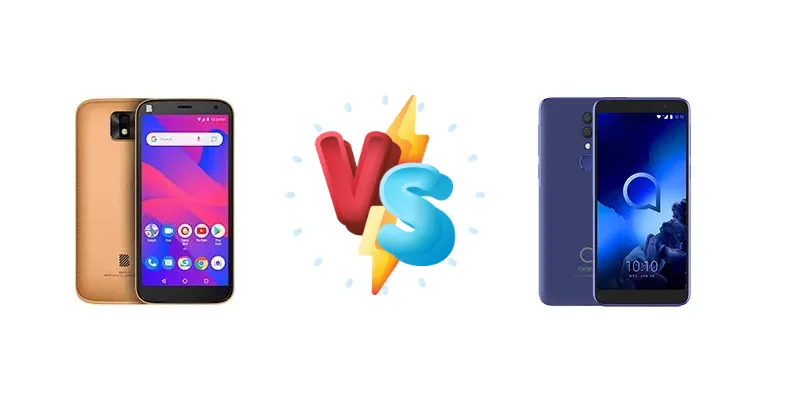
The BLU J4 and the alcatel 1x (2019) represent the extreme end of the smartphone price spectrum. Both devices aim to deliver basic smartphone functionality at an incredibly low cost. However, beneath the similar price points lie significant differences in their core hardware, specifically the chipset. This comparison will dissect those differences to determine which phone offers the best value for users prioritizing performance and longevity.
🏆 Quick Verdict
For the average user needing a functional, if basic, smartphone, the alcatel 1x (2019) offers a slight edge. Its Mediatek MT6739, clocked at 1.5 GHz, provides a modest performance uplift over the BLU J4’s 1.3 GHz Snapdragon 615, translating to slightly snappier app loading and multitasking, despite both utilizing a 28nm process.
| Network |
|---|
| 2G bands | GSM 850 / 900 / 1800 / 1900 | GSM 850 / 900 / 1800 / 1900 |
| 3G bands | HSDPA 850 / 900 / 1900 / 2100 | HSDPA 850 / 900 / 1700(AWS) / 1900 / 2100 - 5059A |
| 4G bands | 3, 40 | 1, 3, 5, 7, 8, 28, 38, 40 - 5008T |
| Speed | HSPA 21.1/5.76 Mbps | HSPA 42.2/5.76 Mbps, LTE Cat4 150/50 Mbps |
| Technology | GSM / HSPA | GSM / HSPA / LTE |
| | - | 1, 3, 7, 8, 20, 28 - 5008Y |
| Launch |
|---|
| Announced | 2019, October. Released 2019, October | 2019, January. Released 2019, Q1 |
| Status | Discontinued | Discontinued |
| Body |
|---|
| Dimensions | 151 x 72.3 x 10 mm (5.94 x 2.85 x 0.39 in) | 146.4 x 68.8 x 8.3 mm (5.76 x 2.71 x 0.33 in) |
| SIM | Nano-SIM + Nano-SIM | · Nano-SIM· Nano-SIM + Nano-SIM |
| Weight | 158 g (5.57 oz) | 130 g (4.59 oz) |
| Display |
|---|
| Protection | Corning Gorilla Glass 3 | - |
| Resolution | 720 x 1440 pixels, 18:9 ratio (~293 ppi density) | 720 x 1440 pixels, 18:9 ratio (~293 ppi density) |
| Size | 5.5 inches, 78.1 cm2 (~71.5% screen-to-body ratio) | 5.5 inches, 78.1 cm2 (~77.5% screen-to-body ratio) |
| Type | IPS LCD | IPS LCD |
| Platform |
|---|
| CPU | Quad-core 1.3 GHz Cortex-A7 | Quad-core 1.5 GHz Cortex-A53 |
| Chipset | Qualcomm MSM8939 Snapdragon 615 (28 nm) | Mediatek MT6739 (28 nm) |
| GPU | Mali-400 | PowerVR GE8100 |
| OS | Android 8.1 Oreo (Go edition) | Android 8.1 (Oreo) |
| Memory |
|---|
| Card slot | microSDXC | microSDXC |
| Internal | 32GB 1GB RAM | 16GB 2GB RAM |
| | eMMC 5.1 | eMMC 5.1 |
| Main Camera |
|---|
| Dual | - | 13 MP
2 MP |
| Features | LED flash | LED flash, HDR |
| Single | 8 MP, AF | - |
| Video | 720p@30fps | 1080p@30fps |
| Selfie camera |
|---|
| Features | - | LED flash |
| Single | 8 MP | 5 MP |
| Video | 720p@30fps | 720p |
| Sound |
|---|
| 3.5mm jack | Yes | Yes |
| 35mm jack | Yes | Yes |
| Loudspeaker | Yes | Yes |
| Comms |
|---|
| Bluetooth | 4.1, A2DP, LE | 4.2, A2DP, LE |
| NFC | No | No |
| Positioning | GPS | GPS |
| Radio | FM radio | FM radio |
| USB | microUSB 2.0 | microUSB 2.0 |
| WLAN | Wi-Fi 802.11 b/g/n, Wi-Fi Direct | Wi-Fi 802.11 b/g/n, Wi-Fi Direct |
| Features |
|---|
| Sensors | Accelerometer | Fingerprint (rear-mounted, 5008T only), accelerometer, proximity |
| Battery |
|---|
| Stand-by | Up to 210 h | - |
| Talk time | Up to 8 h | - |
| Type | Li-Po 2200 mAh, removable | Li-Ion 3000 mAh, removable |
| Misc |
|---|
| Colors | Blue, Black, Brown | Pebble Blue, Pebble Black |
| Models | YU5510A, YU5510 | 5008T, 5008Y, 5008U, 5008R, 5008D_EEA, 5008Y_EEA, 5008D |
| Price | About 70 EUR | About 120 EUR |
BLU J4
- Qualcomm chipset offers potential for better software support.
- Established brand recognition within the budget segment.
- Potential for custom ROM development.
- Slower CPU clock speed compared to the alcatel 1x (2019).
- Older Cortex-A7 architecture may limit performance.
- Likely limited RAM capacity.
alcatel 1x (2019)
- Faster CPU clock speed (1.5 GHz) for snappier performance.
- More efficient Cortex-A53 architecture.
- Potentially better multitasking capabilities.
- Mediatek chipset may have limited software support.
- Brand recognition is lower than BLU.
- Potential for less app compatibility.
Display Comparison
Neither device boasts a standout display. Given the context data focuses solely on the chipset, we can infer both likely utilize similar low-cost LCD panels with resolutions around 720p. Bezels are expected to be substantial on both, maximizing screen real estate within a compact form factor. Color accuracy and brightness are likely to be limited, suitable only for indoor use. The absence of any display specifications suggests neither phone targets media consumption as a primary use case.
Camera Comparison
Without detailed camera specifications, a meaningful comparison is difficult. Both phones likely feature basic camera setups geared towards casual snapshots. Given the price point, image quality will be heavily reliant on software processing and adequate lighting conditions. The presence of a 2MP or 5MP secondary camera on either device is unlikely to significantly enhance the photography experience; these are typically included for marketing purposes rather than genuine functionality. Expect limited dynamic range and detail in challenging lighting scenarios.
Performance
The core difference lies in the chipsets: Qualcomm’s Snapdragon 615 (MSM8939) versus Mediatek’s MT6739. While both are quad-core processors built on a 28nm process, the MT6739’s Cortex-A53 cores are clocked 200MHz higher at 1.5 GHz compared to the J4’s 1.3 GHz Cortex-A7 cores. The Cortex-A53 architecture is generally more efficient than the older Cortex-A7, meaning the alcatel 1x (2019) will likely exhibit better sustained performance under load. However, the Snapdragon 615 benefits from Qualcomm’s mature software optimization and potentially wider compatibility with apps and games. The lack of RAM specifications makes it difficult to assess multitasking capabilities, but both are likely to be limited to 1-2GB.
Battery Life
Battery capacity is not specified for either device. However, given their similar target markets and hardware configurations, both likely house batteries in the 2000-2500 mAh range. Charging wattage is also unknown, but it’s safe to assume both utilize standard 5W charging via micro-USB. Real-world battery life will depend heavily on usage patterns, but both phones should be able to last a full day with moderate use, primarily consisting of calls, texts, and light browsing.
Buying Guide
Buy the BLU J4 if you prioritize Qualcomm’s established software support and potential for custom ROM development, even if it means sacrificing a small amount of raw processing power. Buy the alcatel 1x (2019) if you prefer a slightly more responsive user experience out-of-the-box and are comfortable with Mediatek’s ecosystem. Both are suitable for basic tasks like calling, texting, and light social media use.
Frequently Asked Questions
❓ Will the alcatel 1x (2019) struggle with popular apps like Facebook or WhatsApp?
While the Mediatek MT6739 is an entry-level processor, it should be capable of running basic apps like Facebook and WhatsApp without significant issues. However, expect slower loading times and occasional lag, especially when multitasking. The limited RAM (likely 1-2GB) will be a bottleneck.
❓ Is the Snapdragon 615 in the BLU J4 capable of playing any mobile games?
The Snapdragon 615 can handle very basic 2D games and older 3D titles at low settings. However, demanding games like PUBG or Fortnite will likely be unplayable due to the processor's limited power and the likely low amount of RAM. Expect significant frame rate drops and stuttering.
❓ Which phone is more likely to receive software updates?
Historically, Qualcomm-based devices tend to receive more consistent software updates than those powered by Mediatek. However, given the ultra-budget nature of both phones, the likelihood of receiving any significant updates beyond security patches is low.