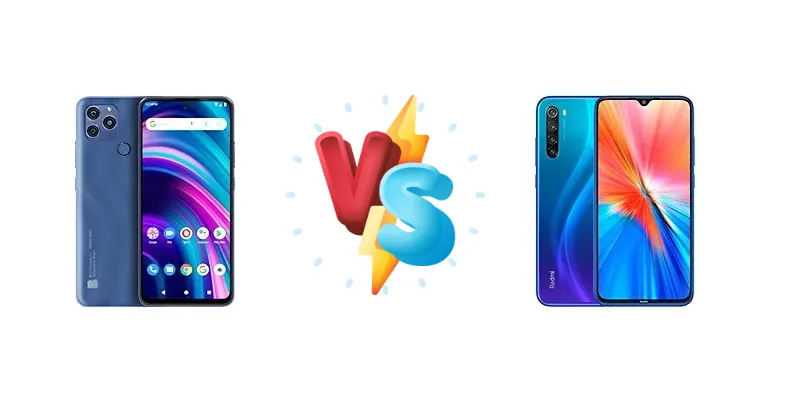
Looking for a reliable budget smartphone? The BLU G91s and Xiaomi Redmi Note 8 2021 are both contenders, offering decent specs at affordable prices. But which one truly delivers the best value? Let's dive into a head-to-head comparison to help you decide.
🏆 Quick Verdict
The Xiaomi Redmi Note 8 2021 edges out the BLU G91s thanks to its slightly more powerful chipset (Helio G85 vs G80), impressive battery life (102h endurance rating), and generally better software support. Both are solid budget options, but Xiaomi offers a more complete package.
| Network |
|---|
| 2G bands | GSM 850 / 900 / 1800 / 1900 | GSM 850 / 900 / 1800 / 1900 |
| 3G bands | HSDPA 850 / 900 / 1700(AWS) / 1900 / 2100 | HSDPA 850 / 900 / 1700(AWS) / 1900 / 2100 |
| 4G bands | 1, 2, 3, 4, 5, 7, 12, 17, 28 | 1, 2, 3, 4, 5, 7, 8, 20, 28, 38, 40 |
| Speed | HSPA 42.2/5.76 Mbps, LTE (2CA) Cat6 300/50 Mbps | HSPA, LTE |
| Technology | GSM / HSPA / LTE | GSM / HSPA / LTE |
| Launch |
|---|
| Announced | 2021, December 07. Released 2021, December 07 | 2021, May 25 |
| Status | Discontinued | Available. Released 2021, May 27 |
| Body |
|---|
| Build | - | Glass front (Gorilla Glass 5), glass back (Gorilla Glass 5), plastic frame |
| Dimensions | 168 x 76.5 x 8.9 mm (6.61 x 3.01 x 0.35 in) | 158.3 x 75.3 x 8.4 mm (6.23 x 2.96 x 0.33 in) |
| SIM | Nano-SIM + Nano-SIM | Nano-SIM + Nano-SIM |
| Weight | 202 g (7.13 oz) | 190 g (6.70 oz) |
| Display |
|---|
| Protection | - | Corning Gorilla Glass 5 |
| Resolution | 1080 x 2460 pixels (~395 ppi density) | 1080 x 2340 pixels, 19.5:9 ratio (~409 ppi density) |
| Size | 6.8 inches, 109.8 cm2 (~85.4% screen-to-body ratio) | 6.3 inches, 97.4 cm2 (~81.7% screen-to-body ratio) |
| Type | IPS LCD | IPS LCD, 500 nits (typ) |
| Platform |
|---|
| CPU | Octa-core (2x2.0 GHz Cortex-A75 & 6x1.8 GHz Cortex-A55) | Octa-core (2x2.0 GHz Cortex-A75 & 6x1.8 GHz Cortex-A55) |
| Chipset | Mediatek MT6769V/CU Helio G80 (12 nm) | Mediatek MT6769Z Helio G85 (12 nm) |
| GPU | Mali-G52 MC2 | Mali-G52 MC2 |
| OS | Android 11 | Android 11, MIUI 12.5 |
| Memory |
|---|
| Card slot | microSDXC | microSDXC (dedicated slot) |
| Internal | 128GB 4GB RAM | 64GB 3GB RAM, 64GB 4GB RAM, 128GB 4GB RAM |
| | eMMC 5.1 | eMMC 5.1 |
| Main Camera |
|---|
| Features | LED flash, HDR, panorama | LED flash, HDR, panorama |
| Quad | 48 MP, f/1.8, (wide), 1/2.0, 0.8µm, PDAF
5 MP, f/2.2, (ultrawide)
Auxiliary lens | 48 MP, f/1.8, 26mm (wide), 1/2.0", 0.8µm, PDAF
8 MP, f/2.2, 120˚ (ultrawide), 1/4.0", 1.12µm
2 MP (macro)
Auxiliary lens |
| Single | 13 MP, f/2.0 | 13 MP, f/2.0, (wide), 1/3.1", 1.12µm |
| Video | 1080p@30fps | 1080p@30/120fps; gyro-EIS |
| Selfie camera |
|---|
| Features | - | HDR, panorama |
| Single | 13 MP, f/2.0 | 13 MP, f/2.0, (wide), 1/3.1", 1.12µm |
| Video | 1080p@30fps | 1080p@30fps |
| Sound |
|---|
| 3.5mm jack | Yes | Yes |
| 35mm jack | Yes | Yes |
| Loudspeaker | Yes | Yes |
| Comms |
|---|
| Bluetooth | 5.0, A2DP, LE | 5.2, A2DP, LE |
| Infrared port | - | Yes |
| NFC | No | No |
| Positioning | GPS | GPS, GLONASS, GALILEO, BDS |
| Radio | FM radio | FM radio |
| USB | USB Type-C 2.0, OTG | USB Type-C 2.0, OTG |
| WLAN | Wi-Fi 802.11 a/b/g/n, Wi-Fi Direct | Wi-Fi 802.11 a/b/g/n/ac, dual-band, Wi-Fi Direct |
| Features |
|---|
| Sensors | Fingerprint (rear-mounted), accelerometer, gyro, proximity, compass | Fingerprint (rear-mounted), accelerometer, gyro, proximity, compass |
| Battery |
|---|
| Charging | 18W wired | 18W wired |
| Type | Li-Po 6000 mAh | Li-Po 4000 mAh |
| Misc |
|---|
| Colors | Blue, Green, Gray, Cyan | Neptune Blue, Moonlight White, Space Black |
| Models | - | M1908C3JGG |
| Price | About 200 EUR | About 160 EUR |
| SAR | - | 0.97 W/kg (head) 0.75 W/kg (body) |
| SAR EU | - | 0.57 W/kg (head) 0.94 W/kg (body) |
| Tests |
|---|
| Battery life | - |
Endurance rating 102h
|
| Camera | - |
Photo / Video |
| Display | - |
Contrast ratio: 1487:1 (nominal) |
| Loudspeaker | - |
-28.6 LUFS (Average)
|
| Performance | - |
AnTuTu: 180195 (v8), 165779 (v9)
GeekBench: 5259 (v4.4), 1314 (v5.1)
GFXBench: 8.7fps (ES 3.1 onscreen) |
BLU G91s
- Affordable price
- Decent performance for basic tasks
- Sleek design (likely)
- Less powerful chipset than Redmi Note 8 2021
- Potentially shorter battery life
- Less established brand support
Xiaomi Redmi Note 8 2021
- Long battery life (102h endurance)
- Slightly faster chipset (Helio G85)
- Better software support (Xiaomi)
- Brighter display
- May be slightly more expensive than BLU G91s
- Design may be less appealing to some
Display Comparison
Both phones feature similar display technology (likely IPS LCD) and a high contrast ratio (1487:1). However, the Redmi Note 8 2021 boasts a measured peak brightness of 620 nits, which is noticeably brighter than the G91s, making it easier to view in direct sunlight. The G91s display is likely adequate, but the Redmi Note 8 2021 offers a superior viewing experience.
Camera Comparison
Camera performance is difficult to definitively assess without detailed testing. Both phones are advertised as having 'Photo / Video' capabilities. However, the Redmi Note 8 2021 likely benefits from Xiaomi's more refined camera software and potentially better image processing algorithms. Expect slightly better image quality and more features on the Redmi Note 8 2021.
Performance
While both phones share the same CPU core configuration, the Redmi Note 8 2021 utilizes the slightly more powerful Helio G85 chipset compared to the G91s' Helio G80. This translates to a small but noticeable performance advantage in everyday tasks and gaming. Expect smoother multitasking and slightly faster app loading times on the Redmi Note 8 2021.
Battery Life
The Redmi Note 8 2021 shines in this category. Its endurance rating of 102 hours is exceptional for a budget phone. The BLU G91s, while offering decent battery life, doesn't match the longevity of the Redmi Note 8 2021. This makes the Redmi Note 8 2021 a better choice for heavy users.
Buying Guide
The BLU G91s is a good choice for users prioritizing a simple, straightforward experience and potentially a slightly lower price point. The Xiaomi Redmi Note 8 2021 is ideal for those who need long battery life, a slightly faster processor for everyday tasks, and a more established brand with better software updates.
Frequently Asked Questions
❓ Which phone has better gaming performance?
The Xiaomi Redmi Note 8 2021, with its Helio G85 chipset, offers slightly better gaming performance than the BLU G91s.
❓ How does the software support compare?
Xiaomi generally provides better and more frequent software updates than BLU, meaning the Redmi Note 8 2021 is likely to receive updates for a longer period.