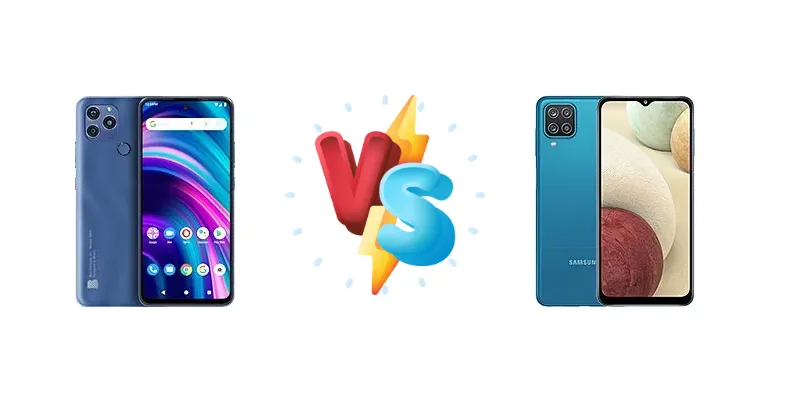
The BLU G91s and Samsung Galaxy A12 (India) represent compelling options in the ultra-budget smartphone segment. While both aim to deliver essential smartphone functionality at an accessible price, they diverge significantly in their core hardware, particularly in their chipsets. This comparison dissects these differences to determine which device offers the best balance of performance, efficiency, and value for the average user.
🏆 Quick Verdict
For most users, the BLU G91s is the better choice. Its Mediatek Helio G80 chipset, built on a 12nm process, offers a noticeable performance advantage over the Samsung Galaxy A12’s Exynos 850, despite the latter’s 8nm fabrication. This translates to smoother multitasking and a more responsive user experience, making the G91s the winner.
| Network |
|---|
| 2G bands | GSM 850 / 900 / 1800 / 1900 | GSM 850 / 900 / 1800 / 1900 |
| 3G bands | HSDPA 850 / 900 / 1700(AWS) / 1900 / 2100 | HSDPA 850 / 900 / 2100 |
| 4G bands | 1, 2, 3, 4, 5, 7, 12, 17, 28 | 1, 3, 5, 7, 8, 20, 28, 38, 40, 41 |
| Speed | HSPA 42.2/5.76 Mbps, LTE (2CA) Cat6 300/50 Mbps | HSPA 42.2/5.76 Mbps, LTE Cat4 150/50 Mbps |
| Technology | GSM / HSPA / LTE | GSM / HSPA / LTE |
| Launch |
|---|
| Announced | 2021, December 07. Released 2021, December 07 | 2021, August 12 |
| Status | Discontinued | Available. Released 2021, August 12 |
| Body |
|---|
| Build | - | Glass front, plastic back, plastic frame |
| Dimensions | 168 x 76.5 x 8.9 mm (6.61 x 3.01 x 0.35 in) | 164 x 75.8 x 8.9 mm (6.46 x 2.98 x 0.35 in) |
| SIM | Nano-SIM + Nano-SIM | · Nano-SIM· Nano-SIM + Nano-SIM |
| Weight | 202 g (7.13 oz) | 205 g (7.23 oz) |
| Display |
|---|
| Resolution | 1080 x 2460 pixels (~395 ppi density) | 720 x 1600 pixels, 20:9 ratio (~270 ppi density) |
| Size | 6.8 inches, 109.8 cm2 (~85.4% screen-to-body ratio) | 6.5 inches, 102.0 cm2 (~82.1% screen-to-body ratio) |
| Type | IPS LCD | PLS LCD |
| Platform |
|---|
| CPU | Octa-core (2x2.0 GHz Cortex-A75 & 6x1.8 GHz Cortex-A55) | Octa-core (4x2.0 GHz Cortex-A55 & 4x2.0 GHz Cortex-A55) |
| Chipset | Mediatek MT6769V/CU Helio G80 (12 nm) | Exynos 850 (8 nm) |
| GPU | Mali-G52 MC2 | Mali-G52 |
| OS | Android 11 | Android 11, upgradable to Android 13, One UI 5.1 |
| Memory |
|---|
| Card slot | microSDXC | microSDXC (dedicated slot) |
| Internal | 128GB 4GB RAM | 64GB 4GB RAM, 128GB 4GB RAM, 128GB 6GB RAM |
| | eMMC 5.1 | eMMC 5.1 |
| Main Camera |
|---|
| Features | LED flash, HDR, panorama | LED flash, panorama, HDR |
| Quad | 48 MP, f/1.8, (wide), 1/2.0, 0.8µm, PDAF
5 MP, f/2.2, (ultrawide)
Auxiliary lens | 48 MP, f/2.0, 26mm (wide), AF
5 MP, f/2.2, 123˚ (ultrawide)
2 MP (macro)
Auxiliary lens |
| Single | 13 MP, f/2.0 | - |
| Video | 1080p@30fps | 1080p@30fps |
| Selfie camera |
|---|
| Single | 13 MP, f/2.0 | 8 MP, f/2.2 |
| Video | 1080p@30fps | 1080p@30fps |
| Sound |
|---|
| 3.5mm jack | Yes | Yes |
| 35mm jack | Yes | Yes |
| Loudspeaker | Yes | Yes |
| Comms |
|---|
| Bluetooth | 5.0, A2DP, LE | 5.0, A2DP, LE |
| NFC | No | No |
| Positioning | GPS | GPS, GLONASS, GALILEO, BDS |
| Radio | FM radio | FM radio, RDS, recording |
| USB | USB Type-C 2.0, OTG | USB Type-C 2.0 |
| WLAN | Wi-Fi 802.11 a/b/g/n, Wi-Fi Direct | Wi-Fi 802.11 b/g/n, Wi-Fi Direct |
| Features |
|---|
| Sensors | Fingerprint (rear-mounted), accelerometer, gyro, proximity, compass | Fingerprint (side-mounted), accelerometer |
| | - | Virtual proximity sensing |
| Battery |
|---|
| Charging | 18W wired | 15W wired |
| Type | Li-Po 6000 mAh | Li-Po 5000 mAh |
| Misc |
|---|
| Colors | Blue, Green, Gray, Cyan | Black, Blue, White |
| Models | - | SM-A127F, SM-A127F/DS |
| Price | About 200 EUR | About 160 EUR |
| SAR | - | 0.79 W/kg (head) |
BLU G91s
- More powerful processor (Helio G80)
- Faster charging (18W)
- Potentially better gaming performance
- Less brand recognition
- Potentially limited software support
Samsung Galaxy A12 (India)
- Established brand reputation (Samsung)
- Larger battery capacity (5000mAh)
- Wider service network
- Less powerful processor (Exynos 850)
- Slower charging (15W)
- Potentially less responsive user experience
Display Comparison
Neither device boasts a standout display. While specific display specs (resolution, panel type) are missing for the BLU G91s, the Samsung Galaxy A12 features a large 6.5-inch PLS IPS LCD. The Exynos 850’s integrated GPU will handle basic display tasks efficiently, but neither phone is expected to deliver vibrant colors or high brightness levels. The absence of high refresh rates on both devices suggests a focus on power conservation rather than visual fluidity.
Camera Comparison
Camera performance is difficult to assess without detailed sensor information. However, both phones likely feature similar budget-oriented camera setups. The focus should be on the primary sensor; any 2MP macro or depth sensors are unlikely to deliver meaningful improvements in image quality. The Exynos 850’s ISP (Image Signal Processor) may offer slightly better image processing capabilities, but the overall experience will heavily depend on software optimization. The G91s's ISP is adequate for its price point, but won't compete with higher-end devices.
Performance
The core difference lies in the chipsets. The BLU G91s utilizes the Mediatek Helio G80, featuring a dual-cluster CPU configuration with 2x 2.0 GHz Cortex-A75 cores and 6x 1.8 GHz Cortex-A55 cores. This contrasts with the Samsung Galaxy A12’s Exynos 850, which employs eight 2.0 GHz Cortex-A55 cores. The A75 cores in the Helio G80 provide a significant architectural advantage, offering higher single-core performance crucial for app launch speeds and responsiveness. While the Exynos 850 benefits from an 8nm process, the Helio G80’s more powerful core design likely offsets this advantage in most real-world scenarios. The G80 is geared towards gaming, while the A12 is more focused on efficiency.
Battery Life
The Samsung Galaxy A12 supports 15W wired charging, while the BLU G91s offers 18W. While the difference isn’t massive, the G91s will likely achieve a slightly faster 0-100% charge time. Battery capacity is not specified for the G91s, but the A12 has a 5000mAh battery. The Exynos 850’s efficiency should contribute to decent battery life on the A12, but the Helio G80’s performance advantage may lead to slightly higher power consumption on the G91s. The 18W charging on the G91s helps mitigate this.
Buying Guide
Buy the BLU G91s if you prioritize performance for gaming or demanding applications and need a phone that feels responsive. Buy the Samsung Galaxy A12 (India) if you value brand recognition, a potentially wider service network, and are primarily focused on basic smartphone tasks like calling, messaging, and light social media use. The A12’s slightly slower charging may be a drawback for some.
Frequently Asked Questions
❓ Does the Exynos 850 in the Galaxy A12 overheat during prolonged gaming sessions?
The Exynos 850 is generally an efficient chip, but it's not designed for intensive gaming. While it won't likely overheat to the point of shutdown, users may experience thermal throttling, leading to reduced frame rates and stuttering during extended gaming sessions. The Helio G80 in the BLU G91s is better equipped to handle sustained loads.
❓ Is the 18W charging on the BLU G91s a significant improvement over the Galaxy A12’s 15W charging?
While not a dramatic difference, the 18W charging on the G91s will likely result in a noticeably faster 0-100% charge time compared to the A12. Expect a reduction of approximately 30-60 minutes in full charge time, depending on usage patterns.
❓ Will the BLU G91s receive regular software updates and security patches?
BLU’s software update track record is less consistent than Samsung’s. While the G91s will likely ship with a relatively recent version of Android, long-term software support and security updates may be less frequent compared to the Galaxy A12.
❓ How does the Helio G80's CPU architecture impact everyday tasks like browsing and social media?
The Helio G80's Cortex-A75 cores provide a significant boost in single-core performance, which directly translates to snappier app launches, smoother scrolling, and a more responsive user experience when navigating everyday tasks like browsing the web or using social media apps.