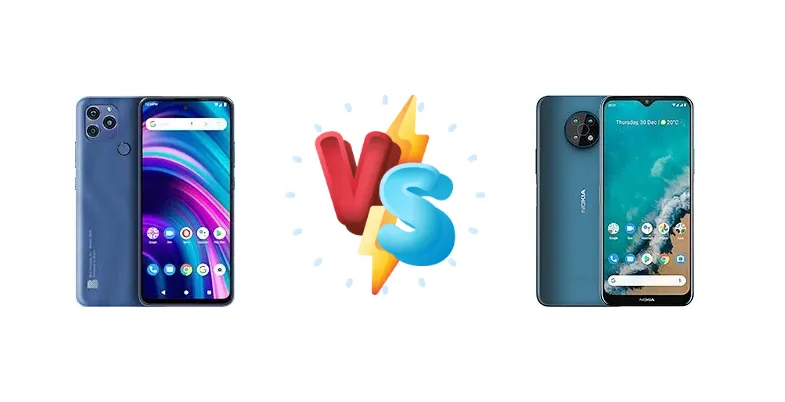
The budget smartphone market is fiercely competitive, offering incredible value for your money. Today, we're pitting two contenders against each other: the BLU G91s and the Nokia G50. Both promise a lot, but which one delivers the best overall experience?
🏆 Quick Verdict
The Nokia G50 edges out the BLU G91s thanks to its 5G connectivity, more efficient 8nm chipset, and generally cleaner software experience. While the BLU G91s offers a slightly larger screen, the Nokia G50's performance and future-proofing make it the better choice for most users.
| Network |
|---|
| 2G bands | GSM 850 / 900 / 1800 / 1900 | GSM 850 / 900 / 1800 / 1900 |
| 3G bands | HSDPA 850 / 900 / 1700(AWS) / 1900 / 2100 | HSDPA 850 / 900 / 1900 / 2100 - EU, ROW, China |
| 4G bands | 1, 2, 3, 4, 5, 7, 12, 17, 28 | 1, 3, 5, 7, 8, 20, 28, 38, 39, 40, 41 - EU, ROW, China |
| 5G bands | - | 1, 3, 5, 7, 28, 38, 40, 41, 78 SA/NSA/Sub6 - EU, ROW, China |
| Speed | HSPA 42.2/5.76 Mbps, LTE (2CA) Cat6 300/50 Mbps | HSPA, LTE, 5G |
| Technology | GSM / HSPA / LTE | GSM / HSPA / LTE / 5G |
| | - | 2, 5, 7, 38, 41, 66, 71, 78 SA/NSA/Sub6 - NA |
| Launch |
|---|
| Announced | 2021, December 07. Released 2021, December 07 | 2021, September 22 |
| Status | Discontinued | Available. Released 2021, October 13 |
| Body |
|---|
| Dimensions | 168 x 76.5 x 8.9 mm (6.61 x 3.01 x 0.35 in) | 173.8 x 77.7 x 8.9 mm (6.84 x 3.06 x 0.35 in) |
| SIM | Nano-SIM + Nano-SIM | · Nano-SIM· Nano-SIM + Nano-SIM |
| Weight | 202 g (7.13 oz) | 220 g (7.76 oz) |
| Display |
|---|
| Resolution | 1080 x 2460 pixels (~395 ppi density) | 720 x 1560 pixels, 19.5:9 ratio (~252 ppi density) |
| Size | 6.8 inches, 109.8 cm2 (~85.4% screen-to-body ratio) | 6.82 inches, 114.2 cm2 (~84.5% screen-to-body ratio) |
| Type | IPS LCD | IPS LCD, 450 nits (typ) |
| Platform |
|---|
| CPU | Octa-core (2x2.0 GHz Cortex-A75 & 6x1.8 GHz Cortex-A55) | Octa-core (2x2.0 GHz Kryo 460 & 6x1.8 GHz Kryo 460) |
| Chipset | Mediatek MT6769V/CU Helio G80 (12 nm) | Qualcomm SM4350 Snapdragon 480 5G (8 nm) |
| GPU | Mali-G52 MC2 | Adreno 619 |
| OS | Android 11 | Android 11, upgradable to Android 13 |
| Memory |
|---|
| Card slot | microSDXC | microSDXC |
| Internal | 128GB 4GB RAM | 64GB 4GB RAM, 128GB 4GB RAM, 128GB 6GB RAM |
| | eMMC 5.1 | - |
| Main Camera |
|---|
| Features | LED flash, HDR, panorama | LED flash, HDR, panorama |
| Quad | 48 MP, f/1.8, (wide), 1/2.0, 0.8µm, PDAF
5 MP, f/2.2, (ultrawide)
Auxiliary lens | - |
| Single | 13 MP, f/2.0 | 8 MP, (wide) |
| Triple | - | 48 MP, f/1.8, (wide), PDAF
5 MP, (ultrawide)
Auxiliary lens |
| Video | 1080p@30fps | 1080p@30fps |
| Selfie camera |
|---|
| Single | 13 MP, f/2.0 | 8 MP, (wide) |
| Video | 1080p@30fps | 1080p@30fps |
| Sound |
|---|
| 3.5mm jack | Yes | Yes |
| 35mm jack | Yes | Yes |
| Loudspeaker | Yes | Yes |
| Comms |
|---|
| Bluetooth | 5.0, A2DP, LE | 5.0, A2DP, LE |
| NFC | No | Yes (market/region dependent) |
| Positioning | GPS | GPS, GALILEO, BDS |
| Radio | FM radio | FM radio |
| USB | USB Type-C 2.0, OTG | USB Type-C 2.0, OTG |
| WLAN | Wi-Fi 802.11 a/b/g/n, Wi-Fi Direct | Wi-Fi 802.11 a/b/g/n/ac/6, dual-band |
| Features |
|---|
| Sensors | Fingerprint (rear-mounted), accelerometer, gyro, proximity, compass | Fingerprint (side-mounted), accelerometer, gyro, proximity, compass |
| Battery |
|---|
| Charging | 18W wired | 18W wired |
| Type | Li-Po 6000 mAh | Li-Po 5000 mAh |
| Misc |
|---|
| Colors | Blue, Green, Gray, Cyan | Midnight Sun, Ocean Blue |
| Models | - | TA-1358, TA-1390, TA-1370, TA-1367, TA-1361 |
| Price | About 200 EUR | About 180 EUR |
| SAR | - | 0.79 W/kg (head) 0.96 W/kg (body) |
| SAR EU | - | 1.15 W/kg (head) 1.13 W/kg (body) |
BLU G91s
- Larger Display
- Potentially Lower Price
- Decent Battery Life
- Less Efficient Chipset
- Slower Performance
- Less Polished Software
Nokia G50
- 5G Connectivity
- More Efficient Chipset
- Smoother Performance
- Cleaner Software
- Generally Better Camera
- Smaller Display
- Potentially Higher Price
Display Comparison
Both phones feature large displays, with the BLU G91s boasting a 6.7-inch screen compared to the Nokia G50's 6.53-inch display. While both are LCD panels, the Nokia G50 often exhibits slightly better color accuracy and brightness. Resolution is generally similar, offering acceptable viewing experiences for everyday use.
Camera Comparison
The Nokia G50 typically features a more versatile camera system, often including a higher resolution main sensor and potentially better image processing. While both phones offer decent camera capabilities for their price range, the Nokia G50 generally produces more detailed and vibrant photos, especially in good lighting conditions. Low-light performance is comparable.
Performance
Here's where the Nokia G50 shines. Its Snapdragon 480 5G chipset, built on an 8nm process, is significantly more efficient than the BLU G91s's Helio G80 (12nm). This translates to better overall performance, smoother multitasking, and less heat generation. The Nokia G50 handles demanding apps and games better than the BLU G91s.
Battery Life
Both phones offer a respectable battery life, typically lasting a full day with moderate usage. Charging speeds are identical at 18W wired, which is relatively standard for this price bracket. Battery optimization on the Nokia G50's more efficient chipset may give it a slight edge in real-world usage.
Buying Guide
The BLU G91s is a good option for users prioritizing a larger display and potentially a slightly lower price point. The Nokia G50 is ideal for those seeking 5G connectivity, a smoother user experience, and a more reliable brand reputation.
Frequently Asked Questions
❓ Is the BLU G91s a good phone for gaming?
While it can handle some casual games, the BLU G91s's chipset isn't ideal for demanding titles. The Nokia G50 offers a significantly better gaming experience.
❓ Does the Nokia G50 support 5G?
Yes, the Nokia G50 is a 5G smartphone, offering faster data speeds where available. The BLU G91s does not support 5G.