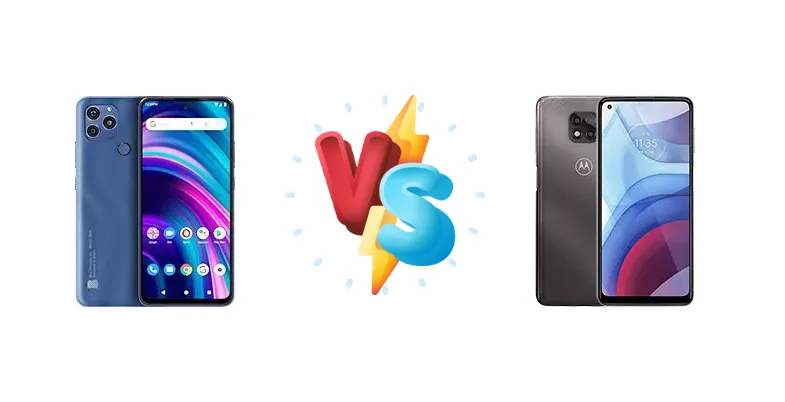
The BLU G91s and Motorola Moto G Power (2021) represent compelling options in the sub-$200 smartphone market. While both aim to deliver essential features at an accessible price, they take different approaches to achieving this. The G91s leverages MediaTek’s Helio G80, prioritizing CPU performance, while the Moto G Power opts for Qualcomm’s Snapdragon 662, focusing on efficiency and battery longevity. This comparison dissects these choices to determine which device best suits your needs.
🏆 Quick Verdict
For users prioritizing raw processing power for tasks like app multitasking and light gaming, the BLU G91s offers a slight edge thanks to its Helio G80 chipset. However, the Motorola Moto G Power (2021) wins for overall user experience, offering better-optimized power efficiency and a more reliable, consistent performance profile for everyday use.
| Network |
|---|
| 2G bands | GSM 850 / 900 / 1800 / 1900 | GSM 850 / 900 / 1800 / 1900 |
| 3G bands | HSDPA 850 / 900 / 1700(AWS) / 1900 / 2100 | HSDPA 850 / 900 / 1700(AWS) / 1900 / 2100 |
| 4G bands | 1, 2, 3, 4, 5, 7, 12, 17, 28 | 1, 2, 3, 4, 5, 7, 8, 12, 13, 14, 17, 25, 26, 29, 30, 38, 41, 66, 71 |
| Speed | HSPA 42.2/5.76 Mbps, LTE (2CA) Cat6 300/50 Mbps | HSPA, LTE |
| Technology | GSM / HSPA / LTE | GSM / CDMA / HSPA / EVDO / LTE |
| | - | CDMA2000 1xEV-DO |
| Launch |
|---|
| Announced | 2021, December 07. Released 2021, December 07 | 2021, January 08 |
| Status | Discontinued | Available. Released 2021, January 14 |
| Body |
|---|
| Build | - | Glass front, plastic back, plastic frame |
| Dimensions | 168 x 76.5 x 8.9 mm (6.61 x 3.01 x 0.35 in) | 165.3 x 75.9 x 9.5 mm (6.51 x 2.99 x 0.37 in) |
| SIM | Nano-SIM + Nano-SIM | Nano-SIM |
| Weight | 202 g (7.13 oz) | 206.5 g (7.30 oz) |
| | - | Water-repellent coating |
| Display |
|---|
| Resolution | 1080 x 2460 pixels (~395 ppi density) | 720 x 1600 pixels, 20:9 ratio (~266 ppi density) |
| Size | 6.8 inches, 109.8 cm2 (~85.4% screen-to-body ratio) | 6.6 inches, 105.2 cm2 (~83.8% screen-to-body ratio) |
| Type | IPS LCD | IPS LCD |
| Platform |
|---|
| CPU | Octa-core (2x2.0 GHz Cortex-A75 & 6x1.8 GHz Cortex-A55) | Octa-core (4x2.0 GHz Kryo 260 Gold & 4x1.8 GHz Kryo 260 Silver) |
| Chipset | Mediatek MT6769V/CU Helio G80 (12 nm) | Qualcomm SM6115 Snapdragon 662 (11 nm) |
| GPU | Mali-G52 MC2 | Adreno 610 |
| OS | Android 11 | Android 10 |
| Memory |
|---|
| Card slot | microSDXC | microSDXC (dedicated slot) |
| Internal | 128GB 4GB RAM | 32GB 3GB RAM, 64GB 4GB RAM |
| | eMMC 5.1 | eMMC 5.1 |
| Main Camera |
|---|
| Features | LED flash, HDR, panorama | LED flash, HDR, panorama |
| Quad | 48 MP, f/1.8, (wide), 1/2.0, 0.8µm, PDAF
5 MP, f/2.2, (ultrawide)
Auxiliary lens | - |
| Single | 13 MP, f/2.0 | - |
| Triple | - | 48 MP, f/1.7, (wide), 1/2.0", 0.8µm, PDAF
2 MP (macro)
Auxiliary lens |
| Video | 1080p@30fps | 1080p@30/60fps, gyro-EIS |
| Selfie camera |
|---|
| Features | - | HDR |
| Single | 13 MP, f/2.0 | 8 MP, f/2.0, 1.12µm |
| Video | 1080p@30fps | 1080p@30fps, gyro-EIS |
| Sound |
|---|
| 3.5mm jack | Yes | Yes |
| 35mm jack | Yes | Yes |
| Loudspeaker | Yes | Yes |
| Comms |
|---|
| Bluetooth | 5.0, A2DP, LE | 5.0, A2DP, LE |
| NFC | No | No |
| Positioning | GPS | GPS, GLONASS, GALILEO |
| Radio | FM radio | FM radio |
| USB | USB Type-C 2.0, OTG | USB Type-C 2.0 |
| WLAN | Wi-Fi 802.11 a/b/g/n, Wi-Fi Direct | Wi-Fi 802.11 a/b/g/n/ac, dual-band, Wi-Fi Direct |
| Features |
|---|
| Sensors | Fingerprint (rear-mounted), accelerometer, gyro, proximity, compass | Fingerprint (side-mounted), accelerometer, gyro, proximity, compass, barometer |
| Battery |
|---|
| Charging | 18W wired | 15W wired |
| Type | Li-Po 6000 mAh | Li-Po 5000 mAh |
| Misc |
|---|
| Colors | Blue, Green, Gray, Cyan | Flash Gray, Polar Silver |
| Price | About 200 EUR | About 60 EUR |
BLU G91s
- Potentially faster CPU performance for multitasking.
- Slightly faster 18W wired charging.
- Lower price point (likely).
- Less efficient chipset, potentially shorter battery life.
- Potential for more thermal throttling under sustained load.
- BLU’s software update track record is less reliable than Motorola’s.
Motorola Moto G Power (2021)
- More efficient Snapdragon 662 chipset for longer battery life.
- Better thermal management, reducing throttling.
- Motorola’s cleaner software experience and more reliable updates.
- Slightly slower CPU performance compared to the Helio G80.
- Slower 15W wired charging.
- May be slightly more expensive.
Display Comparison
Neither device boasts a standout display. Both likely utilize LCD panels, a common trait in this price bracket. The key difference lies under the hood: processing power. Display specs are not provided, so we can assume similar resolutions and refresh rates (likely 60Hz). The focus here isn't on visual fidelity, but on how the chipsets handle UI rendering on these displays.
Camera Comparison
Without detailed camera specifications, a direct comparison is difficult. However, given the price point, both phones likely feature a primary sensor paired with auxiliary lenses of limited utility. The focus should be on image processing capabilities, which are heavily tied to the chipset. The Snapdragon 662’s image signal processor (ISP) is generally well-regarded for its color accuracy and dynamic range. The Helio G80’s ISP is capable, but may not offer the same level of refinement. Expect similar results in good lighting conditions, but the Motorola may have an edge in low-light scenarios.
Performance
The core of the difference lies in the chipsets. The BLU G91s’ MediaTek Helio G80 (12nm) features a dual-cluster configuration with 2x 2.0 GHz Cortex-A75 cores and 6x 1.8 GHz Cortex-A55 cores. This architecture prioritizes peak performance, offering a noticeable boost in CPU-intensive tasks compared to the Motorola’s Snapdragon 662 (11nm). The Snapdragon 662, with its 4x 2.0 GHz Kryo 260 Gold and 4x 1.8 GHz Kryo 260 Silver cores, is designed for sustained performance and efficiency. The 11nm process node on the Snapdragon 662 contributes to better thermal management, potentially reducing throttling during extended use. While the G80 may win in benchmarks, the 662’s efficiency translates to a smoother, more consistent experience in daily tasks.
Battery Life
The Motorola Moto G Power (2021) is named appropriately. While the exact battery capacity isn't specified, Motorola’s ‘Power’ line is known for prioritizing battery life. The 15W charging, while slower than the BLU G91s’ 18W, is less critical given the likely larger battery capacity. The Snapdragon 662’s efficiency further extends battery life. The Helio G80, while powerful, consumes more power, meaning the BLU G91s will likely require more frequent charging despite the slightly faster charging speed. Users prioritizing all-day battery life will strongly favor the Moto G Power.
Buying Guide
Buy the BLU G91s if you frequently switch between numerous apps, occasionally engage in casual gaming, and prioritize a slightly faster processor at the lowest possible price. Buy the Motorola Moto G Power (2021) if you value long battery life, consistent performance throughout the day, and a more established brand reputation with reliable software updates, even if it means sacrificing a small amount of peak processing power.
Frequently Asked Questions
❓ Will the BLU G91s struggle with demanding games like PUBG Mobile?
While the Helio G80 can handle PUBG Mobile, you’ll likely need to lower graphics settings to maintain a stable frame rate. The Snapdragon 662 in the Moto G Power will offer a more consistent gaming experience, albeit at similar settings, due to its better thermal management preventing performance throttling.
❓ How important is the difference in charging speeds between 15W and 18W?
The difference between 15W and 18W charging isn’t massive. Expect roughly a 30-minute difference for a full charge, but the larger battery capacity in the Moto G Power will likely offset this advantage, resulting in similar overall charging times from empty to full.
❓ Does the Motorola Moto G Power (2021) receive regular software updates?
Motorola has improved its software update commitment in recent years. While not as frequent as Google or Samsung, the Moto G Power (2021) is likely to receive at least one major Android update and regular security patches, offering a more secure and up-to-date experience than many other phones in this price range.