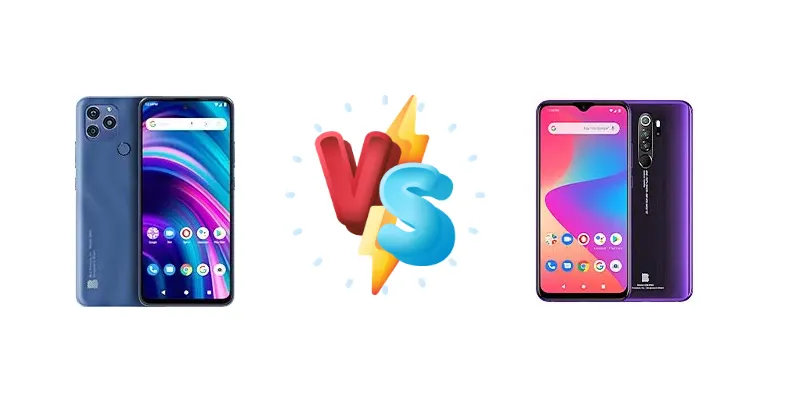
BLU has carved a niche in the ultra-budget smartphone market, and the G91s and G90 Pro represent their attempts at delivering a playable gaming experience without breaking the bank. While both phones share a similar aesthetic and price point, significant differences in their chipsets and features dictate which one is the better choice for specific users. This comparison will dissect those differences, focusing on real-world performance implications.
🏆 Quick Verdict
For most users, the BLU G90 Pro is the superior choice. The Helio G90T chipset provides a noticeable performance uplift over the G80 in the G91s, and the addition of 10W wireless charging adds a layer of convenience. While the performance gap isn't massive, it's enough to justify the slight price premium.
| Network |
|---|
| 2G bands | GSM 850 / 900 / 1800 / 1900 | GSM 850 / 900 / 1800 / 1900 |
| 3G bands | HSDPA 850 / 900 / 1700(AWS) / 1900 / 2100 | HSDPA 850 / 900 / 1700(AWS) / 1900 / 2100 |
| 4G bands | 1, 2, 3, 4, 5, 7, 12, 17, 28 | 1, 2, 3, 4, 5, 7, 8, 12, 13, 17, 28 |
| Speed | HSPA 42.2/5.76 Mbps, LTE (2CA) Cat6 300/50 Mbps | HSPA 42.2/5.76 Mbps, LTE (2CA) Cat6 300/50 Mbps |
| Technology | GSM / HSPA / LTE | GSM / HSPA / LTE |
| Launch |
|---|
| Announced | 2021, December 07. Released 2021, December 07 | 2020, August 25. Released 2020, August 25 |
| Status | Discontinued | Discontinued |
| Body |
|---|
| Dimensions | 168 x 76.5 x 8.9 mm (6.61 x 3.01 x 0.35 in) | 162 x 77 x 10.1 mm (6.38 x 3.03 x 0.40 in) |
| SIM | Nano-SIM + Nano-SIM | Nano-SIM + Nano-SIM |
| Weight | 202 g (7.13 oz) | 215 g (7.58 oz) |
| Display |
|---|
| Protection | - | Corning Gorilla Glass |
| Resolution | 1080 x 2460 pixels (~395 ppi density) | 1080 x 2340 pixels, 19.5:9 ratio (~396 ppi density) |
| Size | 6.8 inches, 109.8 cm2 (~85.4% screen-to-body ratio) | 6.5 inches, 103.7 cm2 (~83.1% screen-to-body ratio) |
| Type | IPS LCD | IPS LCD |
| Platform |
|---|
| CPU | Octa-core (2x2.0 GHz Cortex-A75 & 6x1.8 GHz Cortex-A55) | Octa-core (2x2.05 GHz Cortex-A76 & 6x2.0 GHz Cortex-A55) |
| Chipset | Mediatek MT6769V/CU Helio G80 (12 nm) | Mediatek MT6785 Helio G90T (12 nm) |
| GPU | Mali-G52 MC2 | Mali-G76 MC4 |
| OS | Android 11 | Android 10 |
| Memory |
|---|
| Card slot | microSDXC | microSDXC |
| Internal | 128GB 4GB RAM | 128GB 4GB RAM |
| | eMMC 5.1 | eMMC 5.1 |
| Main Camera |
|---|
| Features | LED flash, HDR, panorama | LED flash, panorama, HDR |
| Quad | 48 MP, f/1.8, (wide), 1/2.0, 0.8µm, PDAF
5 MP, f/2.2, (ultrawide)
Auxiliary lens | - |
| Single | 13 MP, f/2.0 | 3.15 MP |
| Triple | - | 48 MP, f/1.8, (wide), 1/2.0", 0.8µm, PDAF
8 MP, f/2.2, (ultrawide), 1/4.0", 1.12µm
2 MP (macro)
Auxiliary lens |
| Video | 1080p@30fps | 4K@30fps |
| Selfie camera |
|---|
| Single | 13 MP, f/2.0 | 32 MP, f/2.0, (wide), 1/2.8", 0.8µm |
| Video | 1080p@30fps | 1080p@30fps |
| Sound |
|---|
| 3.5mm jack | Yes | Yes |
| 35mm jack | Yes | Yes |
| Loudspeaker | Yes | Yes |
| Comms |
|---|
| Bluetooth | 5.0, A2DP, LE | 4.1, A2DP, LE |
| NFC | No | No |
| Positioning | GPS | GPS |
| Radio | FM radio | FM radio |
| USB | USB Type-C 2.0, OTG | USB Type-C 2.0, OTG |
| WLAN | Wi-Fi 802.11 a/b/g/n, Wi-Fi Direct | Wi-Fi 802.11 a/b/g/n, Wi-Fi Direct |
| Features |
|---|
| Browser | - | HTML |
| Sensors | Fingerprint (rear-mounted), accelerometer, gyro, proximity, compass | Fingerprint (rear-mounted), accelerometer, gyro, proximity, compass |
| Battery |
|---|
| Charging | 18W wired | 18W wired
10W wireless (Qi) |
| Stand-by | - | Up to 560 h (2G) / Up to 445 h (3G) |
| Talk time | - | Up to 8 h 10 min (2G) / Up to 6 h 30 min (3G) |
| Type | Li-Po 6000 mAh | Li-Po 5100 mAh |
| Misc |
|---|
| Colors | Blue, Green, Gray, Cyan | Purple Haze |
| Models | - | xt502 |
| Price | About 200 EUR | About 170 EUR |
| SAR | - | 1.16 W/kg (head) 0.59 W/kg (body) |
| SAR EU | - | 0.96 W/kg (head) |
BLU G91s
- Potentially slightly better battery life in light use.
- More affordable price point (likely).
- Reliable for basic smartphone tasks.
- Less powerful processor for gaming and multitasking.
- No wireless charging.
- Likely slower app loading times.
BLU G90 Pro
- More powerful Helio G90T chipset.
- 10W wireless charging support.
- Improved gaming performance.
- Snappier overall user experience.
- Potentially slightly shorter battery life.
- Slightly higher price point.
Display Comparison
Both the BLU G91s and G90 Pro likely feature similar LCD panels, given their price bracket. However, detailed display specs like resolution, brightness, and color gamut are not provided. The lack of information makes a direct comparison difficult. We can assume both will offer adequate, but not exceptional, viewing experiences. Bezels are likely to be substantial on both devices, typical for this price range. Color accuracy is unlikely to be a strong point on either.
Camera Comparison
Without detailed camera sensor information, a precise comparison is challenging. However, it's safe to assume both phones utilize budget-friendly sensors. The G90 Pro likely has a slightly better main sensor, benefiting from the overall more powerful chipset’s image signal processor (ISP). The ISP on the G90T will likely offer better noise reduction and dynamic range. Any secondary cameras (ultra-wide, macro) on both devices are likely to be of limited quality and should not be a primary consideration for buyers. Focusing on the main sensor’s megapixel count and aperture (if available) is crucial.
Performance
The core difference lies in the chipsets. The BLU G90 Pro’s Mediatek Helio G90T (12nm) boasts a more powerful CPU configuration – 2x2.05 GHz Cortex-A76 cores alongside 6x2.0 GHz Cortex-A55 cores – compared to the G91s’ Helio G80 (12nm) with its 2x2.0 GHz Cortex-A75 and 6x1.8 GHz Cortex-A55 setup. The Cortex-A76 cores in the G90T offer a significant architectural advantage, resulting in faster single-core and multi-core performance. This translates to snappier app launches, smoother multitasking, and improved gaming frame rates. While both use the same 12nm process, the G90T’s more efficient core design will likely result in better sustained performance under load. The GPU in the G90T is also more capable, further enhancing the gaming experience.
Battery Life
Both phones feature 18W wired charging, offering similar charging speeds. The G90 Pro adds the convenience of 10W wireless charging (Qi standard), a feature absent on the G91s. While 10W wireless charging isn’t particularly fast, it provides a convenient top-up option. Battery capacity is not specified, but the G90 Pro’s more powerful chipset may consume slightly more power. The G91s might offer marginally longer battery life in light usage scenarios, but the G90 Pro’s wireless charging capability and superior performance likely outweigh this difference for most users.
Buying Guide
Buy the BLU G91s if you prioritize maximizing battery life and are content with basic gaming and everyday tasks. It's a solid option for users who primarily need a reliable communication device. Buy the BLU G90 Pro if you want a more responsive experience for gaming, multitasking, and appreciate the convenience of wireless charging. It's the better choice for those who demand a bit more from their smartphone.
Frequently Asked Questions
❓ Will the BLU G90 Pro handle demanding games like PUBG Mobile at high settings?
The Helio G90T in the G90 Pro is capable of running PUBG Mobile at medium to high settings with playable frame rates. However, don't expect a consistently smooth 60fps experience; you may need to adjust settings for optimal performance. The G91s with the Helio G80 will struggle with higher settings and may require significant compromises.
❓ Does the BLU G90 Pro's wireless charging work with any Qi-compatible charger?
Yes, the BLU G90 Pro supports the standard Qi wireless charging protocol, meaning it will work with any Qi-compatible wireless charger. However, using a higher wattage (e.g., 15W or 20W) charger won't increase the charging speed beyond the phone's 10W limit.
❓ Is the difference in CPU cores (Cortex-A75 vs A76) really noticeable in everyday use?
Yes, the Cortex-A76 cores in the G90 Pro offer a significant architectural improvement over the Cortex-A75 cores in the G91s. This translates to faster app launches, smoother scrolling, and a more responsive overall user experience, even in everyday tasks like browsing the web or using social media.