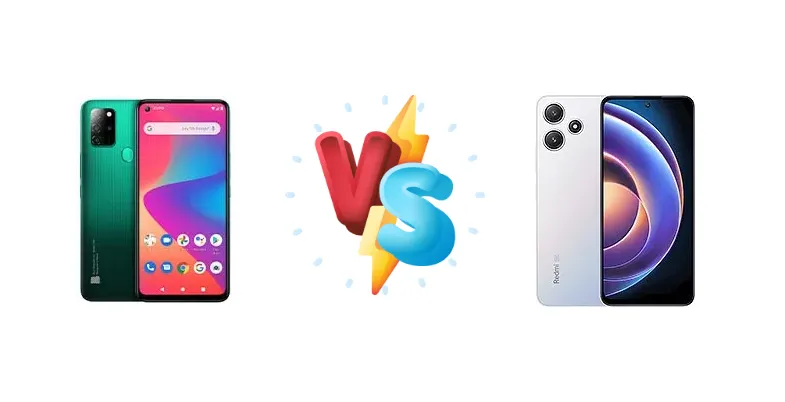
The BLU G91 and Xiaomi Redmi Note 12R represent distinct approaches to the budget smartphone market. The G91 aims for affordability, while the Redmi Note 12R leverages newer chipset technology for improved performance. This comparison dissects their key differences to help you determine which device best suits your needs.
🏆 Quick Verdict
For most users, the Xiaomi Redmi Note 12R is the superior choice. Its Snapdragon 4 Gen 2 chipset, built on a 4nm process, delivers significantly better performance and efficiency than the BLU G91’s older Cortex-A53 CPU. The faster 18W charging with PD support is also a substantial advantage.
| Network |
|---|
| 2G bands | GSM 850 / 900 / 1800 / 1900 | GSM 850 / 900 / 1800 / 1900 |
| 3G bands | HSDPA 850 / 900 / 1700(AWS) / 1900 / 2100 | HSDPA 850 / 900 / 2100 |
| 4G bands | 1, 2, 3, 4, 5, 7, 12, 17, 28 | 1, 3, 5, 8, 34, 38, 39, 40, 41 |
| 5G bands | - | 1, 5, 8, 28, 41, 78 SA/NSA |
| Speed | HSPA 42.2/11.5 Mbps, LTE Cat4 150/50 Mbps | HSPA, LTE, 5G |
| Technology | GSM / HSPA / LTE | GSM / CDMA / HSPA / EVDO / LTE / 5G |
| Launch |
|---|
| Announced | 2021, February 24. Released 2021, February 24 | 2023, June 28 |
| Status | Discontinued | Available. Released 2023, June 28 |
| Body |
|---|
| Build | - | Glass front, plastic frame, glass back |
| Dimensions | 163 x 76 x 9 mm (6.42 x 2.99 x 0.35 in) | 168.6 x 76.3 x 8.2 mm (6.64 x 3.00 x 0.32 in) |
| SIM | Nano-SIM + Nano-SIM | Nano-SIM + Nano-SIM |
| Weight | 196 g (6.91 oz) | 199 g (7.02 oz) |
| Display |
|---|
| Resolution | 720 x 1600 pixels, 20:9 ratio (~270 ppi density) | 1080 x 2460 pixels (~396 ppi density) |
| Size | 6.5 inches, 102.0 cm2 (~82.3% screen-to-body ratio) | 6.79 inches, 109.5 cm2 (~85.1% screen-to-body ratio) |
| Type | IPS LCD | IPS LCD, 90Hz, 550 nits |
| Platform |
|---|
| CPU | Octa-core 1.8 GHz Cortex-A53 | Octa-core (2x2.2 GHz Cortex-A78 & 6x1.95 GHz Cortex-A55) |
| Chipset | - | Qualcomm SM4450 Snapdragon 4 Gen 2 (4 nm) |
| GPU | - | Adreno 613 |
| OS | Android 10 | Android 13, MIUI 14 |
| Memory |
|---|
| Card slot | microSDXC (dedicated slot) | microSDXC (uses shared SIM slot) |
| Internal | 128GB 4GB RAM | 128GB 4GB RAM, 128GB 6GB RAM, 128GB 8GB RAM, 256GB 8GB RAM |
| Main Camera |
|---|
| Dual | - | 50 MP, f/1.8, (wide), PDAF
2 MP (macro) |
| Features | LED flash | LED flash, HDR |
| Quad | 16 MP, (wide), AF
5 MP, (ultrawide)
2 MP (macro)
Auxiliary lens | - |
| Single | 16 MP | - |
| Video | 1080p@30fps | 1080p@30fps |
| Selfie camera |
|---|
| Features | - | HDR |
| Single | 16 MP | 5 MP, f/2.2, (wide), 1/5.0", 1.12µm |
| Video | 1080p@30fps | 1080p@30fps |
| Sound |
|---|
| 3.5mm jack | Yes | - |
| 35mm jack | Yes | Yes |
| Loudspeaker | Yes | Yes |
| Comms |
|---|
| Bluetooth | 4.0, A2DP | 5.3, A2DP, LE |
| Infrared port | - | Yes |
| NFC | No | Yes (market/region dependent) |
| Positioning | GPS | GPS, GLONASS, GALILEO, BDS |
| Radio | FM radio | No |
| USB | USB Type-C 2.0 | USB Type-C |
| WLAN | Wi-Fi 802.11 a/b/g/n, Wi-Fi Direct | Wi-Fi 802.11 a/b/g/n/ac, dual-band |
| Features |
|---|
| Sensors | Fingerprint (rear-mounted), accelerometer, proximity | Fingerprint (side-mounted), accelerometer, compass |
| Battery |
|---|
| Charging | 10W wired | 18W wired, PD |
| Type | Li-Po 5000 mAh | Li-Po 5000 mAh |
| Misc |
|---|
| Colors | Blue, Green, Twilight | Black, Blue, Silver |
| Models | - | 23076RA4BC |
| Price | About 150 EUR | About 150 EUR |
BLU G91
- Lowest possible price point
- Functional for basic smartphone tasks
- Simple and straightforward user experience
- Outdated processor and architecture
- Slow charging speed (10W)
- Likely inferior camera performance
Xiaomi Redmi Note 12R
- Significantly faster and more efficient processor
- Faster 18W charging with PD support
- Improved image processing capabilities
- Higher price than the BLU G91
- May still lack advanced features found in higher-end phones
- Potential for bloatware (Xiaomi's MIUI)
Display Comparison
Neither device's display specifications are provided, so we must infer. Given the price points, both likely utilize LCD panels. However, the Redmi Note 12R, being a newer device, likely benefits from improved color calibration and potentially higher peak brightness. Bezels are expected to be similar, reflecting the budget nature of both phones. The G91, being older, may have a lower PWM dimming frequency, potentially causing more screen flicker for sensitive users.
Camera Comparison
Without specific camera sensor details, a direct comparison is difficult. However, given the market segment, both phones likely feature a primary camera paired with basic auxiliary lenses. The Redmi Note 12R, benefiting from a newer image signal processor (ISP) within the Snapdragon 4 Gen 2, will likely offer superior image processing, resulting in better dynamic range and noise reduction. The G91’s older ISP will likely struggle in low-light conditions. We can expect both to have a 2MP macro lens of limited utility.
Performance
The performance gap is the most significant differentiator. The BLU G91’s Octa-core 1.8 GHz Cortex-A53 CPU is based on an older architecture, designed for efficiency rather than raw power. In contrast, the Xiaomi Redmi Note 12R’s Qualcomm SM4450 Snapdragon 4 Gen 2 (4 nm) features a more modern CPU configuration with 2x2.2 GHz Cortex-A78 and 6x1.95 GHz Cortex-A55 cores. The Cortex-A78 cores provide a substantial performance boost in CPU-intensive tasks. Crucially, the 4nm manufacturing process of the Snapdragon 4 Gen 2 translates to better thermal efficiency, reducing throttling during sustained workloads. This means the Redmi Note 12R will maintain higher performance for longer periods.
Battery Life
Battery capacity isn't specified for either device. However, the Redmi Note 12R’s 18W wired charging with Power Delivery (PD) is a clear advantage over the BLU G91’s 10W charging. PD support allows for faster and more efficient charging with compatible chargers. While a larger battery capacity on the G91 could partially offset the slower charging, the Redmi Note 12R’s more efficient chipset will likely result in comparable or better real-world battery life, coupled with significantly faster recharge times.
Buying Guide
Buy the BLU G91 if your primary need is a functional smartphone for basic tasks like calls, texts, and light social media, and you are operating on an extremely tight budget. Buy the Xiaomi Redmi Note 12R if you prioritize smoother multitasking, occasional gaming, faster charging, and a more future-proofed experience, even if it means spending a bit more.
Frequently Asked Questions
❓ Will the Snapdragon 4 Gen 2 in the Redmi Note 12R handle popular games like PUBG Mobile?
The Snapdragon 4 Gen 2 is capable of running PUBG Mobile, but likely at medium settings to maintain a stable frame rate. While not a gaming powerhouse, it offers a significantly better gaming experience than the BLU G91’s older processor, which would struggle with demanding titles.
❓ Is the 10W charging on the BLU G91 noticeably slow compared to the Redmi Note 12R's 18W charging?
Yes, the difference is substantial. 10W charging will take significantly longer to fully charge the BLU G91, potentially requiring several hours. The Redmi Note 12R’s 18W charging with PD will provide a much faster recharge, getting you back up and running quicker.
❓ Does the Xiaomi Redmi Note 12R support software updates for security patches and new Android versions?
Xiaomi generally provides software updates for its Redmi Note series, but the duration and frequency can vary. Expect at least a couple of major Android version updates and several years of security patches. The BLU G91, being an older device, is less likely to receive long-term software support.