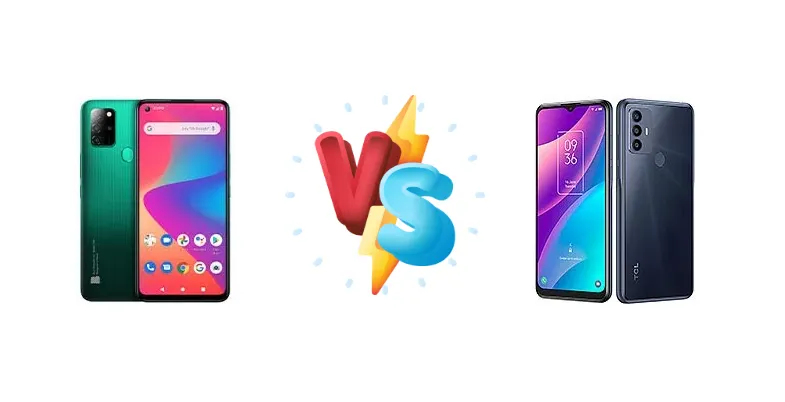
The BLU G91 and TCL 30 SE represent the fiercely competitive sub-$200 smartphone market. Both aim to deliver essential smartphone functionality at an accessible price, but they take different approaches to achieving this. The G91 relies on a standard octa-core processor, while the 30 SE utilizes MediaTek’s Helio G25 chipset, promising a slight edge in graphics performance. This comparison will dissect their key differences to help you determine which device best suits your needs.
🏆 Quick Verdict
For the average user prioritizing a slightly smoother experience and faster charging, the TCL 30 SE is the better choice. Its Helio G25 chipset, with its higher clocked cores, offers a noticeable performance uplift over the BLU G91’s Cortex-A53 processor, and the 15W charging is a welcome addition for those on the go.
| Network |
|---|
| 2G bands | GSM 850 / 900 / 1800 / 1900 | GSM 850 / 900 / 1800 / 1900 |
| 3G bands | HSDPA 850 / 900 / 1700(AWS) / 1900 / 2100 | HSDPA 850 / 900 / 1900 / 2100 - EMEA/APAC |
| 4G bands | 1, 2, 3, 4, 5, 7, 12, 17, 28 | 1, 3, 5, 7, 8, 20, 28, 38, 40, 41 - EMEA |
| Speed | HSPA 42.2/11.5 Mbps, LTE Cat4 150/50 Mbps | HSPA 42.2/11.5 Mbps, LTE Cat4 150/50 Mbps |
| Technology | GSM / HSPA / LTE | GSM / HSPA / LTE |
| | - | 2, 3, 4, 5, 7, 8, 12, 13, 17, 26, 28, 66 - LATAM |
| Launch |
|---|
| Announced | 2021, February 24. Released 2021, February 24 | 2022, February 27 |
| Status | Discontinued | Available. Released 2022, April 20 |
| Body |
|---|
| Build | - | Glass front, plastic frame, plastic back |
| Dimensions | 163 x 76 x 9 mm (6.42 x 2.99 x 0.35 in) | 165.2 x 75.5 x 8.9 mm (6.50 x 2.97 x 0.35 in) |
| SIM | Nano-SIM + Nano-SIM | · Nano-SIM· Nano-SIM + Nano-SIM |
| Weight | 196 g (6.91 oz) | 190 g (6.70 oz) |
| Display |
|---|
| Resolution | 720 x 1600 pixels, 20:9 ratio (~270 ppi density) | 720 x 1600 pixels, 20:9 ratio (~269 ppi density) |
| Size | 6.5 inches, 102.0 cm2 (~82.3% screen-to-body ratio) | 6.52 inches, 102.6 cm2 (~82.3% screen-to-body ratio) |
| Type | IPS LCD | IPS LCD, 450 nits (typ) |
| Platform |
|---|
| CPU | Octa-core 1.8 GHz Cortex-A53 | Octa-core (4x2.0 GHz Cortex-A53 & 4x1.5 GHz Cortex-A53) |
| Chipset | - | Mediatek MT6762G Helio G25 (12 nm) |
| GPU | - | PowerVR GE8320 |
| OS | Android 10 | Android 12, TCL UI 4.0 |
| Memory |
|---|
| Card slot | microSDXC (dedicated slot) | microSDXC (dedicated slot) |
| Internal | 128GB 4GB RAM | 64GB 4GB RAM, 128GB 4GB RAM |
| | - | eMMC 5.1 |
| Main Camera |
|---|
| Features | LED flash | LED flash, HDR, panorama |
| Quad | 16 MP, (wide), AF
5 MP, (ultrawide)
2 MP (macro)
Auxiliary lens | - |
| Single | 16 MP | 8 MP, f/2.0, 26mm (wide), 1/4", 1.12µm |
| Triple | - | 50 MP, f/1.9, 28mm (wide), 1/2.76", 0.64µm, PDAF
2 MP (macro)
Auxiliary lens |
| Video | 1080p@30fps | 1080p@30fps |
| Selfie camera |
|---|
| Features | - | HDR |
| Single | 16 MP | 8 MP, f/2.0, 26mm (wide), 1/4.0", 1.12µm |
| Video | 1080p@30fps | 1080p@30fps |
| Sound |
|---|
| 3.5mm jack | Yes | Yes |
| 35mm jack | Yes | Yes |
| Loudspeaker | Yes | Yes |
| Comms |
|---|
| Bluetooth | 4.0, A2DP | 5.0, A2DP, LE |
| NFC | No | Yes (6165H/6165H1 only) |
| Positioning | GPS | GPS, GLONASS, GALILEO, BDS |
| Radio | FM radio | Unspecified |
| USB | USB Type-C 2.0 | USB Type-C 2.0 |
| WLAN | Wi-Fi 802.11 a/b/g/n, Wi-Fi Direct | Wi-Fi 802.11 b/g/n, Wi-Fi Direct |
| Features |
|---|
| Sensors | Fingerprint (rear-mounted), accelerometer, proximity | Fingerprint (rear-mounted), accelerometer, proximity, compass |
| Battery |
|---|
| Charging | 10W wired | 15W wired |
| Type | Li-Po 5000 mAh | Li-Po 5000 mAh |
| Misc |
|---|
| Colors | Blue, Green, Twilight | Atlantic Blue, Space Gray, Glacial Blue |
| Models | - | 6165H, 6156H1, 6165A, 6165A1, 6165S |
| Price | About 150 EUR | - |
BLU G91
- Potentially lower price point.
- Simple and straightforward user experience.
- Reliable for basic smartphone functions.
- Slower processor performance.
- Slower 10W charging.
- Likely less refined software experience.
TCL 30 SE
- Faster MediaTek Helio G25 processor.
- Faster 15W wired charging.
- Potentially better image processing.
- May be slightly more expensive.
- MediaTek chipsets sometimes have less consistent software updates.
- Still an entry-level device with limitations.
Display Comparison
Neither device boasts a standout display. Given the price point, details like panel type and resolution are not provided. However, the focus should be on usability. Both will likely feature 720p+ displays, adequate for everyday use. The absence of information regarding refresh rates suggests both are standard 60Hz panels. Bezels are expected to be noticeable on both devices, contributing to a larger overall footprint.
Camera Comparison
Without detailed sensor information, a direct camera comparison is difficult. Both phones likely feature a primary camera paired with auxiliary lenses of limited utility. The absence of Optical Image Stabilization (OIS) on either device suggests image quality will be heavily reliant on software processing. Users should expect acceptable results in well-lit conditions, but performance will degrade significantly in low light. Focusing on the chipset’s image signal processor (ISP) capabilities, the Helio G25 in the TCL 30 SE likely offers slightly better image processing than the BLU G91’s ISP, potentially resulting in more detailed and vibrant photos.
Performance
The TCL 30 SE’s MediaTek Helio G25 chipset is the key differentiator here. While both phones utilize Cortex-A53 cores, the G25 features a split configuration – four cores clocked at 2.0 GHz and four at 1.5 GHz – compared to the BLU G91’s uniform 1.8 GHz octa-core setup. This higher clock speed on the primary cores of the G25 translates to snappier app launches and smoother multitasking. The G25’s 12nm process node also offers a slight efficiency advantage. While neither chipset is a powerhouse, the TCL 30 SE will demonstrably outperform the BLU G91 in CPU-intensive tasks and light gaming.
Battery Life
Battery capacity is not specified for either device, but both will likely fall in the 4000-5000 mAh range, typical for this price segment. The TCL 30 SE’s 15W wired charging is a significant advantage over the BLU G91’s 10W charging. This translates to a faster 0-100% charge time, reducing downtime. While a larger battery capacity on the BLU G91 could partially offset the slower charging, the convenience of the TCL 30 SE’s faster charging is a compelling benefit for users who rely heavily on their smartphones throughout the day.
Buying Guide
Buy the BLU G91 if you need a basic, functional smartphone for essential tasks like calls, texts, and light social media browsing, and are comfortable with slower charging speeds. Buy the TCL 30 SE if you prefer a phone capable of handling slightly more demanding apps and occasional gaming, and value the convenience of faster 15W wired charging. The TCL 30 SE is the better option for users who want a bit more future-proofing.
Frequently Asked Questions
❓ Will the TCL 30 SE handle popular games like PUBG Mobile or Call of Duty Mobile?
While the Helio G25 isn't a gaming powerhouse, the TCL 30 SE should be able to run PUBG Mobile and Call of Duty Mobile at lower graphics settings and frame rates. Expect playable performance, but don't anticipate a high-end gaming experience. The BLU G91 will struggle more with these titles.
❓ How long will it take to fully charge the BLU G91 with its 10W charger?
Given the likely battery capacity (4000-5000 mAh) and the 10W charging rate, a full charge from 0% to 100% on the BLU G91 will likely take between 3 to 4 hours. This is considerably slower than the TCL 30 SE’s 15W charging.
❓ Is the difference in processor speed between the BLU G91 and TCL 30 SE noticeable in everyday use?
Yes, the difference is noticeable. The TCL 30 SE’s Helio G25, with its higher clocked cores, will result in snappier app launches, smoother scrolling, and a more responsive overall user experience compared to the BLU G91. This is especially apparent when multitasking.