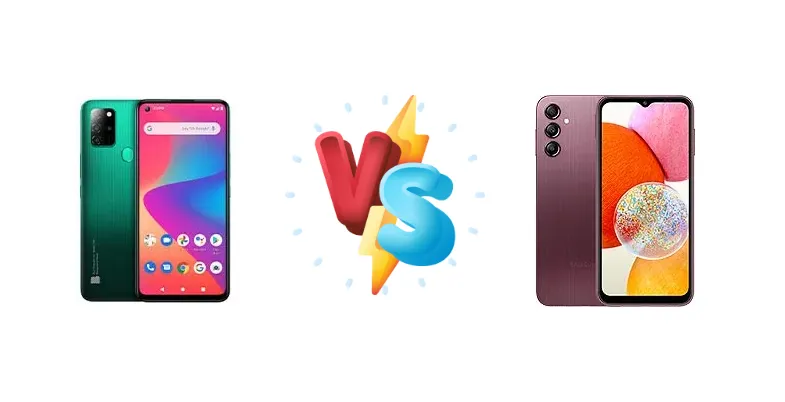
The sub-$200 smartphone market is fiercely competitive. The BLU G91 and Samsung Galaxy A14 both aim to deliver essential smartphone functionality at an accessible price. However, they take different approaches: the BLU G91 prioritizes affordability, while the Samsung Galaxy A14 offers a more powerful chipset, albeit with potential variations in its implementation.
🏆 Quick Verdict
For most users, the Samsung Galaxy A14 is the better choice. Its Mediatek Helio G80 (or Exynos 850) chipset provides a significantly more responsive experience for everyday tasks and light gaming, justifying the slightly higher price. The BLU G91 remains a viable option for those on the absolute tightest budget.
| Network |
|---|
| 2G bands | GSM 850 / 900 / 1800 / 1900 | GSM 850 / 900 / 1800 / 1900 |
| 3G bands | HSDPA 850 / 900 / 1700(AWS) / 1900 / 2100 | HSDPA 850 / 900 / 2100 |
| 4G bands | 1, 2, 3, 4, 5, 7, 12, 17, 28 | 1, 3, 5, 7, 8, 20, 28, 38, 40, 41 |
| Speed | HSPA 42.2/11.5 Mbps, LTE Cat4 150/50 Mbps | HSPA, LTE |
| Technology | GSM / HSPA / LTE | GSM / HSPA / LTE |
| Launch |
|---|
| Announced | 2021, February 24. Released 2021, February 24 | 2023, February 28 |
| Status | Discontinued | Available. Released 2023, March 27 |
| Body |
|---|
| Build | - | Glass front, plastic back, plastic frame |
| Dimensions | 163 x 76 x 9 mm (6.42 x 2.99 x 0.35 in) | 167.7 x 78 x 9.1 mm (6.60 x 3.07 x 0.36 in) |
| SIM | Nano-SIM + Nano-SIM | · Nano-SIM· Nano-SIM + Nano-SIM |
| Weight | 196 g (6.91 oz) | 201 g (7.09 oz) |
| Display |
|---|
| Resolution | 720 x 1600 pixels, 20:9 ratio (~270 ppi density) | 1080 x 2408 pixels, 20:9 ratio (~400 ppi density) |
| Size | 6.5 inches, 102.0 cm2 (~82.3% screen-to-body ratio) | 6.6 inches, 104.9 cm2 (~80.2% screen-to-body ratio) |
| Type | IPS LCD | PLS LCD |
| Platform |
|---|
| CPU | Octa-core 1.8 GHz Cortex-A53 | Octa-core (2x2.0 GHz Cortex-A75 & 6x1.8 GHz Cortex-A55) - Version AOcta-core (4x2.0 GHz Cortex-A55 & 4x2.0 GHz Cortex-A55) - Version B |
| Chipset | - | Mediatek MT6769 Helio G80 (12 nm) - Version AExynos 850 (8 nm) - Version B |
| GPU | - | Mali-G52 MC2 |
| OS | Android 10 | Android 13, upgradable to Android 15, One UI 7 |
| Memory |
|---|
| Card slot | microSDXC (dedicated slot) | microSDXC (dedicated slot) |
| Internal | 128GB 4GB RAM | 64GB 4GB RAM, 128GB 4GB RAM, 128GB 6GB RAM |
| Main Camera |
|---|
| Features | LED flash | LED flash, panorama, HDR |
| Quad | 16 MP, (wide), AF
5 MP, (ultrawide)
2 MP (macro)
Auxiliary lens | - |
| Single | 16 MP | 13 MP, f/2.0, (wide) |
| Triple | - | 50 MP, f/1.8, 26mm (wide), 1/2.75", 0.64µm, PDAF
5 MP, f/2.2, 17mm (ultrawide), 1/5.0", 1.12µm
2 MP (macro) |
| Video | 1080p@30fps | 1080p@30fps |
| Selfie camera |
|---|
| Single | 16 MP | 13 MP, f/2.0, 26mm (wide), 1/3.1", 1.12µm |
| Video | 1080p@30fps | 1080p@30fps |
| Sound |
|---|
| 3.5mm jack | Yes | Yes |
| 35mm jack | Yes | Yes |
| Loudspeaker | Yes | Yes |
| Comms |
|---|
| Bluetooth | 4.0, A2DP | 5.1 or 5.3, A2DP, LE |
| NFC | No | Yes (market/region dependent) |
| Positioning | GPS | GPS, GALILEO, GLONASS, BDS, QZSS |
| Radio | FM radio | Unspecified |
| USB | USB Type-C 2.0 | USB Type-C 2.0 |
| WLAN | Wi-Fi 802.11 a/b/g/n, Wi-Fi Direct | Wi-Fi 802.11 a/b/g/n/ac, dual-band, Wi-Fi Direct |
| Features |
|---|
| Sensors | Fingerprint (rear-mounted), accelerometer, proximity | Fingerprint (side-mounted), accelerometer, proximity, compass |
| Battery |
|---|
| Charging | 10W wired | 15W wired |
| Type | Li-Po 5000 mAh | Li-Po 5000 mAh |
| Misc |
|---|
| Colors | Blue, Green, Twilight | Black, Dark Red, Silver, Green |
| Models | - | SM-A145F, SM-A145F/DSN, SM-A145M, SM-A145M/DS, SM-A145P, SM-A145R |
| Price | About 150 EUR | € 85.76 / $ 147.60 / £ 79.95 |
| SAR EU | - | 0.46 W/kg (head) 1.37 W/kg (body) |
BLU G91
- Most affordable option
- Functional for basic tasks
- Simple and straightforward software experience
- Slow performance
- Limited multitasking capabilities
- Subpar camera performance
Samsung Galaxy A14
- Significantly better performance
- More efficient chipset for longer battery life
- Faster charging (15W)
- Higher price point
- Potential for software bloat (Samsung)
- Camera quality still limited by sensor size
Display Comparison
Neither device boasts a standout display. Both likely utilize LCD panels, common in this price bracket. The lack of specified resolution or refresh rate suggests both are 720p at 60Hz. The key difference lies in processing power impacting UI smoothness, not display quality. Bezels are expected to be substantial on both, and color accuracy will likely be standard for budget phones.
Camera Comparison
Camera performance will be limited on both devices. The absence of detailed sensor information suggests both rely on basic sensors. While the Galaxy A14 may have a higher megapixel count on its main sensor, image quality will be heavily reliant on Samsung’s image processing algorithms. The BLU G91’s camera is likely to struggle in low-light conditions. The presence of a 2MP macro camera on the A14 is largely a marketing gimmick, offering minimal practical benefit. Focusing on the main sensor’s performance is key, and the A14’s more powerful ISP (Image Signal Processor) within the Helio G80/Exynos 850 will likely yield better results.
Performance
The Samsung Galaxy A14’s chipset is the defining factor. The Mediatek Helio G80 (Version A) is built on a 12nm process and features a combination of Cortex-A75 and A55 cores, offering a substantial performance uplift over the BLU G91’s Octa-core 1.8 GHz Cortex-A53. The Exynos 850 (Version B), built on an 8nm process, further improves efficiency and performance. The A75 cores in the Helio G80 provide a noticeable boost in single-core performance, crucial for app launch times and general responsiveness. The BLU G91’s Cortex-A53 cores are older and less efficient, resulting in slower performance and potential lag during multitasking. While RAM amounts aren't specified, the chipset difference will be the primary bottleneck for the BLU G91.
Battery Life
Battery life is a complex equation. While mAh isn't specified for either device, the Samsung Galaxy A14’s more efficient chipset (Helio G80/Exynos 850) will likely translate to longer real-world usage despite potentially having a similar battery capacity. The A14’s 15W charging is slightly faster than the BLU G91’s 10W charging, reducing the time to fully recharge. However, neither offers particularly fast charging speeds, so expect several hours for a full charge.
Buying Guide
Buy the BLU G91 if you need a functional smartphone for basic communication – calls, texts, and light social media – and your budget is strictly limited. You're willing to accept slower performance and limited multitasking capabilities. Buy the Samsung Galaxy A14 if you prioritize a smoother user experience, occasional gaming, and a more future-proofed device, and are willing to spend a bit more for those benefits.
Frequently Asked Questions
❓ Does the Samsung Galaxy A14's Exynos 850 chip overheat during prolonged gaming sessions?
The Exynos 850 is an 8nm chip, offering better thermal efficiency than the BLU G91's Cortex-A53. While it won't deliver flagship-level gaming performance, it's unlikely to overheat significantly during moderate gaming. Expect some throttling after extended periods, but it should remain playable.
❓ Is the 2MP macro camera on the Samsung Galaxy A14 worth using?
Generally, 2MP macro cameras on budget phones offer limited practical benefit. The low resolution results in images lacking detail. It's best to rely on the main sensor for most photography, and consider the macro lens a novelty feature rather than a core component of the camera system.
❓ Will the BLU G91 struggle with popular apps like Facebook and WhatsApp?
The BLU G91's older Cortex-A53 processor and limited RAM will likely result in slower app launch times and occasional lag when using apps like Facebook and WhatsApp, especially with multiple apps open simultaneously. It's functional, but not ideal for heavy multitasking.
❓ What version of Android does each phone ship with, and what is the update policy?
While not specified, the Samsung Galaxy A14 likely ships with a more recent version of Android and benefits from Samsung's generally better software update policy compared to BLU. BLU devices often receive limited or no software updates, meaning the G91 may become outdated faster.