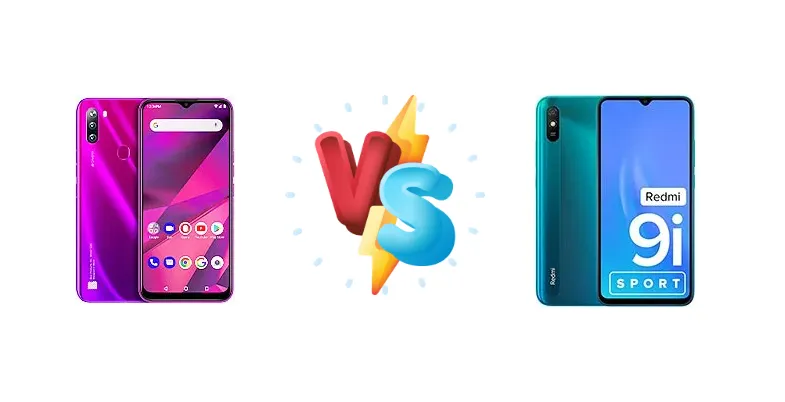
The BLU G90 and Xiaomi Redmi 9i Sport represent the fiercely competitive sub-$150 smartphone market. Both devices aim to deliver essential smartphone functionality at an incredibly accessible price point. This comparison dissects their core components to determine which offers the best balance of performance, features, and value for budget-conscious consumers.
🏆 Quick Verdict
For most users, the Xiaomi Redmi 9i Sport emerges as the slightly better choice. Its Helio G25 chipset, with a higher clocked CPU, provides a noticeable performance edge in everyday tasks and light gaming, justifying the often minimal price difference. However, the BLU G90 remains a viable option for those prioritizing a specific aesthetic or availability.
| Network |
|---|
| 2G bands | GSM 850 / 900 / 1800 / 1900 | GSM 850 / 900 / 1800 / 1900 |
| 3G bands | HSDPA 850 / 900 / 1700(AWS) / 1900 / 2100 | HSDPA 850 / 900 / 2100 |
| 4G bands | 1, 2, 3, 4, 5, 7, 8, 12, 13, 17, 28 | 1, 3, 5, 8, 40, 41 |
| Speed | HSPA 42.2/5.76 Mbps, LTE (2CA) Cat6 300/50 Mbps | HSPA, LTE |
| Technology | GSM / HSPA / LTE | GSM / HSPA / LTE |
| Launch |
|---|
| Announced | 2020, June 24. Released 2020, June 24 | 2021, September 28 |
| Status | Discontinued | Available. Released 2021, September 28 |
| Body |
|---|
| Dimensions | 164.6 x 76.5 x 8.8 mm (6.48 x 3.01 x 0.35 in) | 164.9 x 77.1 x 9 mm (6.49 x 3.04 x 0.35 in) |
| SIM | Nano-SIM + Nano-SIM | Nano-SIM + Nano-SIM |
| Weight | 185 g (6.53 oz) | 194 g (6.84 oz) |
| | - | Water-repellent coating |
| Display |
|---|
| Resolution | 720 x 1600 pixels, 20:9 ratio (~270 ppi density) | 720 x 1600 pixels, 20:9 ratio (~269 ppi density) |
| Size | 6.5 inches, 102.0 cm2 (~81.0% screen-to-body ratio) | 6.53 inches, 102.9 cm2 (~81.0% screen-to-body ratio) |
| Type | IPS LCD | IPS LCD, 400 nits (typ) |
| Platform |
|---|
| CPU | Octa-core (4x1.8 GHz Cortex-A53 & 4x1.5 GHz Cortex-A53) | Octa-core (4x2.0 GHz Cortex-A53 & 4x1.5 GHz Cortex-A53) |
| Chipset | Mediatek MT6762D Helio A25 (12 nm) | Mediatek MT6762G Helio G25 (12 nm) |
| GPU | PowerVR GE8320 | PowerVR GE8320 |
| OS | Android 10 | Android 10, MIUI 12 |
| Memory |
|---|
| Card slot | microSDXC | microSDXC (dedicated slot) |
| Internal | 64GB 4GB RAM | 64GB 4GB RAM, 128GB 4GB RAM |
| | eMMC 5.1 | eMMC 5.1 |
| Main Camera |
|---|
| Features | LED flash, panorama, HDR | LED flash, HDR |
| Single | - | 13 MP, f/2.2, 28mm (wide), 1.0µm, PDAF |
| Triple | 16 MP, f/2.0, (wide), 1/3.06", 1.0µm, PDAF
8 MP, f/2.2, (ultrawide), 1/4.0", 1.12µm
Auxiliary lens | - |
| Video | 1080p@30fps | 1080p@30fps |
| Selfie camera |
|---|
| Features | - | HDR |
| Single | 13 MP, f/2.0 | 5 MP, f/2.2, (wide), 1.12µm |
| Video | 1080p@30fps | 1080p@30fps |
| Sound |
|---|
| 3.5mm jack | Yes | Yes |
| 35mm jack | Yes | Yes |
| Loudspeaker | Yes | Yes |
| Comms |
|---|
| Bluetooth | 4.1, A2DP, LE | 5.0, A2DP, LE |
| NFC | No | No |
| Positioning | GPS | GPS, GLONASS, BDS |
| Radio | FM radio | FM radio |
| USB | USB Type-C 2.0, OTG | microUSB 2.0, OTG |
| WLAN | Wi-Fi 802.11 a/b/g/n, Wi-Fi Direct | Wi-Fi 802.11 а/b/g/n, Wi-Fi Direct |
| Features |
|---|
| Sensors | Fingerprint (rear-mounted), accelerometer, proximity | Accelerometer, proximity, compass |
| Battery |
|---|
| Charging | 10W wired | 10W wired |
| Type | Li-Po 4000 mAh | Li-Po 5000 mAh |
| Misc |
|---|
| Colors | Black, White, Magenta, Blue | Carbon Black, Coral Green, Metallic Blue |
| Price | About 120 EUR | About 100 EUR |
BLU G90
- Potentially wider regional availability.
- BLU's software customization options.
- Competitive price point.
- Slightly slower processor than the Redmi 9i Sport.
- Likely less frequent software updates.
Xiaomi Redmi 9i Sport
- Faster processor (Helio G25) for improved performance.
- Xiaomi's established brand reputation and ecosystem.
- Potentially more frequent software updates.
- May have limited availability in certain regions.
- Xiaomi's MIUI software can be resource-intensive.
Display Comparison
Neither device boasts a standout display. Both utilize standard LCD panels, and detailed specifications like resolution and brightness are not provided. However, given the price point, users should expect 720p resolution and moderate brightness levels. The focus here isn't on visual fidelity, but rather on basic usability. Bezels are likely to be substantial on both models, maximizing screen real estate within a compact form factor.
Camera Comparison
Camera performance is expected to be similar on both devices, relying on basic image sensors and software processing. Detailed sensor information is unavailable, but it's safe to assume both feature a primary camera and potentially a depth sensor. The lack of Optical Image Stabilization (OIS) on either device means low-light photography will be challenging. Users should manage expectations and focus on capturing images in well-lit conditions. The inclusion of a 2MP macro camera on either device is largely a marketing tactic, offering limited practical benefit due to the low resolution.
Performance
The core difference lies in the chipset: the BLU G90 features the Mediatek MT6762D Helio A25, while the Redmi 9i Sport utilizes the MT6762G Helio G25. While both are 12nm chips with an octa-core configuration (4x1.8 GHz Cortex-A53 & 4x1.5 GHz Cortex-A53 for the G90, and 4x2.0 GHz Cortex-A53 & 4x1.5 GHz Cortex-A53 for the G25), the G25’s higher CPU clock speed (2.0 GHz vs 1.8 GHz) translates to a tangible performance boost. This is particularly noticeable when launching apps or switching between them. The G25 also includes a slightly more capable GPU, offering a smoother experience in less demanding mobile games. Both phones will struggle with graphically intensive titles, but the Redmi 9i Sport will likely maintain a more playable framerate.
Battery Life
Both phones feature 10W wired charging, indicating similar charging speeds. While battery capacity isn't specified, typical capacities for phones in this price range are around 5000mAh. Therefore, both devices should comfortably last a full day with moderate usage. The slower charging speed means a full charge will take several hours, making overnight charging the most practical option. The efficiency of the Helio G25 in the Redmi 9i Sport might slightly offset the potential difference in battery capacity, leading to comparable real-world battery life.
Buying Guide
Buy the BLU G90 if you need a readily available device in specific regions where Xiaomi's presence is limited, or if you prefer BLU's software customization. Buy the Xiaomi Redmi 9i Sport if you prioritize slightly better performance for multitasking and gaming, and appreciate Xiaomi's established ecosystem and generally more frequent software updates within this price bracket.
Frequently Asked Questions
❓ Will the Redmi 9i Sport handle popular games like PUBG Mobile?
While the Redmi 9i Sport can *run* PUBG Mobile, expect to play at the lowest graphics settings and potentially experience frame drops. The Helio G25 is not a gaming-focused chipset, and demanding titles will push it to its limits. The BLU G90 will perform similarly, or slightly worse.
❓ How reliable are software updates for the BLU G90?
BLU is not known for providing consistent or long-term software support. Users should expect limited updates, primarily security patches. The Xiaomi Redmi 9i Sport, while still a budget device, generally receives more frequent updates within Xiaomi's ecosystem.
❓ Is the difference in CPU clock speed between the Helio A25 and G25 really noticeable in everyday use?
Yes, the 200MHz clock speed difference, combined with the G25's slightly improved GPU, translates to a smoother experience when launching apps, multitasking, and browsing the web. It won't be a dramatic difference, but it's perceptible, especially when pushing the phones with multiple tasks.