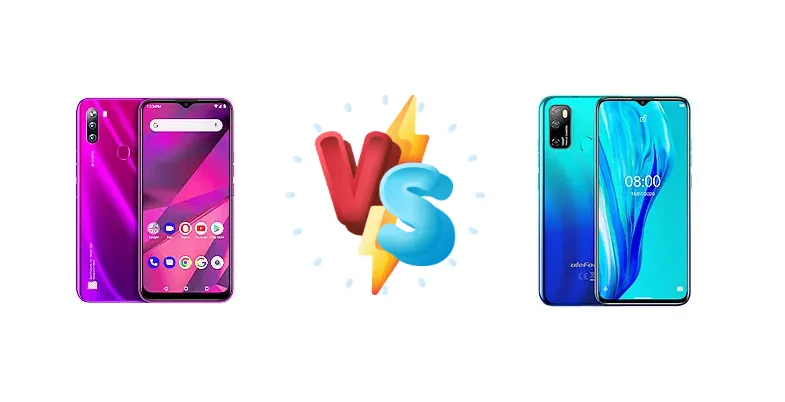
The BLU G90 and Ulefone Note 9P represent the fiercely competitive sub-$150 smartphone market. Both devices rely on Mediatek’s Helio series of chipsets, but subtle differences in their processing power and features can significantly impact the user experience. This comparison dissects these nuances to help you determine which phone delivers the best value.
🏆 Quick Verdict
For the average user prioritizing basic functionality and occasional social media browsing, the Ulefone Note 9P offers a slight edge due to its reverse wired charging capability. However, the BLU G90’s Helio A25 chipset provides a marginal performance advantage in CPU-intensive tasks, making it a better choice for light gaming.
| Network |
|---|
| 2G bands | GSM 850 / 900 / 1800 / 1900 | GSM 850 / 900 / 1800 / 1900 |
| 3G bands | HSDPA 850 / 900 / 1700(AWS) / 1900 / 2100 | HSDPA 850 / 900 / 1700(AWS) / 1900 / 2100 |
| 4G bands | 1, 2, 3, 4, 5, 7, 8, 12, 13, 17, 28 | 1, 2, 3, 4, 5, 7, 8, 12, 17, 19, 20, 28 |
| Speed | HSPA 42.2/5.76 Mbps, LTE (2CA) Cat6 300/50 Mbps | HSPA 42.2/11.5 Mbps, LTE Cat7 300/150 Mbps |
| Technology | GSM / HSPA / LTE | GSM / HSPA / LTE |
| Launch |
|---|
| Announced | 2020, June 24. Released 2020, June 24 | 2020, July 27. Released 2020, July 27 |
| Status | Discontinued | Discontinued |
| Body |
|---|
| Dimensions | 164.6 x 76.5 x 8.8 mm (6.48 x 3.01 x 0.35 in) | 166 x 76.7 x 9.2 mm (6.54 x 3.02 x 0.36 in) |
| SIM | Nano-SIM + Nano-SIM | Nano-SIM + Nano-SIM |
| Weight | 185 g (6.53 oz) | 188 g (6.63 oz) |
| Display |
|---|
| Resolution | 720 x 1600 pixels, 20:9 ratio (~270 ppi density) | 720 x 1600 pixels, 20:9 ratio (~269 ppi density) |
| Size | 6.5 inches, 102.0 cm2 (~81.0% screen-to-body ratio) | 6.52 inches, 102.6 cm2 (~80.6% screen-to-body ratio) |
| Type | IPS LCD | IPS LCD |
| Platform |
|---|
| CPU | Octa-core (4x1.8 GHz Cortex-A53 & 4x1.5 GHz Cortex-A53) | Octa-core (4x1.8 GHz & 4x1.5 GHz) |
| Chipset | Mediatek MT6762D Helio A25 (12 nm) | Mediatek MT6762 Helio P22 (12 nm) |
| GPU | PowerVR GE8320 | PowerVR GE8320 |
| OS | Android 10 | Android 10 |
| Memory |
|---|
| Card slot | microSDXC | microSDXC (dedicated slot) |
| Internal | 64GB 4GB RAM | 64GB 4GB RAM |
| | eMMC 5.1 | eMMC 5.1 |
| Main Camera |
|---|
| Features | LED flash, panorama, HDR | Dual-LED flash, HDR |
| Triple | 16 MP, f/2.0, (wide), 1/3.06", 1.0µm, PDAF
8 MP, f/2.2, (ultrawide), 1/4.0", 1.12µm
Auxiliary lens | 16 MP, f/2.2, AF
5 MP (macro)
Auxiliary lens |
| Video | 1080p@30fps | 1080p@30fps |
| Selfie camera |
|---|
| Single | 13 MP, f/2.0 | 8 MP, f/2.2 |
| Video | 1080p@30fps | 720p@30fps |
| Sound |
|---|
| 3.5mm jack | Yes | Yes |
| 35mm jack | Yes | Yes |
| Loudspeaker | Yes | Yes |
| Comms |
|---|
| Bluetooth | 4.1, A2DP, LE | 5.0, A2DP, LE |
| NFC | No | No |
| Positioning | GPS | GPS, GLONASS, GALILEO, BDS |
| Radio | FM radio | Stereo FM radio, RDS, recording |
| USB | USB Type-C 2.0, OTG | USB Type-C 2.0, OTG |
| WLAN | Wi-Fi 802.11 a/b/g/n, Wi-Fi Direct | Wi-Fi 802.11 a/b/g/n/ac, dual-band, Wi-Fi Direct |
| Features |
|---|
| Sensors | Fingerprint (rear-mounted), accelerometer, proximity | Fingerprint (rear-mounted), accelerometer, proximity, compass |
| Battery |
|---|
| Charging | 10W wired | 10W wired
Reverse wired |
| Type | Li-Po 4000 mAh | Li-Po 4500 mAh |
| Misc |
|---|
| Colors | Black, White, Magenta, Blue | Aurora Blue, Midnight Green, Black |
| Price | About 120 EUR | About 120 EUR |
| SAR | - | 0.29 W/kg (head) 1.01 W/kg (body) |
BLU G90
- Slightly better CPU performance with Helio A25
- Potentially smoother performance in CPU-intensive tasks
- Competitive price point
- Lacks reverse wired charging
- Limited camera capabilities
- Basic display specifications
Ulefone Note 9P
- Convenient reverse wired charging
- Slightly better GPU performance (potentially)
- Competitive price point
- Marginally lower CPU performance
- Limited camera capabilities
- Basic display specifications
Display Comparison
Neither BLU nor Ulefone provide detailed display specifications beyond the basic panel type. Given the price point, both likely utilize IPS LCD panels. The absence of information regarding brightness nits, color gamut coverage, or refresh rates suggests a focus on cost reduction. Bezels are expected to be substantial on both devices, typical for this segment. Color accuracy is unlikely to be a strong point on either phone, making them suitable for casual viewing but not color-critical work.
Camera Comparison
Camera details are sparse for both phones. It’s safe to assume both feature a primary camera and potentially a depth sensor. The absence of information regarding sensor size or aperture suggests both will perform poorly in low-light conditions. The Ulefone Note 9P’s inclusion of reverse wired charging suggests a slightly more robust power management system, which *could* translate to marginally better image processing, but this is speculative. Avoid expecting high-quality photos from either device; they are adequate for basic social media sharing.
Performance
The core difference lies in the chipsets: the BLU G90 features the Mediatek MT6762D Helio A25, while the Ulefone Note 9P uses the MT6762 Helio P22. Both are 12nm chips with octa-core CPUs, but the A25’s Cortex-A53 cores are clocked slightly higher (4x1.8 GHz vs 4x1.8 GHz on the P22). This translates to a marginal CPU performance advantage for the G90 in benchmarks. However, the P22 often benefits from slightly better GPU performance, potentially offering a smoother experience in less demanding games. Both phones will struggle with graphically intensive titles. RAM configurations are not specified, but expect 2-3GB, which will limit multitasking capabilities on both devices.
Battery Life
Both phones feature 10W wired charging, indicating similar charging speeds – expect around 3-4 hours for a full charge. The Ulefone Note 9P distinguishes itself with reverse wired charging, a feature absent on the BLU G90. This allows the Note 9P to act as a power bank for other devices, a useful feature for users who frequently travel or rely on accessories. Battery capacity is not specified, but typical capacities for this price range are 3000-4000mAh, offering all-day battery life with moderate usage.
Buying Guide
Buy the BLU G90 if you need a phone for basic tasks with a slight performance boost for light gaming and app usage. It’s ideal for users who don’t require advanced features. Buy the Ulefone Note 9P if you value the convenience of reverse wired charging – allowing you to top up accessories or even another phone – and prioritize a slightly more versatile feature set, even if it means a minor performance trade-off.
Frequently Asked Questions
❓ Will the Ulefone Note 9P's reverse charging work with wireless earbuds?
The Ulefone Note 9P utilizes standard USB wired charging for its reverse charging feature. Therefore, it will only work with devices that can be charged via a USB cable, and not directly with wireless earbuds or charging cases.
❓ Can the BLU G90 handle popular games like PUBG Mobile or Call of Duty?
While the BLU G90’s Helio A25 chipset can *run* PUBG Mobile and Call of Duty, expect very low graphics settings and potentially choppy frame rates. The phone’s limited RAM and processing power are not ideal for demanding games. It's best suited for less graphically intensive titles.
❓ How much storage space is available on each phone after the operating system is installed?
Neither BLU nor Ulefone specify the internal storage capacity. However, given the price point, expect around 16-32GB. After accounting for the Android operating system and pre-installed apps, usable storage will likely be limited to 8-16GB, necessitating the use of a microSD card.