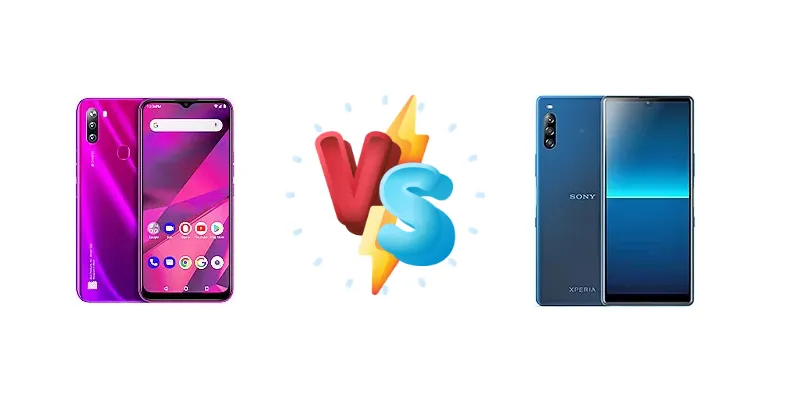
The BLU G90 and Sony Xperia L4 represent distinct approaches to the ultra-budget smartphone market. The BLU G90 aims for a balance of features at an aggressive price point, while the Sony Xperia L4 leverages the brand's imaging expertise and a more refined software experience, despite similar core hardware. This comparison dissects their specifications to determine which device offers the most compelling package.
🏆 Quick Verdict
For the average user prioritizing basic functionality and a slightly more responsive experience, the Sony Xperia L4 emerges as the better choice. Its Helio P22 chipset, clocked at 2.0 GHz, provides a noticeable performance edge over the BLU G90’s Helio A25, and the inclusion of USB Power Delivery offers greater charging flexibility.
| Network |
|---|
| 2G bands | GSM 850 / 900 / 1800 / 1900 | GSM 850 / 900 / 1800 / 1900 |
| 3G bands | HSDPA 850 / 900 / 1700(AWS) / 1900 / 2100 | HSDPA 850 / 900 / 1900 / 2100 |
| 4G bands | 1, 2, 3, 4, 5, 7, 8, 12, 13, 17, 28 | 1, 2, 3, 5, 7, 8, 20, 40 |
| Speed | HSPA 42.2/5.76 Mbps, LTE (2CA) Cat6 300/50 Mbps | HSPA 42.2/5.76 Mbps, LTE (2CA) Cat6 300/50 Mbps |
| Technology | GSM / HSPA / LTE | GSM / HSPA / LTE |
| Launch |
|---|
| Announced | 2020, June 24. Released 2020, June 24 | 2020, February 20. Released 2020, April 28 |
| Status | Discontinued | Discontinued |
| Body |
|---|
| Build | - | Glass front, plastic back, plastic frame |
| Dimensions | 164.6 x 76.5 x 8.8 mm (6.48 x 3.01 x 0.35 in) | 159 x 71 x 8.7 mm (6.26 x 2.80 x 0.34 in) |
| SIM | Nano-SIM + Nano-SIM | · Nano-SIM· Nano-SIM + Nano-SIM |
| Weight | 185 g (6.53 oz) | 178 g (6.28 oz) |
| Display |
|---|
| Resolution | 720 x 1600 pixels, 20:9 ratio (~270 ppi density) | 720 x 1680 pixels, 21:9 ratio (~295 ppi density) |
| Size | 6.5 inches, 102.0 cm2 (~81.0% screen-to-body ratio) | 6.2 inches, 89.8 cm2 (~79.5% screen-to-body ratio) |
| Type | IPS LCD | IPS LCD |
| Platform |
|---|
| CPU | Octa-core (4x1.8 GHz Cortex-A53 & 4x1.5 GHz Cortex-A53) | Octa-core 2.0 GHz Cortex-A53 |
| Chipset | Mediatek MT6762D Helio A25 (12 nm) | Mediatek MT6762 Helio P22 (12 nm) |
| GPU | PowerVR GE8320 | PowerVR GE8320 |
| OS | Android 10 | Android 9.0 (Pie) |
| Memory |
|---|
| Card slot | microSDXC | microSDXC (uses shared SIM slot) |
| Internal | 64GB 4GB RAM | 64GB 3GB RAM |
| | eMMC 5.1 | eMMC 5.1 |
| Main Camera |
|---|
| Features | LED flash, panorama, HDR | LED flash, HDR, panorama |
| Triple | 16 MP, f/2.0, (wide), 1/3.06", 1.0µm, PDAF
8 MP, f/2.2, (ultrawide), 1/4.0", 1.12µm
Auxiliary lens | 13 MP, f/2.0, 26mm (wide), 1/3.0", PDAF
5 MP, f/2.2, 17mm (ultrawide), 1/5.0", 1.12µm
Auxiliary lens |
| Video | 1080p@30fps | 1080p@30fps |
| Selfie camera |
|---|
| Single | 13 MP, f/2.0 | 8 MP, f/2.0, 27mm (wide), 1/4.0", 1.12µm |
| Video | 1080p@30fps | 1080p@30fps |
| Sound |
|---|
| 3.5mm jack | Yes | Yes |
| 35mm jack | Yes | Yes |
| Loudspeaker | Yes | Yes |
| Comms |
|---|
| Bluetooth | 4.1, A2DP, LE | 5.0, A2DP, LE |
| NFC | No | Yes |
| Positioning | GPS | GPS, GLONASS |
| Radio | FM radio | FM radio |
| USB | USB Type-C 2.0, OTG | USB Type-C 2.0 |
| WLAN | Wi-Fi 802.11 a/b/g/n, Wi-Fi Direct | Wi-Fi 802.11 a/b/g/n, dual-band, Wi-Fi Direct |
| Features |
|---|
| Sensors | Fingerprint (rear-mounted), accelerometer, proximity | Fingerprint (side-mounted), accelerometer, proximity, compass |
| Battery |
|---|
| Charging | 10W wired | USB Power Delivery |
| Type | Li-Po 4000 mAh | Li-Ion 3580 mAh |
| Misc |
|---|
| Colors | Black, White, Magenta, Blue | Black, Blue |
| Models | - | XQ-AD52, XQ-AD51 |
| Price | About 120 EUR | About 200 EUR |
BLU G90
- Potentially larger display size for media consumption.
- Aggressive pricing makes it highly accessible.
- May offer longer battery life if equipped with a larger capacity battery.
- Slower processor (Helio A25) impacts performance.
- Limited 10W charging is significantly slower.
- Likely less refined software experience.
Sony Xperia L4
- Faster processor (Helio P22) for smoother performance.
- USB Power Delivery enables faster and more versatile charging.
- Sony’s image processing offers potentially better camera quality.
- May be slightly more expensive than the BLU G90.
- Potentially smaller display size.
- Battery life could be compromised by faster charging and potentially smaller capacity.
Display Comparison
Neither device boasts a standout display. Both utilize 12nm chipsets, suggesting similar power constraints impacting display capabilities. While specific panel technologies aren't specified, the focus is on affordability. The BLU G90 likely prioritizes size, while the Xperia L4 may offer slightly better color calibration, consistent with Sony’s brand reputation. Expect both to be adequate for everyday use but lacking in brightness and color accuracy compared to higher-end devices.
Camera Comparison
Camera performance is difficult to assess without detailed sensor information. However, given the price points, both phones likely employ basic camera setups. Sony’s image processing algorithms generally offer a more refined look, even with similar hardware. The Xperia L4 benefits from Sony’s expertise in image signal processing, potentially resulting in better dynamic range and color accuracy. The BLU G90 may rely on more aggressive post-processing to compensate for potentially lower-quality sensors. It's reasonable to assume both phones will struggle in low-light conditions.
Performance
The core difference lies in the chipsets. The Sony Xperia L4’s Mediatek Helio P22, with its 2.0 GHz Cortex-A53 cores, offers a clear advantage over the BLU G90’s Helio A25 (1.8 GHz & 1.5 GHz Cortex-A53). The higher clock speed translates to snappier app launches and smoother multitasking. While both utilize the same architecture, the P22’s frequency boost is significant. The impact is most noticeable in demanding applications and light gaming. Neither phone is a gaming powerhouse, but the Xperia L4 will handle casual titles more comfortably. Both devices likely feature similar RAM configurations, further emphasizing the chipset as the primary performance differentiator.
Battery Life
Battery capacity isn’t specified for either device, making a direct comparison challenging. However, the Sony Xperia L4’s inclusion of USB Power Delivery is a significant advantage. This allows for faster charging with compatible chargers and greater flexibility in charging options. The BLU G90 is limited to 10W wired charging, which will result in considerably longer charge times. While a larger battery capacity on the G90 could offset the slower charging, the convenience and speed of USB Power Delivery on the Xperia L4 are compelling.
Buying Guide
Buy the BLU G90 if you need maximum screen real estate on a very tight budget and are willing to accept slightly slower performance. It’s ideal for users primarily focused on media consumption and basic communication. Buy the Sony Xperia L4 if you prefer a more polished user experience, slightly faster performance for everyday tasks, and the convenience of USB Power Delivery for charging, even if it means a potentially higher upfront cost.
Frequently Asked Questions
❓ Will the Sony Xperia L4’s Helio P22 handle popular social media apps like TikTok and Instagram smoothly?
Yes, the Helio P22’s 2.0 GHz clock speed is sufficient to run social media apps like TikTok and Instagram without significant lag. While it won’t offer a flagship-level experience, it will provide a usable and reasonably smooth experience for everyday social media browsing and content creation.
❓ How long will it take to fully charge the BLU G90 with its 10W charging?
With 10W charging, expect the BLU G90 to take approximately 3-4 hours to fully charge from 0% to 100%, depending on the battery capacity. This is considerably slower than the Sony Xperia L4’s USB Power Delivery charging, which can significantly reduce charging times with a compatible charger.
❓ Is the difference in performance between the Helio A25 and Helio P22 noticeable in everyday tasks like browsing and messaging?
Yes, the difference is noticeable. The Helio P22’s higher clock speed results in snappier app launches and smoother multitasking. While both chips can handle basic tasks, the Xperia L4 will feel more responsive and less prone to lag during everyday use.
❓ Does the Sony Xperia L4 support fast charging with any specific USB Power Delivery standard?
While the Xperia L4 supports USB Power Delivery, the specific wattage supported isn't explicitly stated. It likely supports a standard PD profile, allowing for faster charging with compatible chargers, but it won't be on par with the fastest charging speeds found in flagship devices.