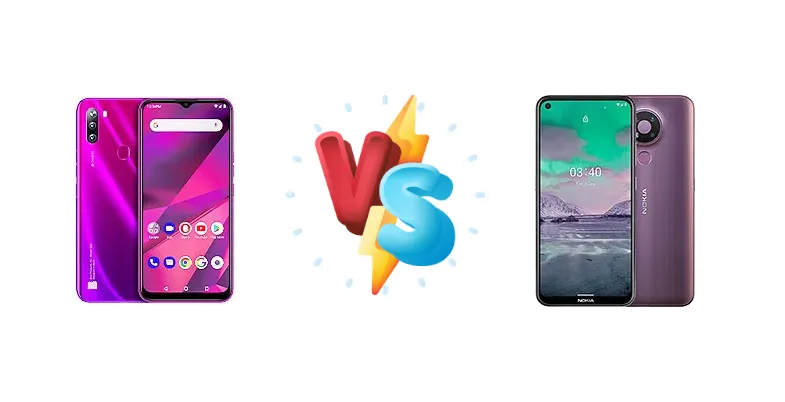
The BLU G90 and Nokia 3.4 represent two compelling options in the ultra-budget smartphone space. While both aim to deliver essential smartphone functionality at a low price point, they diverge significantly in their core hardware. This comparison dissects the differences between the MediaTek Helio A25-powered BLU G90 and the Qualcomm Snapdragon 460-equipped Nokia 3.4, focusing on real-world performance implications.
🏆 Quick Verdict
For the average user prioritizing responsiveness and a smoother overall experience, the Nokia 3.4 emerges as the better choice. The Snapdragon 460’s Cortex-A73 cores provide a noticeable performance uplift over the Helio A25’s all-Cortex-A53 configuration, making everyday tasks feel snappier. Both phones share the same slow 10W charging, but the Nokia 3.4’s chipset offers a more future-proof foundation.
| Network |
|---|
| 2G bands | GSM 850 / 900 / 1800 / 1900 | GSM 850 / 900 / 1800 / 1900 |
| 3G bands | HSDPA 850 / 900 / 1700(AWS) / 1900 / 2100 | HSDPA 850 / 900 / 1700(AWS) / 1900 / 2100 |
| 4G bands | 1, 2, 3, 4, 5, 7, 8, 12, 13, 17, 28 | 1, 2, 3, 4, 5, 7, 8, 12, 17, 13, 28, 66 |
| Speed | HSPA 42.2/5.76 Mbps, LTE (2CA) Cat6 300/50 Mbps | HSPA, LTE |
| Technology | GSM / HSPA / LTE | GSM / HSPA / LTE |
| Launch |
|---|
| Announced | 2020, June 24. Released 2020, June 24 | 2020, September 22. Released 2020, October 26 |
| Status | Discontinued | Discontinued |
| Body |
|---|
| Dimensions | 164.6 x 76.5 x 8.8 mm (6.48 x 3.01 x 0.35 in) | 161 x 76 x 8.7 mm (6.34 x 2.99 x 0.34 in) |
| SIM | Nano-SIM + Nano-SIM | · Nano-SIM· Nano-SIM + Nano-SIM |
| Weight | 185 g (6.53 oz) | 180 g (6.35 oz) |
| Display |
|---|
| Resolution | 720 x 1600 pixels, 20:9 ratio (~270 ppi density) | 720 x 1560 pixels, 19.5:9 ratio (~269 ppi density) |
| Size | 6.5 inches, 102.0 cm2 (~81.0% screen-to-body ratio) | 6.39 inches, 100.2 cm2 (~81.9% screen-to-body ratio) |
| Type | IPS LCD | IPS LCD, 400 nits (typ) |
| Platform |
|---|
| CPU | Octa-core (4x1.8 GHz Cortex-A53 & 4x1.5 GHz Cortex-A53) | Octa-core (4x1.8 GHz Cortex-A73 & 4x1.8 GHz Cortex-A53) |
| Chipset | Mediatek MT6762D Helio A25 (12 nm) | Qualcomm SM4250 Snapdragon 460 (11 nm) |
| GPU | PowerVR GE8320 | Adreno 610 |
| OS | Android 10 | Android 10, upgradable to Android 11 |
| Memory |
|---|
| Card slot | microSDXC | microSDXC (dedicated slot) |
| Internal | 64GB 4GB RAM | 32GB 3GB RAM, 64GB 3GB RAM, 64GB 4GB RAM |
| | eMMC 5.1 | eMMC 5.1 |
| Main Camera |
|---|
| Features | LED flash, panorama, HDR | LED flash, HDR, panorama |
| Triple | 16 MP, f/2.0, (wide), 1/3.06", 1.0µm, PDAF
8 MP, f/2.2, (ultrawide), 1/4.0", 1.12µm
Auxiliary lens | 13 MP, (wide), PDAF
5 MP, (ultrawide)
Auxiliary lens |
| Video | 1080p@30fps | 1080p@30fps |
| Selfie camera |
|---|
| Single | 13 MP, f/2.0 | 8 MP, (wide) |
| Video | 1080p@30fps | 1080p@30fps |
| Sound |
|---|
| 3.5mm jack | Yes | Yes |
| 35mm jack | Yes | Yes |
| Loudspeaker | Yes | Yes |
| Comms |
|---|
| Bluetooth | 4.1, A2DP, LE | 4.2, A2DP, aptX |
| NFC | No | Yes (market/region dependent) |
| Positioning | GPS | GPS, GLONASS, GALILEO, BDS |
| Radio | FM radio | FM radio |
| USB | USB Type-C 2.0, OTG | USB Type-C 2.0 |
| WLAN | Wi-Fi 802.11 a/b/g/n, Wi-Fi Direct | Wi-Fi 802.11 b/g/n |
| Features |
|---|
| Sensors | Fingerprint (rear-mounted), accelerometer, proximity | Fingerprint (rear-mounted), accelerometer, gyro, proximity |
| Battery |
|---|
| Charging | 10W wired | 10W wired |
| Type | Li-Po 4000 mAh | Li-Po 4000 mAh |
| Misc |
|---|
| Colors | Black, White, Magenta, Blue | Fjord, Dusk, Charcoal |
| Models | - | TA-1288, TA-1285, TA-1283 |
| Price | About 120 EUR | About 100 EUR |
| SAR | - | 0.83 W/kg (head) 1.05 W/kg (body) |
| SAR EU | - | 0.36 W/kg (head) 1.56 W/kg (body) |
BLU G90
- Potentially lower price point
- Functional for basic smartphone tasks
- Acceptable for users with minimal demands
- Significantly slower performance
- Less efficient chipset
- Likely inferior camera image quality
Nokia 3.4
- Superior performance with Cortex-A73 cores
- More efficient Snapdragon 460 chipset
- Better image processing capabilities
- Stronger brand reputation for software updates
- May be slightly more expensive
- Still limited by 10W charging
- Budget camera system
Display Comparison
Neither BLU nor Nokia provide detailed display specifications beyond resolution. However, the core difference lies beneath the surface. Display quality will likely be similar, but the chipset’s ability to efficiently drive the display differs. The Snapdragon 460’s superior GPU will likely result in smoother scrolling and transitions, even if both displays share similar panel technology and resolution. Expect both to be adequate for basic viewing, but not exceptional.
Camera Comparison
Without detailed camera sensor information, a direct comparison is difficult. However, both phones likely feature budget-oriented camera setups. The image signal processor (ISP) within the Snapdragon 460 generally offers superior image processing capabilities compared to the Helio A25’s ISP. This means the Nokia 3.4 is likely to produce more detailed and vibrant photos, particularly in challenging lighting conditions. Expect both to struggle with low-light photography, but the Nokia 3.4 should have a slight edge. The presence of any OIS (Optical Image Stabilization) would be a significant advantage, but is unlikely on either device.
Performance
The performance gap is the most significant differentiator. The Nokia 3.4’s Qualcomm Snapdragon 460 utilizes four Cortex-A73 cores clocked at 1.8 GHz alongside four Cortex-A53 cores, all built on an 11nm process. This contrasts with the BLU G90’s MediaTek Helio A25, which employs eight Cortex-A53 cores, all clocked at varying speeds (1.8 GHz and 1.5 GHz), fabricated on a 12nm process. The A73 cores in the Snapdragon 460 offer substantially higher single-core performance, translating to faster app launch times and a more fluid user interface. The 11nm process also contributes to better power efficiency. While both are octa-core, the architectural difference is crucial; the Nokia 3.4 will handle multitasking and more demanding apps with greater ease.
Battery Life
Both the BLU G90 and Nokia 3.4 are equipped with 10W wired charging, a significant drawback in today’s fast-charging landscape. Neither phone will charge quickly. Battery life will depend heavily on usage patterns, but the Snapdragon 460’s improved power efficiency could translate to slightly longer battery life for the Nokia 3.4, despite potentially having similar battery capacities. Expect a full charge to take well over two hours in both cases.
Buying Guide
Buy the BLU G90 if your primary need is a functional smartphone for very basic tasks like calls, texts, and light social media, and you are operating on an extremely tight budget. Buy the Nokia 3.4 if you value a more responsive user experience, occasional light gaming, and a chipset from a more established manufacturer known for software support and optimization. The Nokia 3.4 is the better all-rounder.
Frequently Asked Questions
❓ Will the Nokia 3.4 handle popular social media apps like TikTok and Instagram smoothly?
Yes, the Snapdragon 460’s Cortex-A73 cores provide enough processing power to run social media apps like TikTok and Instagram with reasonable smoothness. While it won’t offer a flagship-level experience, it will be significantly more responsive than the BLU G90, which may exhibit noticeable lag when switching between apps or scrolling through feeds.
❓ Is the 10W charging on either phone a major drawback for daily use?
Yes, 10W charging is quite slow by today’s standards. Expect a full charge to take over two hours in most cases. Neither phone is ideal for users who need quick top-ups throughout the day. It’s best to charge them overnight.
❓ Can the Nokia 3.4 handle light gaming, such as casual puzzle games or older titles?
The Nokia 3.4 can handle light gaming reasonably well. The Snapdragon 460’s Adreno 610 GPU is capable of running less demanding games at playable frame rates. However, don’t expect to run graphically intensive titles like PUBG Mobile at high settings. The BLU G90 will struggle even more with gaming due to its weaker GPU.
❓ Which phone is likely to receive more software updates and security patches?
Nokia has a stronger track record of providing software updates and security patches for its smartphones, even in the budget segment. BLU, while offering affordable devices, typically provides less consistent software support. This means the Nokia 3.4 is likely to remain secure and functional for a longer period.