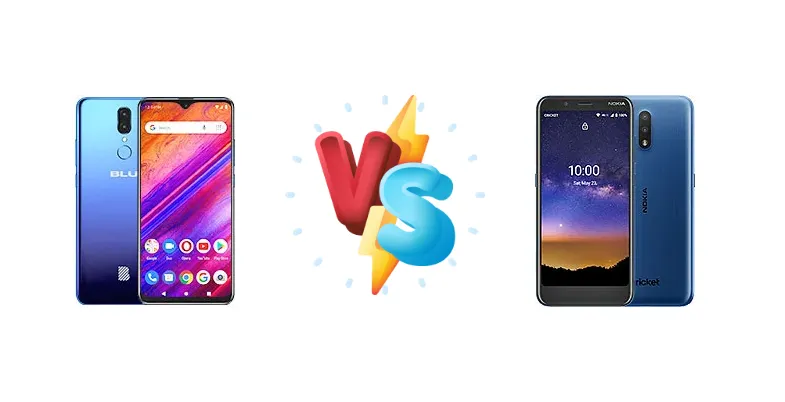
The BLU G9 and Nokia C2 Tava represent the ultra-budget end of the smartphone spectrum, targeting first-time buyers or those needing a reliable secondary device. While both aim for affordability, they differ significantly in their underlying hardware, particularly in their chipsets. This comparison dissects those differences to determine which phone delivers the best experience for the price.
🏆 Quick Verdict
For most users, the BLU G9 emerges as the better choice. Its Mediatek Helio P22 chipset, built on a smaller 12nm process, offers a noticeable performance advantage over the Nokia C2 Tava’s Helio A22, despite both featuring a 2.0 GHz clock speed. While the Nokia C2 Tava benefits from 10W charging, the G9’s superior processing power provides a smoother overall user experience.
| Network |
|---|
| 2G bands | GSM 850 / 900 / 1800 / 1900 | GSM 850 / 900 / 1800 / 1900 |
| 3G bands | HSDPA 850 / 1700(AWS) / 1900 | HSDPA 850 / 1700(AWS) / 1900 |
| 4G bands | 1, 2, 3, 4, 5, 7, 8, 12, 13, 17, 28 | LTE |
| Speed | HSPA 42.2/11.5 Mbps, LTE (2CA) Cat6 300/50 Mbps | HSPA 42.2/5.76 Mbps, LTE Cat6 300/50 Mbps |
| Technology | GSM / HSPA / LTE | GSM / HSPA / LTE |
| Launch |
|---|
| Announced | 2019, May. Released 2019, May | 2020, May 29. Released 2020, May 29 |
| Status | Discontinued | Discontinued |
| Body |
|---|
| Build | - | Glass front, plastic back, plastic frame |
| Dimensions | 155.4 x 71.8 x 8 mm (6.12 x 2.83 x 0.31 in) | 150.6 x 72.4 x 9.1 mm (5.93 x 2.85 x 0.36 in) |
| SIM | Nano-SIM + Micro-SIM | Nano-SIM |
| Weight | 165 g (5.82 oz) | 180 g (6.35 oz) |
| Display |
|---|
| Resolution | 720 x 1520 pixels, 19:9 ratio (~267 ppi density) | 720 x 1440 pixels, 18:9 ratio (~295 ppi density) |
| Size | 6.3 inches, 99.1 cm2 (~88.8% screen-to-body ratio) | 5.45 inches, 76.7 cm2 (~70.3% screen-to-body ratio) |
| Type | IPS LCD | IPS LCD |
| Platform |
|---|
| CPU | Octa-core 2.0 GHz Cortex-A53 | Quad-core 2.0 GHz Cortex-A53 |
| Chipset | Mediatek MT6762 Helio P22 (12 nm) | Mediatek MT6761 Helio A22 (16 nm) |
| GPU | PowerVR GE8320 | PowerVR GE8320 |
| OS | Android 9.0 (Pie) | Android 10 |
| Memory |
|---|
| Card slot | microSDXC | microSDXC |
| Internal | 64GB 4GB RAM | 16GB 2GB RAM, 32GB 2GB RAM |
| | eMMC 5.1 | eMMC 5.1 |
| Main Camera |
|---|
| Dual | 13 MP, f/2.0, 1/3.0", PDAF
Auxiliary lens | 8 MP, AF
2 MP |
| Features | LED flash | LED flash, HDR, panorama |
| Video | 1080p@30fps | 1080p@30fps |
| Selfie camera |
|---|
| Single | 13 MP, f/2.0, 1/3" | 5 MP |
| Video | 1080p@30fps | 720p@30fps |
| Sound |
|---|
| 3.5mm jack | Yes | Yes |
| 35mm jack | Yes | Yes |
| Loudspeaker | Yes | Yes |
| Comms |
|---|
| Bluetooth | 4.0, A2DP | 4.2, A2DP, LE |
| NFC | No | No |
| Positioning | GPS | GPS |
| Radio | FM radio | FM radio |
| USB | USB Type-C 2.0 | USB Type-C 2.0 |
| WLAN | Wi-Fi 802.11 a/b/g/n, Wi-Fi Direct | Wi-Fi 802.11 b/g/n |
| Features |
|---|
| Sensors | Fingerprint (rear-mounted), accelerometer, gyro, proximity, compass | Accelerometer, proximity |
| Battery |
|---|
| Charging | - | 10W wired |
| Stand-by | Up to 750 h (2G) / Up to 650 h (3G) | - |
| Talk time | Up to 30 h (2G) / Up to 24 h (3G) | - |
| Type | Li-Po 4000 mAh, non-removable | Li-Po 3000 mAh, removable |
| Misc |
|---|
| Colors | Black, Blue | Tempered Blue |
| Price | About 160 EUR | About 100 EUR |
BLU G9
- More powerful Mediatek Helio P22 chipset
- More efficient 12nm fabrication process
- Smoother multitasking experience
- Charging speed likely slower than Nokia C2 Tava
- Display specs are unknown, potentially basic
Nokia C2 Tava
- 10W wired charging for faster top-ups
- Potentially cleaner software experience (Nokia's Android)
- Lower price point (likely)
- Less powerful Mediatek Helio A22 chipset
- Less efficient 16nm fabrication process
- Limited multitasking capabilities
Display Comparison
Neither device boasts a standout display. Given the context data focuses on processing power, we can infer both likely utilize basic IPS LCD panels. The Nokia C2 Tava’s omission of display specs suggests a focus on cost reduction, potentially resulting in lower brightness and narrower viewing angles compared to the BLU G9, which, while not specified, benefits from being a slightly newer device and potentially a more refined panel. Bezels are likely substantial on both, typical of this price bracket.
Camera Comparison
Camera performance is likely similar on both devices, relying on software processing to enhance image quality. Without specific sensor details, it’s safe to assume both feature basic camera setups. The presence of a 2MP macro lens on either device is largely a marketing tactic, offering minimal practical benefit. Image quality will be acceptable for casual snapshots in good lighting conditions, but expect significant noise and lack of detail in low-light scenarios. The G9’s slightly more powerful ISP (Image Signal Processor) within the Helio P22 may offer a marginal improvement in image processing.
Performance
The core difference lies in the chipsets. The BLU G9’s Mediatek Helio P22 (12nm) is a more efficient and capable processor than the Nokia C2 Tava’s Helio A22 (16nm). The 12nm fabrication process allows for higher transistor density and lower power consumption for the same level of performance. While both CPUs feature an octa-core configuration clocked at 2.0 GHz Cortex-A53, the P22’s architecture and GPU are superior. The Helio A22’s quad-core design limits its multitasking capabilities, making the G9 noticeably smoother when switching between apps. The G9 will handle basic games better, while the C2 Tava may struggle with more demanding titles.
Battery Life
Battery capacity isn’t specified for either device, but given their target market, both likely house batteries in the 3000-4000 mAh range. The Nokia C2 Tava’s inclusion of 10W wired charging is a slight advantage, allowing for faster top-ups compared to the BLU G9, which likely relies on slower charging speeds. However, the Helio P22’s greater efficiency in the G9 could offset the slower charging, resulting in comparable real-world battery life despite potentially having a similar capacity.
Buying Guide
Buy the BLU G9 if you prioritize responsiveness and the ability to handle multiple apps or light gaming. Its more powerful chipset will translate to a less frustrating experience. Buy the Nokia C2 Tava if your primary needs are basic communication – calls, texts, and light social media – and you value a slightly more streamlined software experience often associated with Nokia’s Android builds, and the convenience of 10W charging.
Frequently Asked Questions
❓ Will the Nokia C2 Tava struggle with popular apps like Facebook or WhatsApp?
While the Nokia C2 Tava can run these apps, the Helio A22 chipset’s quad-core design and limited processing power may result in noticeable lag and slower loading times, especially when multitasking. Users primarily focused on these basic apps will be fine, but those expecting a fluid experience may find it frustrating.
❓ Is the BLU G9 a good choice for playing mobile games?
The BLU G9 is a better option for light gaming than the Nokia C2 Tava. The Helio P22’s GPU offers improved graphics performance, allowing for playable frame rates in less demanding titles. However, don’t expect to run graphically intensive games at high settings. It’s suitable for casual gaming, but not for serious mobile gamers.
❓ Does the Nokia C2 Tava receive regular software updates?
Nokia is generally known for providing relatively timely Android updates, even on their budget devices. However, the C2 Tava is an entry-level model, so the frequency and duration of updates may be limited compared to their higher-end phones. Expect at least one major Android version update, but don't count on long-term support.
❓ How much storage does each phone offer, and is it expandable?
Storage capacity isn't specified in the provided data. However, both phones likely come with 32GB of internal storage, which is standard for this price range. Expandable storage via microSD card is highly probable on both devices, allowing users to increase storage capacity for photos, videos, and other files.