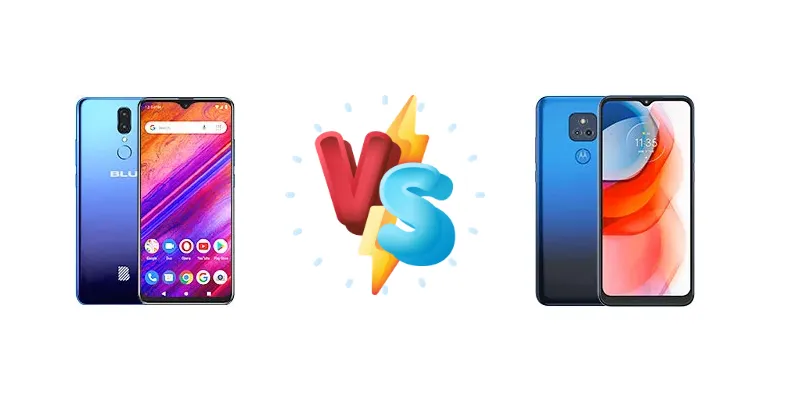
The sub-$150 smartphone market is fiercely competitive. Both the BLU G9 and the Motorola Moto G Play (2021) aim to deliver essential smartphone functionality at an accessible price. However, they take different approaches, primarily in their core processing power. This comparison dissects the architectural differences between the MediaTek Helio P22 and the Qualcomm Snapdragon 460 to determine which device offers the best user experience.
🏆 Quick Verdict
For the average user prioritizing responsiveness and future-proofing, the Motorola Moto G Play (2021) is the better choice. While the BLU G9 offers a slightly older design, the Snapdragon 460’s more efficient 11nm process and Kryo architecture provide a noticeable performance edge, especially in multitasking and sustained workloads.
| Network |
|---|
| 2G bands | GSM 850 / 900 / 1800 / 1900 | GSM 850 / 900 / 1800 / 1900 |
| 3G bands | HSDPA 850 / 1700(AWS) / 1900 | HSDPA 850 / 900 / 1700(AWS) / 1900 / 2100 |
| 4G bands | 1, 2, 3, 4, 5, 7, 8, 12, 13, 17, 28 | 1, 2, 3, 4, 5, 7, 8, 12, 13, 17, 25, 26, 38, 41, 66, 71 |
| Speed | HSPA 42.2/11.5 Mbps, LTE (2CA) Cat6 300/50 Mbps | HSPA, LTE |
| Technology | GSM / HSPA / LTE | GSM / CDMA / HSPA / LTE |
| | - | 2, 4, 5, 12, 14, 30, 66 |
| Launch |
|---|
| Announced | 2019, May. Released 2019, May | 2021, January 08 |
| Status | Discontinued | Available. Released 2021, January 14 |
| Body |
|---|
| Build | - | Plastic frame, plastic back |
| Dimensions | 155.4 x 71.8 x 8 mm (6.12 x 2.83 x 0.31 in) | 166.6 x 76 x 9.4 mm (6.56 x 2.99 x 0.37 in) |
| SIM | Nano-SIM + Micro-SIM | Nano-SIM |
| Weight | 165 g (5.82 oz) | 204 g (7.20 oz) |
| | - | Water-repellent coating |
| Display |
|---|
| Resolution | 720 x 1520 pixels, 19:9 ratio (~267 ppi density) | 720 x 1600 pixels, 20:9 ratio (~270 ppi density) |
| Size | 6.3 inches, 99.1 cm2 (~88.8% screen-to-body ratio) | 6.5 inches, 102.0 cm2 (~80.6% screen-to-body ratio) |
| Type | IPS LCD | IPS LCD |
| Platform |
|---|
| CPU | Octa-core 2.0 GHz Cortex-A53 | Octa-core (4x1.8 GHz Kryo 240 & 4x1.6 GHz Kryo 240) |
| Chipset | Mediatek MT6762 Helio P22 (12 nm) | Qualcomm SM4250 Snapdragon 460 (11 nm) |
| GPU | PowerVR GE8320 | Adreno 610 |
| OS | Android 9.0 (Pie) | Android 10 |
| Memory |
|---|
| Card slot | microSDXC | microSDXC (dedicated slot) |
| Internal | 64GB 4GB RAM | 32GB 3GB RAM |
| | eMMC 5.1 | eMMC 5.1 |
| Main Camera |
|---|
| Dual | 13 MP, f/2.0, 1/3.0", PDAF
Auxiliary lens | 13 MP, f/2.0, (wide), 1/3.1", 1.12µm, PDAF
Auxiliary lens |
| Features | LED flash | LED flash, HDR, panorama |
| Video | 1080p@30fps | 1080p@30/60fps |
| Selfie camera |
|---|
| Features | - | HDR |
| Single | 13 MP, f/2.0, 1/3" | 5 MP, f/2.2, (wide), 1.12µm |
| Video | 1080p@30fps | 1080p@30fps |
| Sound |
|---|
| 3.5mm jack | Yes | Yes |
| 35mm jack | Yes | Yes |
| Loudspeaker | Yes | Yes |
| Comms |
|---|
| Bluetooth | 4.0, A2DP | 5.0, A2DP, LE |
| NFC | No | No |
| Positioning | GPS | GPS, GLONASS, GALILEO |
| Radio | FM radio | Unspecified |
| USB | USB Type-C 2.0 | USB Type-C 2.0 |
| WLAN | Wi-Fi 802.11 a/b/g/n, Wi-Fi Direct | Wi-Fi 802.11 a/b/g/n/ac, dual-band, Wi-Fi Direct |
| Features |
|---|
| Sensors | Fingerprint (rear-mounted), accelerometer, gyro, proximity, compass | Fingerprint (rear-mounted), accelerometer, proximity |
| Battery |
|---|
| Charging | - | 10W wired |
| Stand-by | Up to 750 h (2G) / Up to 650 h (3G) | - |
| Talk time | Up to 30 h (2G) / Up to 24 h (3G) | - |
| Type | Li-Po 4000 mAh, non-removable | Li-Po 5000 mAh |
| Misc |
|---|
| Colors | Black, Blue | Misty Blue |
| Models | - | XT2093-3, XT2093-7, XT2093-DL, XT2093DL |
| Price | About 160 EUR | About 60 EUR |
BLU G9
- Potentially lower price point.
- Simple and straightforward user experience.
- May offer slightly more storage for the price (depending on configuration).
- Less efficient chipset (Helio P22).
- Slower performance in multitasking.
- Likely less refined image processing.
Motorola Moto G Play (2021)
- More efficient Snapdragon 460 chipset.
- Improved multitasking and app responsiveness.
- Better long-term performance and software support.
- Slower 10W charging.
- May be slightly more expensive.
- Potentially less storage for the price (depending on configuration).
Display Comparison
Neither device boasts a standout display. Given the context data focuses on chipsets, we can infer both likely utilize LCD panels common in this price bracket. The absence of specifications like resolution or refresh rate suggests neither is geared towards media consumption. Bezels are likely substantial on both, maximizing screen real estate within a budget-friendly form factor. Color accuracy will likely be standard for the segment, prioritizing power efficiency over color fidelity.
Camera Comparison
Without detailed camera specifications, a direct comparison is difficult. However, given the price point, both devices likely feature basic camera setups. The absence of mentions of OIS or large sensors suggests image quality will be adequate in good lighting conditions but struggle in low light. The focus will likely be on computational photography to enhance images, but the Helio P22’s image signal processor (ISP) is likely less capable than the Snapdragon 460’s, resulting in slightly less refined image processing. Any 2MP macro or depth sensors on either device should be considered marketing features rather than significant photographic tools.
Performance
The core difference lies in the chipsets. The Motorola Moto G Play (2021) features the Qualcomm Snapdragon 460, built on an 11nm process. This smaller node generally translates to improved power efficiency and thermal performance compared to the BLU G9’s MediaTek Helio P22 (12nm). The Snapdragon 460’s octa-core CPU, utilizing a dual-cluster configuration (4x1.8 GHz Kryo 240 & 4x1.6 GHz Kryo 240), is architecturally more sophisticated than the BLU G9’s homogenous octa-core 2.0 GHz Cortex-A53 setup. This means the Snapdragon 460 can dynamically allocate resources more effectively, leading to better multitasking and app launch speeds. While clock speed isn't everything, the architectural advantage and process node give the Snapdragon 460 a clear edge.
Battery Life
The Moto G Play (2021) includes 10W wired charging, a standard offering in this segment. While the mAh capacity isn't specified, the Snapdragon 460’s superior power efficiency will likely translate to longer battery life compared to the BLU G9, despite potentially having a similar battery size. The 11nm process allows the Moto G Play to accomplish more per watt, meaning less energy is consumed during typical usage. The 10W charging, while slow by modern standards, will still provide a reasonable charge overnight.
Buying Guide
Buy the BLU G9 if you need a basic smartphone for calls, texts, and light social media use, and are prioritizing the absolute lowest price point. Buy the Motorola Moto G Play (2021) if you prefer a smoother, more responsive experience, anticipate using multiple apps simultaneously, or want a device that will feel less dated over time. The Snapdragon 460 offers a tangible benefit for everyday tasks.
Frequently Asked Questions
❓ Will the Snapdragon 460 in the Moto G Play (2021) handle basic gaming like PUBG Mobile?
While not a gaming powerhouse, the Snapdragon 460 can handle PUBG Mobile at lower settings (balanced graphics, medium frame rate). Expect occasional frame drops during intense action, but it's playable. The Helio P22 in the BLU G9 will struggle more with consistent performance in demanding titles.
❓ Does the Motorola Moto G Play (2021) support software updates for security patches and Android versions?
Motorola typically provides at least one major Android update and several years of security patches for its G Play series. While not as extensive as Google Pixel or Samsung, it's generally better software support than you'd find on a BLU device, which often has limited or no updates.
❓ Is the 10W charging on the Moto G Play (2021) really that slow?
Yes, 10W charging is relatively slow compared to modern fast charging standards. Expect a full charge to take around 3-4 hours. However, given the likely smaller battery capacity and the Snapdragon 460's efficiency, you won't necessarily need to charge it every day.