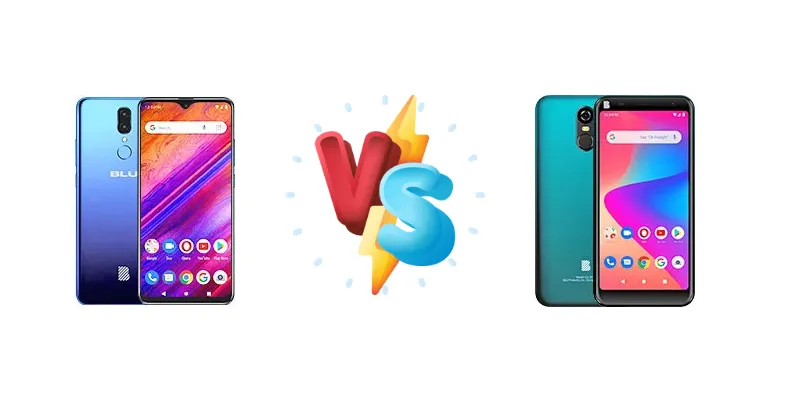
The BLU G9 and BLU C6 2020 represent distinct points in the budget smartphone landscape. The C6 2020 is an older, ultra-affordable option, while the G9 aims to offer a more modern experience with a newer chipset. This comparison dissects their core differences to determine which device provides the best value for users prioritizing performance and usability.
🏆 Quick Verdict
For most users, the BLU G9 is the superior choice. Its Mediatek Helio P22 chipset, with its octa-core CPU, provides a significantly smoother and more responsive experience than the BLU C6 2020’s quad-core Cortex-A7. While the C6 2020 may be cheaper, the G9’s performance uplift justifies the price difference for all but the most basic users.
| Network |
|---|
| 2G bands | GSM 850 / 900 / 1800 / 1900 | GSM 850 / 900 / 1800 / 1900 |
| 3G bands | HSDPA 850 / 1700(AWS) / 1900 | HSDPA 850 / 900 / 1900 / 2100 |
| 4G bands | 1, 2, 3, 4, 5, 7, 8, 12, 13, 17, 28 | - |
| Speed | HSPA 42.2/11.5 Mbps, LTE (2CA) Cat6 300/50 Mbps | HSPA 21.1/5.76 Mbps |
| Technology | GSM / HSPA / LTE | GSM / HSPA |
| Launch |
|---|
| Announced | 2019, May. Released 2019, May | 2020, October. Released 2020, October |
| Status | Discontinued | Discontinued |
| Body |
|---|
| Dimensions | 155.4 x 71.8 x 8 mm (6.12 x 2.83 x 0.31 in) | 160.7 x 78.4 x 10.3 mm (6.33 x 3.09 x 0.41 in) |
| SIM | Nano-SIM + Micro-SIM | Nano-SIM + Nano-SIM |
| Weight | 165 g (5.82 oz) | 230 g (8.11 oz) |
| Display |
|---|
| Resolution | 720 x 1520 pixels, 19:9 ratio (~267 ppi density) | 720 x 1440 pixels, 18:9 ratio (~268 ppi density) |
| Size | 6.3 inches, 99.1 cm2 (~88.8% screen-to-body ratio) | 6.0 inches, 92.9 cm2 (~73.7% screen-to-body ratio) |
| Type | IPS LCD | IPS LCD |
| Platform |
|---|
| CPU | Octa-core 2.0 GHz Cortex-A53 | Quad-core 1.3 GHz Cortex-A7 |
| Chipset | Mediatek MT6762 Helio P22 (12 nm) | - |
| GPU | PowerVR GE8320 | Mali-400 |
| OS | Android 9.0 (Pie) | Android 10 (Go edition) |
| Memory |
|---|
| Card slot | microSDXC | microSDXC |
| Internal | 64GB 4GB RAM | 16GB 1GB RAM |
| | eMMC 5.1 | eMMC 5.1 |
| Main Camera |
|---|
| Dual | 13 MP, f/2.0, 1/3.0", PDAF
Auxiliary lens | - |
| Features | LED flash | LED flash |
| Single | - | 8 MP, AF |
| Video | 1080p@30fps | 720p@30fps |
| Selfie camera |
|---|
| Single | 13 MP, f/2.0, 1/3" | 8 MP |
| Video | 1080p@30fps | 720p@30fps |
| Sound |
|---|
| 3.5mm jack | Yes | Yes |
| 35mm jack | Yes | Yes |
| Loudspeaker | Yes | Yes |
| Comms |
|---|
| Bluetooth | 4.0, A2DP | 4.1, A2DP |
| NFC | No | No |
| Positioning | GPS | GPS |
| Radio | FM radio | FM radio |
| USB | USB Type-C 2.0 | microUSB 2.0 |
| WLAN | Wi-Fi 802.11 a/b/g/n, Wi-Fi Direct | Wi-Fi 802.11 b/g/n, Wi-Fi Direct |
| Features |
|---|
| Sensors | Fingerprint (rear-mounted), accelerometer, gyro, proximity, compass | Fingerprint (rear-mounted), accelerometer, proximity |
| Battery |
|---|
| Stand-by | Up to 750 h (2G) / Up to 650 h (3G) | - |
| Talk time | Up to 30 h (2G) / Up to 24 h (3G) | - |
| Type | Li-Po 4000 mAh, non-removable | Li-Po 4000 mAh |
| Misc |
|---|
| Colors | Black, Blue | Red, Gradient Blue, Gradient Greena |
| Price | About 160 EUR | About 70 EUR |
BLU G9
- Significantly faster processor for smoother performance
- More modern chipset architecture for better multitasking
- Potentially improved power efficiency
- Price is higher than the BLU C6 2020
- Detailed specifications are limited
BLU C6 2020
- Lowest possible price point
- Simple and easy to use for basic tasks
- Acceptable for minimal smartphone usage
- Slow processor struggles with multitasking
- Outdated CPU architecture
- Limited future-proofing
Display Comparison
Detailed display specifications are unavailable for either device. However, given the market segment, both likely utilize LCD panels. The G9’s newer design likely benefits from slightly smaller bezels. Color accuracy is expected to be basic on both, prioritizing cost over fidelity. The absence of higher refresh rates is standard for this price point.
Camera Comparison
Camera details beyond sensor count are unavailable. Given the price points, image quality will be limited on both devices. The G9 *may* benefit from slightly improved image processing capabilities due to its newer chipset, but don't expect flagship-level results. Any 2MP macro or depth sensors on either device are likely to offer minimal practical benefit, serving primarily as marketing features.
Performance
The core difference lies in the chipset. The BLU G9’s Mediatek MT6762 Helio P22 (12nm) features an octa-core CPU clocked at 2.0 GHz, utilizing Cortex-A53 cores. This is a substantial upgrade over the BLU C6 2020’s quad-core 1.3 GHz Cortex-A7. The Helio P22’s architecture allows for better multitasking and smoother app launches. The 12nm process node also contributes to improved power efficiency compared to the older Cortex-A7. Users will experience noticeably faster performance in the G9, especially when running multiple apps or demanding applications.
Battery Life
Battery capacity is unspecified for both devices. However, the Helio P22’s 12nm process should contribute to better battery life on the G9 despite potentially having a similar capacity to the C6 2020. Charging wattage is also unknown, but both are likely to utilize standard 5W or 10W charging, resulting in relatively slow 0-100% charge times.
Buying Guide
Buy the BLU G9 if you need a phone capable of handling everyday tasks like social media, web browsing, and light gaming without significant lag. It’s ideal for users who want a more future-proof device. Buy the BLU C6 2020 if you prioritize absolute affordability and only need a phone for basic communication – calls, texts, and very light app usage. It’s best suited for first-time smartphone owners or as a temporary backup device.
Frequently Asked Questions
❓ Will the BLU G9 handle popular social media apps like Facebook and Instagram without lagging?
Yes, the BLU G9’s Mediatek Helio P22 chipset is significantly more capable than the BLU C6 2020’s processor. It should handle Facebook, Instagram, and similar apps smoothly, even with multiple apps open in the background.
❓ Is the BLU C6 2020 suitable for someone who primarily uses their phone for calls and texts?
Absolutely. The BLU C6 2020 is perfectly adequate for basic communication tasks like making calls and sending texts. Its limitations become apparent when attempting more demanding applications.
❓ Can the BLU G9 run mobile games like PUBG or Call of Duty?
While the BLU G9 can *run* these games, performance will be limited to the lowest graphics settings and potentially lower frame rates. It’s not designed for serious mobile gaming, but it can handle casual gaming sessions.
❓ What type of charging port do both phones use?
Both devices almost certainly use a Micro-USB port, which is standard for phones in this price range. Expect relatively slow charging speeds.