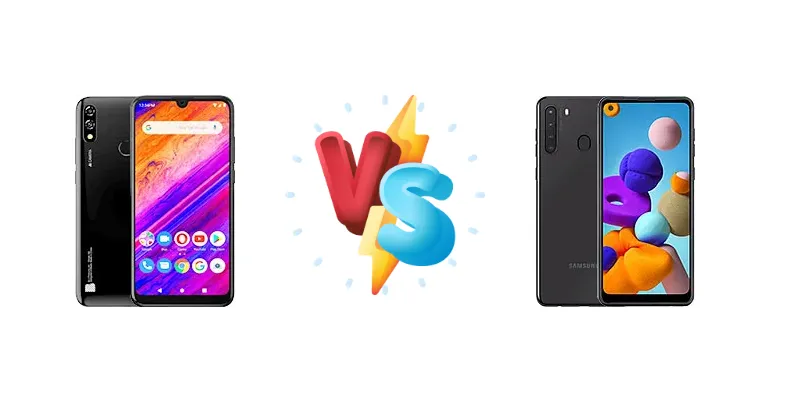
The BLU G8 and Samsung Galaxy A21 represent two approaches to the ultra-budget smartphone market. The BLU G8 aims for a streamlined experience, while the Samsung Galaxy A21 leverages Samsung's brand recognition and a slightly more powerful, though older, chipset. This comparison dissects their key differences to determine which offers the best value.
🏆 Quick Verdict
For the average user prioritizing raw processing power and a faster experience, the Samsung Galaxy A21 is the better choice. Its Mediatek Helio P35, with its faster Cortex-A53 cores, provides a noticeable performance edge over the BLU G8’s Cortex-A55. However, the BLU G8 may appeal to those seeking a simpler, potentially more streamlined software experience.
| Network |
|---|
| 2G bands | GSM 850 / 900 / 1800 / 1900 | GSM 850 / 900 / 1800 / 1900 |
| 3G bands | HSDPA 850 / 1700(AWS) / 1900 - G0170UU | HSDPA 850 / 900 / 1700(AWS) / 1900 / 2100 - USA |
| 4G bands | 1, 3, 4, 5, 7, 28 - G0170LL, G0170VV | 1, 2, 3, 4, 5, 7, 8, 12, 13, 17, 20, 25, 26, 28, 38, 39, 40, 41, 66, 71 - USA |
| Speed | HSPA 42.2/11.5 Mbps, LTE Cat4 150/50 Mbps | HSPA 42.2/5.76 Mbps, LTE Cat4 150/50 Mbps |
| Technology | GSM / HSPA / LTE | GSM / CDMA / HSPA / EVDO / LTE |
| | 2, 4, 5, 12, 17 - G0170UU | CDMA2000 1xEV-DO |
| Launch |
|---|
| Announced | 2019, July. Released 2019, July | 2020, April 08. Released 2020, June 26 |
| Status | Discontinued | Discontinued |
| Body |
|---|
| Build | - | Glass front, plastic back, plastic frame |
| Dimensions | 161.4 x 78 x 9.6 mm (6.35 x 3.07 x 0.38 in) | 167.8 x 76.7 x 8.1 mm (6.61 x 3.02 x 0.32 in) |
| SIM | Nano-SIM + Nano-SIM | · Nano-SIM· Nano-SIM + Nano-SIM |
| Weight | 181 g (6.38 oz) | 193 g (6.81 oz) |
| Display |
|---|
| Resolution | 720 x 1520 pixels, 19:9 ratio (~267 ppi density) | 720 x 1600 pixels, 20:9 ratio (~270 ppi density) |
| Size | 6.3 inches, 99.1 cm2 (~78.7% screen-to-body ratio) | 6.5 inches, 102.0 cm2 (~79.3% screen-to-body ratio) |
| Type | IPS LCD | IPS LCD |
| Platform |
|---|
| CPU | Octa-core 1.6 GHz Cortex-A55 | Octa-core (4x2.35 GHz Cortex-A53 & 4x1.8 GHz Cortex-A53) |
| Chipset | - | Mediatek MT6765 Helio P35 (12 nm) |
| GPU | IMG8322 | PowerVR GE8320 |
| OS | Android 9.0 (Pie) | Android 10, One UI 2.0 |
| Memory |
|---|
| Card slot | microSDXC | microSDXC (dedicated slot) |
| Internal | 64GB 3GB RAM | 32GB 3GB RAM |
| | - | eMMC 5.1 |
| Main Camera |
|---|
| Dual | 13 MP, AF
Auxiliary lens | - |
| Features | LED flash | LED flash, panorama, HDR |
| Quad | - | 16 MP, f/1.8, (wide), 1/3.06", 1.0µm, PDAF
8 MP, f/2.2, (ultrawide), 1/4.0", 1.12µm
2 MP (macro)
Auxiliary lens |
| Video | 1080p@30fps | 1080p@30fps |
| Selfie camera |
|---|
| Single | 13 MP | 13 MP, f/2.0, (wide), 1/3.1", 1.12µm |
| Video | 1080p@30fps | 1080p@30fps |
| Sound |
|---|
| 3.5mm jack | Yes | Yes |
| 35mm jack | Yes | Yes |
| Loudspeaker | Yes | Yes |
| Comms |
|---|
| Bluetooth | 4.1, A2DP | 5.0, A2DP, LE |
| NFC | No | Yes (market/region dependent) |
| Positioning | GPS | GPS, GLONASS, BDS |
| Radio | FM radio | FM radio |
| USB | microUSB 2.0 | USB Type-C 2.0 |
| WLAN | Wi-Fi 802.11 b/g/n, Wi-Fi Direct | Wi-Fi 802.11 a/b/g/n/ac, dual-band, Wi-Fi Direct |
| Features |
|---|
| Sensors | Fingerprint (rear-mounted), accelerometer, proximity | Fingerprint (rear-mounted), accelerometer, gyro, proximity, compass |
| Battery |
|---|
| Charging | - | 15W wired |
| Stand-by | Up to 750 h (2G) / Up to 650 h (3G) | - |
| Talk time | Up to 30 h (2G) / Up to 24 h (3G) | - |
| Type | Li-Po 4000 mAh, non-removable | Li-Po 4000 mAh |
| Misc |
|---|
| Colors | Black, Red, Blue | Black |
| Models | - | SM-A215U, SM-A215U1, SM-S215DL, SM-A215W |
| Price | - | $ 69.88 / C$ 155.00 / £ 54.99 / € 73.89 |
| SAR | - | 1.27 W/kg (head) 0.60 W/kg (body) |
BLU G8
- Potentially simpler software experience.
- May be more affordable than the A21.
- Compact form factor (speculation based on brand history)
- Less powerful processor (Cortex-A55 vs A53).
- Unknown display specifications.
- Likely limited software support.
Samsung Galaxy A21
- Faster processor (Mediatek Helio P35).
- 15W fast charging.
- Samsung’s software ecosystem and support.
- Older chipset architecture.
- Potential for bloatware.
- May be slightly more expensive.
Display Comparison
Neither device boasts a standout display. Specifications are missing for the BLU G8's display, but given its price point, it likely utilizes a standard IPS LCD panel. The Samsung Galaxy A21 also features an IPS LCD, but details regarding its peak brightness and color accuracy are unavailable. Both will likely offer adequate viewing angles but lack the vibrancy and high refresh rates found in higher-end devices. Bezels are expected to be substantial on both models, typical for this price bracket.
Camera Comparison
Camera performance is likely to be similar, leaning towards basic functionality on both devices. Details regarding sensor sizes and apertures are missing for both phones. However, given the market segment, expect 12MP or 13MP main sensors with limited low-light performance. The inclusion of a 2MP macro camera on the A21 is largely a marketing feature, offering minimal practical benefit due to its low resolution and fixed focus. Image processing will likely be more refined on the Samsung Galaxy A21, leveraging Samsung’s software expertise, but neither phone will compete with higher-end camera phones.
Performance
The performance gap is the most significant differentiator. The Samsung Galaxy A21’s Mediatek Helio P35, built on a 12nm process, features an octa-core configuration with four cores clocked at 2.35 GHz (Cortex-A53) and four at 1.8 GHz (Cortex-A53). This contrasts with the BLU G8’s octa-core 1.6 GHz Cortex-A55 processor. While both are octa-core, the A53 cores in the Helio P35 are architecturally more capable than the A55 cores in the BLU G8, resulting in faster application loading and smoother multitasking. The 12nm process of the Helio P35 also suggests potentially better power efficiency under load compared to an unknown process node for the BLU G8’s CPU.
Battery Life
Battery capacity is not specified for the BLU G8. The Samsung Galaxy A21 features a 15W wired charging capability. While the battery capacity isn’t exceptionally large, the 15W charging offers a faster replenishment rate than many competitors in this price range. Without knowing the BLU G8’s battery capacity, it’s difficult to definitively assess battery life, but the A21’s faster charging provides a tangible advantage for users who frequently need to top up their device.
Buying Guide
Buy the BLU G8 if you need a basic, functional smartphone for essential tasks like calls, texts, and light social media use, and prioritize simplicity. Buy the Samsung Galaxy A21 if you prefer a phone capable of handling more demanding apps, occasional gaming, and benefit from Samsung’s established software ecosystem and 15W fast charging.
Frequently Asked Questions
❓ Is the Mediatek Helio P35 in the Samsung Galaxy A21 prone to overheating during extended gaming sessions?
The Helio P35 is a relatively efficient chipset, but it's not a powerhouse. While it can handle casual gaming, prolonged sessions with graphically demanding titles may lead to some thermal throttling, resulting in reduced performance. It's unlikely to overheat to the point of being unusable, but expect some performance dips.
❓ How does the software experience differ between the BLU G8 and the Samsung Galaxy A21?
The Samsung Galaxy A21 runs Samsung’s One UI, which is feature-rich but can include pre-installed apps (bloatware). The BLU G8 likely runs a near-stock version of Android, offering a cleaner, more streamlined experience. However, this also means potentially less frequent software updates and fewer advanced features.
❓ Will the Samsung Galaxy A21’s 15W charging significantly reduce charging time compared to a standard 10W charger?
Yes, 15W charging will noticeably reduce charging time. While the exact difference depends on the battery’s current charge level, you can expect a 0-100% charge to be approximately 20-30% faster with a 15W charger compared to a standard 10W charger.