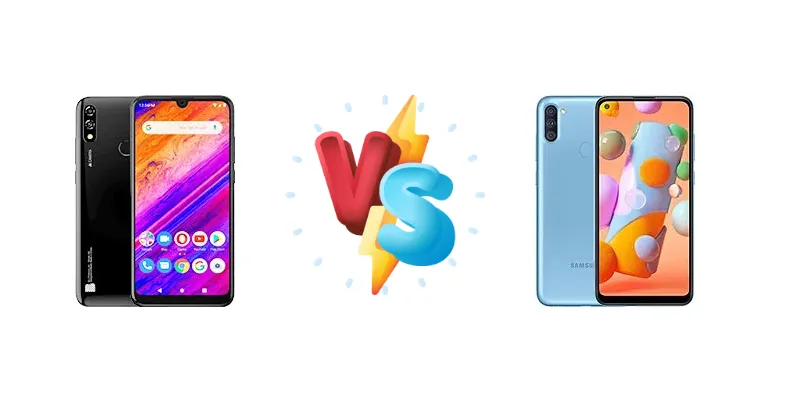
The BLU G8 and Samsung Galaxy A11 represent the lower end of the smartphone market, targeting users prioritizing affordability. However, even within this segment, key differences exist. The G8 relies on a MediaTek octa-core processor, while the A11 utilizes Qualcomm’s Snapdragon 450. This comparison dissects these differences to determine which device delivers the best experience for the price.
🏆 Quick Verdict
For the average user prioritizing consistent, if not blazing-fast, performance and reliable charging, the Samsung Galaxy A11 is the better choice. Its Snapdragon 450, despite being an older chipset, offers a more mature software ecosystem and 15W charging, providing a smoother overall experience than the BLU G8’s Cortex-A55.
| Network |
|---|
| 2G bands | GSM 850 / 900 / 1800 / 1900 | GSM 850 / 900 / 1800 / 1900 |
| 3G bands | HSDPA 850 / 1700(AWS) / 1900 - G0170UU | HSDPA 850 / 900 / 1900 / 2100 |
| 4G bands | 1, 3, 4, 5, 7, 28 - G0170LL, G0170VV | 1, 2, 3, 5, 7, 8, 20, 28, 38, 40, 41 |
| Speed | HSPA 42.2/11.5 Mbps, LTE Cat4 150/50 Mbps | HSPA 42.2/5.76 Mbps, LTE Cat4 150/50 Mbps |
| Technology | GSM / HSPA / LTE | GSM / HSPA / LTE |
| | 2, 4, 5, 12, 17 - G0170UU | 1, 2, 3, 4, 5, 7, 8, 12, 13, 17, 20, 25, 26, 28, 38, 39, 40, 41, 66, 71 - SM-A115U |
| Launch |
|---|
| Announced | 2019, July. Released 2019, July | 2020, March 13. Released 2020, May 01 |
| Status | Discontinued | Discontinued |
| Body |
|---|
| Build | - | Glass front, plastic back, plastic frame |
| Dimensions | 161.4 x 78 x 9.6 mm (6.35 x 3.07 x 0.38 in) | 161.4 x 76.3 x 8 mm (6.35 x 3.00 x 0.31 in) |
| SIM | Nano-SIM + Nano-SIM | · Nano-SIM· Nano-SIM + Nano-SIM |
| Weight | 181 g (6.38 oz) | 177 g (6.24 oz) |
| Display |
|---|
| Resolution | 720 x 1520 pixels, 19:9 ratio (~267 ppi density) | 720 x 1560 pixels, 19.5:9 ratio (~268 ppi density) |
| Size | 6.3 inches, 99.1 cm2 (~78.7% screen-to-body ratio) | 6.4 inches, 100.5 cm2 (~81.6% screen-to-body ratio) |
| Type | IPS LCD | PLS LCD |
| Platform |
|---|
| CPU | Octa-core 1.6 GHz Cortex-A55 | Octa-core 1.8 GHz Cortex-A53 |
| Chipset | - | Qualcomm SDM450 Snapdragon 450 (14 nm) |
| GPU | IMG8322 | Adreno 506 |
| OS | Android 9.0 (Pie) | Android 10, upgradable to Android 12, One UI Core 4.1 |
| Memory |
|---|
| Card slot | microSDXC | microSDXC (dedicated slot) |
| Internal | 64GB 3GB RAM | 32GB 2GB RAM, 32GB 3GB RAM, 64GB 3GB RAM, 64GB 4GB RAM |
| | - | eMMC 5.1 |
| Main Camera |
|---|
| Dual | 13 MP, AF
Auxiliary lens | - |
| Features | LED flash | LED flash, panorama, HDR |
| Triple | - | 13 MP, f/1.8, 27mm (wide), AF
5 MP, f/2.2, 115˚ (ultrawide)
Auxiliary lens |
| Video | 1080p@30fps | 1080p@30fps |
| Selfie camera |
|---|
| Single | 13 MP | 8 MP, f/2.0 |
| Video | 1080p@30fps | 1080p@30fps |
| Sound |
|---|
| 3.5mm jack | Yes | Yes |
| 35mm jack | Yes | Yes |
| Loudspeaker | Yes | Yes |
| Comms |
|---|
| Bluetooth | 4.1, A2DP | 4.2, A2DP, LE |
| NFC | No | No |
| Positioning | GPS | GPS, GLONASS, GALILEO, BDS |
| Radio | FM radio | FM radio |
| USB | microUSB 2.0 | USB Type-C 2.0 |
| WLAN | Wi-Fi 802.11 b/g/n, Wi-Fi Direct | Wi-Fi 802.11 b/g/n, Wi-Fi Direct |
| Features |
|---|
| Sensors | Fingerprint (rear-mounted), accelerometer, proximity | Fingerprint (rear-mounted), accelerometer, proximity |
| Battery |
|---|
| Charging | - | 15W wired |
| Stand-by | Up to 750 h (2G) / Up to 650 h (3G) | - |
| Talk time | Up to 30 h (2G) / Up to 24 h (3G) | - |
| Type | Li-Po 4000 mAh, non-removable | Li-Po 4000 mAh |
| Misc |
|---|
| Colors | Black, Red, Blue | Black, White, Blue, Red |
| Models | - | SM-A115F/DS, SM-A115F, SM-A115M, SM-A115M/DS, SM-A115U, SM-A115A, SM-A115AZ, SM-A115U1, SM-A115W, SM-A115AP, SM-S115DL |
| Price | - | About 160 EUR |
| SAR EU | - | 0.52 W/kg (head) 0.99 W/kg (body) |
BLU G8
- Potentially lower price point
- Octa-core processor for multitasking
- May offer expandable storage
- Less powerful processor than Snapdragon 450
- Likely slower charging speeds
- Potentially limited software support
Samsung Galaxy A11
- More efficient Snapdragon 450 chipset
- 15W fast charging
- Established brand with better software support
- Slightly higher price
- 720p+ display resolution
- Basic camera performance
Display Comparison
Neither device boasts a standout display. Specifications are missing for the BLU G8's display, but given its price point, it likely features a 720p LCD panel. The Galaxy A11 also utilizes a 720p+ LCD. The key difference lies in the processing power driving the display; the Snapdragon 450’s GPU will likely provide a slightly smoother scrolling experience, though both will struggle with demanding graphics. Bezels are expected to be substantial on both devices, typical of this price bracket.
Camera Comparison
Camera performance on both devices is expected to be basic. Without detailed sensor information for the BLU G8, it’s difficult to make a direct comparison. The Galaxy A11 typically features a 13MP main sensor, which, while not exceptional, will likely outperform any similarly-sized sensor paired with a less capable image signal processor (ISP) found in the G8. The prevalence of 2MP macro and depth sensors on both phones suggests limited utility; these are primarily for marketing purposes and offer minimal image quality improvement. Image processing will also favor the A11 due to Qualcomm’s more mature ISP.
Performance
The Samsung Galaxy A11’s Qualcomm Snapdragon 450 (14nm) holds a clear advantage over the BLU G8’s octa-core 1.6 GHz Cortex-A55. While both are octa-core, the Cortex-A53 cores in the Snapdragon 450 are architecturally more efficient and clocked higher at 1.8 GHz. The 14nm process node of the Snapdragon 450 also contributes to better thermal management, reducing the likelihood of performance throttling during sustained use. This translates to faster app loading times and a more responsive user experience on the A11, particularly noticeable when multitasking. The G8’s Cortex-A55 cores, while newer, are operating at a lower clock speed and lack the architectural refinements of the A53.
Battery Life
Battery capacity is not specified for the BLU G8, but given its market positioning, it’s likely comparable to the Galaxy A11’s 4000mAh cell. However, the A11’s 15W wired charging is a significant advantage. The G8 likely supports slower charging speeds, resulting in longer charge times. While both phones should provide all-day battery life with moderate use, the A11’s faster charging capability offers greater convenience and reduces downtime.
Buying Guide
Buy the BLU G8 if you need a phone for extremely basic tasks – calls, texts, and light social media – and are comfortable with potentially slower app loading times and a less refined software experience. Buy the Samsung Galaxy A11 if you prefer a more responsive user interface, faster charging, and the backing of a well-established brand with broader software support, even if it means paying a slight premium.
Frequently Asked Questions
❓ Is the Snapdragon 450 in the Galaxy A11 powerful enough for casual gaming?
The Snapdragon 450 can handle casual games like Candy Crush or Subway Surfers without issue. However, demanding titles like PUBG Mobile will require significantly reduced graphics settings and may still experience frame drops. It’s suitable for light gaming, but not a dedicated gaming device.
❓ How does the software experience differ between the BLU G8 and the Samsung Galaxy A11?
The Samsung Galaxy A11 benefits from Samsung’s One UI, which offers a more polished and feature-rich experience compared to the typically stock-Android-based software on the BLU G8. Samsung also provides more consistent software updates and security patches, ensuring a more secure and up-to-date device.
❓ Does the BLU G8 support VoLTE and Wi-Fi calling?
Support for VoLTE and Wi-Fi calling on the BLU G8 can vary depending on the carrier and region. It's crucial to check compatibility with your specific carrier before purchasing, as these features are essential for modern network connectivity.
❓ What type of charging port does the Samsung Galaxy A11 use?
The Samsung Galaxy A11 uses a Micro-USB port for charging and data transfer. While not as modern as USB-C, it’s still a widely compatible standard, and the 15W charging capability provides reasonable charging speeds.