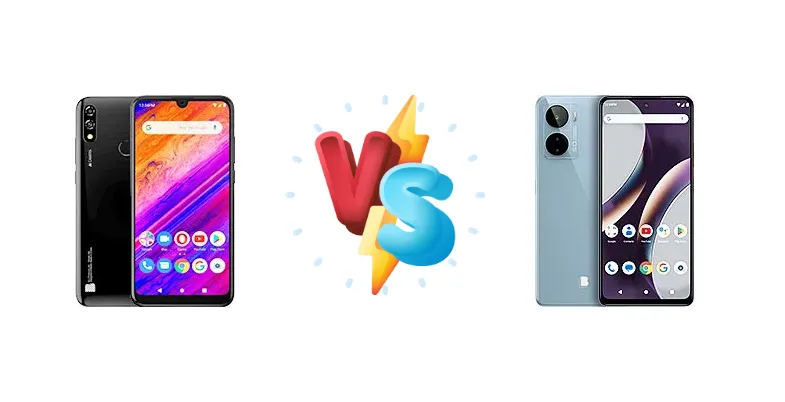
BLU consistently targets the ultra-budget segment, but their offerings vary significantly in internal hardware. The G8 represents a baseline experience, while the G93 introduces Mediatek's Helio G99 chipset. This comparison dissects the core differences between these two devices, focusing on how the G93's upgraded processor impacts real-world performance and user experience.
🏆 Quick Verdict
For most users, the BLU G93 is the clear winner. The Helio G99 chipset delivers a substantial performance boost over the G8's Cortex-A55, making it significantly better for gaming and demanding applications. While the G8 remains a functional device, the G93 offers a far more future-proof experience for a likely modest price increase.
| Network |
|---|
| 2G bands | GSM 850 / 900 / 1800 / 1900 | GSM 850 / 900 / 1800 / 1900 |
| 3G bands | HSDPA 850 / 1700(AWS) / 1900 - G0170UU | HSDPA 850 / 900 / 1700(AWS) / 1900 / 2100 |
| 4G bands | 1, 3, 4, 5, 7, 28 - G0170LL, G0170VV | 1, 2, 3, 4, 5, 7, 8, 12, 13, 17, 28, 66 |
| Speed | HSPA 42.2/11.5 Mbps, LTE Cat4 150/50 Mbps | HSPA, LTE |
| Technology | GSM / HSPA / LTE | GSM / HSPA / LTE |
| | 2, 4, 5, 12, 17 - G0170UU | - |
| Launch |
|---|
| Announced | 2019, July. Released 2019, July | 2023, June |
| Status | Discontinued | Available. Released 2023, July |
| Body |
|---|
| Build | - | Glass front, aluminum frame, glass back |
| Dimensions | 161.4 x 78 x 9.6 mm (6.35 x 3.07 x 0.38 in) | 168.7 x 76.7 x 9 mm (6.64 x 3.02 x 0.35 in) |
| SIM | Nano-SIM + Nano-SIM | Nano-SIM + Nano-SIM |
| Weight | 181 g (6.38 oz) | 210 g (7.41 oz) |
| Display |
|---|
| Resolution | 720 x 1520 pixels, 19:9 ratio (~267 ppi density) | 1080 x 2460 pixels (~396 ppi density) |
| Size | 6.3 inches, 99.1 cm2 (~78.7% screen-to-body ratio) | 6.78 inches, 109.2 cm2 (~84.4% screen-to-body ratio) |
| Type | IPS LCD | IPS LCD, 120Hz |
| Platform |
|---|
| CPU | Octa-core 1.6 GHz Cortex-A55 | Octa-core (2x2.2 GHz Cortex-A76 & 6x2.0 GHz Cortex-A55) |
| Chipset | - | Mediatek Helio G99 (6 nm) |
| GPU | IMG8322 | Mali-G57 MC2 |
| OS | Android 9.0 (Pie) | Android 13 |
| Memory |
|---|
| Card slot | microSDXC | microSDXC |
| Internal | 64GB 3GB RAM | 128GB 6GB RAM |
| Main Camera |
|---|
| Dual | 13 MP, AF
Auxiliary lens | - |
| Features | LED flash | LED flash, HDR, panorama |
| Triple | - | 50 MP, f/1.8, (wide), PDAF
2 MP (macro)
Auxiliary lens |
| Video | 1080p@30fps | 1440p@30fps, 1080p@30fps |
| Selfie camera |
|---|
| Single | 13 MP | 13 MP, f/2.0 |
| Video | 1080p@30fps | 1080p@30fps |
| Sound |
|---|
| 3.5mm jack | Yes | - |
| 35mm jack | Yes | Yes |
| Loudspeaker | Yes | Yes |
| Comms |
|---|
| Bluetooth | 4.1, A2DP | 5.2, A2DP, LE |
| NFC | No | Yes |
| Positioning | GPS | GPS |
| Radio | FM radio | FM radio |
| USB | microUSB 2.0 | USB Type-C 2.0, OTG |
| WLAN | Wi-Fi 802.11 b/g/n, Wi-Fi Direct | Wi-Fi 802.11 a/b/g/n/ac, dual-band |
| Features |
|---|
| Sensors | Fingerprint (rear-mounted), accelerometer, proximity | Fingerprint (side-mounted), accelerometer, proximity, compass |
| Battery |
|---|
| Charging | - | 18W wired |
| Stand-by | Up to 750 h (2G) / Up to 650 h (3G) | - |
| Talk time | Up to 30 h (2G) / Up to 24 h (3G) | - |
| Type | Li-Po 4000 mAh, non-removable | Li-Po 5000 mAh |
| Misc |
|---|
| Colors | Black, Red, Blue | Black, Light Blue, Cream |
| Price | - | About 160 EUR |
BLU G8
- Lowest possible price point
- Sufficient for basic smartphone tasks
- Likely longer battery life *per charge* due to lower power demands
- Poor performance for gaming or demanding apps
- Slow app loading times
- May struggle with multitasking
BLU G93
- Significantly faster performance thanks to Helio G99
- Improved gaming experience
- Faster charging with 18W support
- Likely slightly higher price than the G8
- Potentially shorter battery life *per charge* under heavy load
- May still lack advanced features found in higher-end phones
Display Comparison
Both devices' display specifications are not provided, so a direct comparison is limited. However, given the G93's focus on gaming, it's reasonable to expect a slightly higher refresh rate or improved color accuracy compared to the G8. The G8 likely utilizes a standard 60Hz panel, while the G93 *could* offer 90Hz for smoother visuals. Bezels are likely similar, reflecting the budget nature of both phones. Without specific nit brightness data, it's difficult to assess outdoor visibility.
Camera Comparison
Without detailed camera specifications, a precise comparison is challenging. However, it's common for budget phones to prioritize megapixel count over sensor size and image quality. We can assume both phones feature a multi-camera setup, but the G93's image signal processor (ISP), integrated within the Helio G99, will likely offer superior image processing capabilities. This could result in better dynamic range, noise reduction, and overall image clarity compared to the G8. Any 2MP macro or depth sensors on either device should be considered marketing features rather than significant photographic tools.
Performance
The performance gap between these two is substantial. The BLU G8's Octa-core 1.6 GHz Cortex-A55 CPU is an entry-level processor designed for efficiency, not speed. The BLU G93, however, features the Mediatek Helio G99 (6nm). This chipset boasts a combination of 2x2.2 GHz Cortex-A76 and 6x2.0 GHz Cortex-A55 cores. The Cortex-A76 cores represent a significant architectural improvement over the A55, offering considerably higher single-core performance. The 6nm manufacturing process further enhances efficiency and allows for sustained performance under load, reducing thermal throttling. This translates to faster app loading times, smoother multitasking, and a much better gaming experience on the G93.
Battery Life
Battery capacity data is missing for both devices. However, the G93's Helio G99 chipset, built on a 6nm process, is inherently more power-efficient than the G8's processor. This means the G93 could achieve comparable or even better battery life despite potentially having a similar capacity battery. The G93 also supports 18W wired charging, which will significantly reduce charging times compared to the G8, assuming the G8 has a slower charging rate (a common cost-saving measure in this segment). Expect a full charge on the G93 in under 2 hours with the appropriate charger.
Buying Guide
Buy the BLU G8 if you prioritize absolute affordability and only need a smartphone for basic tasks like calls, texts, and light social media browsing. Its Cortex-A55 processor is sufficient for these workloads. Buy the BLU G93 if you enjoy mobile gaming, frequently use resource-intensive apps, or simply want a phone that feels more responsive and capable. The Helio G99 provides a noticeable upgrade in processing power and efficiency.
Frequently Asked Questions
❓ Will the BLU G93 run demanding games like PUBG Mobile smoothly?
The Helio G99 chipset in the BLU G93 is specifically designed for gaming. While it won't deliver flagship-level performance, it should be capable of running PUBG Mobile at medium settings with a playable frame rate. Expect some frame drops during intense action, but overall, the gaming experience will be significantly better than on the BLU G8.
❓ Is the 18W charging on the BLU G93 a significant improvement over a standard 10W charger?
Yes, 18W charging is a noticeable improvement. A standard 10W charger will take considerably longer to fully charge the G93. With 18W charging, you can expect to go from 0% to 100% in approximately 2 hours, depending on battery capacity. This is a significant convenience factor for users who rely heavily on their smartphones.
❓ Does the BLU G93 have any thermal throttling issues during prolonged gaming sessions?
The Helio G99's 6nm process helps mitigate thermal throttling, but it's not entirely eliminated. While the G93 will likely sustain performance for longer periods than the G8, you may still experience some performance reduction after extended gaming sessions. The phone's design and cooling solution will also play a role in managing heat.