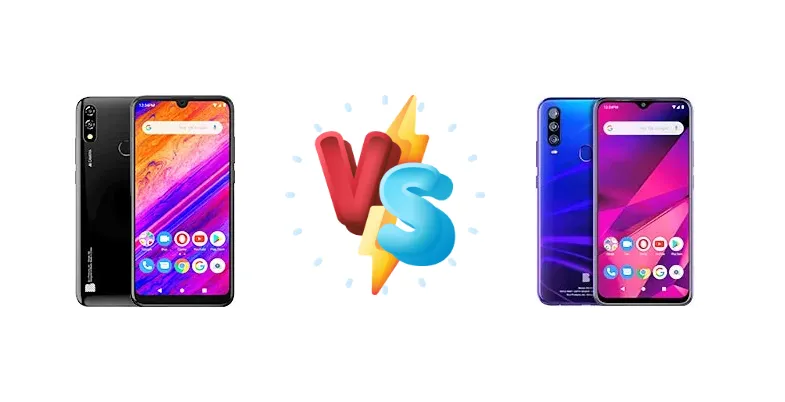
BLU consistently targets the ultra-budget smartphone market, and the G8 and G9 Pro represent two distinct approaches. The G8 focuses on simplicity, while the G9 Pro attempts to inject more modern features like wireless charging and a more powerful chipset. This comparison dissects the differences to determine which phone offers the best value for your money.
🏆 Quick Verdict
For most users, the BLU G9 Pro is the superior choice. Its Mediatek Helio P60 chipset provides a significant performance boost over the G8’s Cortex-A55, making it noticeably faster for everyday tasks and light gaming. The addition of 18W wired and 10W wireless charging further sweetens the deal, justifying the likely price premium.
| Network |
|---|
| 2G bands | GSM 850 / 900 / 1800 / 1900 | GSM 850 / 900 / 1800 / 1900 |
| 3G bands | HSDPA 850 / 1700(AWS) / 1900 - G0170UU | HSDPA 850 / 900 / 1700(AWS) / 1900 / 2100 |
| 4G bands | 1, 3, 4, 5, 7, 28 - G0170LL, G0170VV | 1, 2, 3, 4, 5, 7, 8, 12, 13, 17, 28 |
| Speed | HSPA 42.2/11.5 Mbps, LTE Cat4 150/50 Mbps | HSPA 42.2/5.76 Mbps, LTE (2CA) Cat6 300/50 Mbps |
| Technology | GSM / HSPA / LTE | GSM / HSPA / LTE |
| | 2, 4, 5, 12, 17 - G0170UU | - |
| Launch |
|---|
| Announced | 2019, July. Released 2019, July | 2019, August. Released 2019, August |
| Status | Discontinued | Discontinued |
| Body |
|---|
| Dimensions | 161.4 x 78 x 9.6 mm (6.35 x 3.07 x 0.38 in) | 157 x 75.1 x 8.6 mm (6.18 x 2.96 x 0.34 in) |
| SIM | Nano-SIM + Nano-SIM | Nano-SIM + Nano-SIM |
| Weight | 181 g (6.38 oz) | 183 g (6.46 oz) |
| Display |
|---|
| Resolution | 720 x 1520 pixels, 19:9 ratio (~267 ppi density) | 1080 x 2340 pixels, 19.5:9 ratio (~409 ppi density) |
| Size | 6.3 inches, 99.1 cm2 (~78.7% screen-to-body ratio) | 6.3 inches, 97.4 cm2 (~82.6% screen-to-body ratio) |
| Type | IPS LCD | IPS LCD |
| Platform |
|---|
| CPU | Octa-core 1.6 GHz Cortex-A55 | Octa-core (4x2.0 GHz Cortex-A73 & 4x2.0 GHz Cortex-A53) |
| Chipset | - | Mediatek MT6771 Helio P60 (12 nm) |
| GPU | IMG8322 | Mali-G72 MP3 |
| OS | Android 9.0 (Pie) | Android 9.0 (Pie), planned upgrade to Android 10 |
| Memory |
|---|
| Card slot | microSDXC | microSDXC |
| Internal | 64GB 3GB RAM | 128GB 4GB RAM |
| | - | eMMC 5.1 |
| Main Camera |
|---|
| Dual | 13 MP, AF
Auxiliary lens | - |
| Features | LED flash | LED flash, HDR, panorama |
| Triple | - | 48 MP, f/1.8, 1/2.0", 0.8µm, PDAF
8 MP, f/2.2, (ultrawide)
Auxiliary lens |
| Video | 1080p@30fps | 1080p@30fps |
| Selfie camera |
|---|
| Single | 13 MP | 16 MP, f/2.0 |
| Video | 1080p@30fps | 1080p@30fps |
| Sound |
|---|
| 3.5mm jack | Yes | Yes |
| 35mm jack | Yes | Yes |
| Loudspeaker | Yes | Yes |
| Comms |
|---|
| Bluetooth | 4.1, A2DP | 4.1, A2DP, LE |
| NFC | No | No |
| Positioning | GPS | GPS |
| Radio | FM radio | FM radio |
| USB | microUSB 2.0 | USB Type-C 2.0, OTG |
| WLAN | Wi-Fi 802.11 b/g/n, Wi-Fi Direct | Wi-Fi 802.11 a/b/g/n, Wi-Fi Direct |
| Features |
|---|
| Sensors | Fingerprint (rear-mounted), accelerometer, proximity | Fingerprint (rear-mounted), accelerometer, gyro, proximity, compass |
| Battery |
|---|
| Charging | - | 18W wired
10W wireless (Qi) |
| Stand-by | Up to 750 h (2G) / Up to 650 h (3G) | Up to 625 h (3G) |
| Talk time | Up to 30 h (2G) / Up to 24 h (3G) | Up to 21 h (3G) |
| Type | Li-Po 4000 mAh, non-removable | Li-Po 4000 mAh, non-removable |
| Misc |
|---|
| Colors | Black, Red, Blue | Nightfall, Black |
BLU G8
- Potentially lower price point
- Simpler user experience
- May have longer standby time due to less powerful processor
- Significantly slower performance
- Slower charging speeds
- Limited multitasking capabilities
BLU G9 Pro
- Faster and more responsive performance
- 18W wired and 10W wireless charging
- Improved image processing capabilities
- Likely higher price
- Potentially slightly shorter battery life under heavy load
- More complex chipset may lead to slightly more heat
Display Comparison
Neither BLU provides detailed display specifications. However, given their price points, both likely utilize IPS LCD panels. The G9 Pro’s advantage isn’t in panel technology, but in the chipset’s ability to drive the display more efficiently, potentially resulting in smoother scrolling and animations. Without knowing the resolution or brightness levels, it’s difficult to assess color accuracy or outdoor visibility, but the G9 Pro’s more powerful GPU suggests better image processing capabilities.
Camera Comparison
Detailed camera specs are unavailable for either device. However, it’s safe to assume both feature basic camera setups geared towards casual photography. The G9 Pro’s more powerful ISP (Image Signal Processor) within the Helio P60 chipset will likely result in better image processing, particularly in low-light conditions. Expect improved noise reduction and dynamic range. Without knowing sensor sizes or apertures, it’s impossible to definitively declare a camera winner, but the G9 Pro has a clear advantage in processing power.
Performance
The core difference lies in the chipset. The BLU G8’s Octa-core 1.6 GHz Cortex-A55 CPU is an entry-level processor designed for basic tasks. In contrast, the BLU G9 Pro’s Mediatek MT6771 Helio P60 features a more sophisticated configuration: four Cortex-A73 cores clocked at 2.0 GHz and four Cortex-A53 cores, also at 2.0 GHz. The Cortex-A73 cores represent a significant architectural leap over the A55, offering substantially improved single-core and multi-core performance. This translates to faster app launches, smoother multitasking, and a more responsive user interface. The Helio P60’s 12nm process node also contributes to better power efficiency compared to the likely larger node used in the G8’s processor.
Battery Life
Battery capacity isn’t specified for either phone. However, the G9 Pro’s 18W wired charging and 10W wireless charging (Qi standard) are significant advantages. The G8 likely supports only slower, standard charging. While a larger battery capacity on the G8 *could* offset the slower charging, the G9 Pro’s faster charging allows for quicker top-ups, minimizing downtime. The Helio P60’s power efficiency also contributes to potentially longer battery life despite potentially having a similar capacity battery.
Buying Guide
Buy the BLU G8 if you prioritize absolute simplicity and are on the tightest of budgets, needing only a phone for basic communication and minimal app usage. Buy the BLU G9 Pro if you value a smoother user experience, faster app loading times, and the convenience of wireless charging, even if it means spending a bit more upfront. The G9 Pro is the better option for anyone who uses social media, streams videos, or plays casual games.
Frequently Asked Questions
❓ Will the BLU G9 Pro handle popular social media apps like TikTok and Instagram smoothly?
Yes, the Helio P60 chipset in the G9 Pro is significantly more capable than the G8’s processor. It will handle scrolling through feeds, recording videos, and applying filters in apps like TikTok and Instagram with noticeably less lag and stuttering.
❓ Is the 10W wireless charging on the BLU G9 Pro fast enough for convenient daily use?
10W wireless charging is slower than many flagship phones, but it’s still a convenient feature for topping up the battery overnight or during work hours. It’s significantly more convenient than constantly plugging and unplugging a cable, and a welcome addition at this price point.
❓ Can the BLU G9 Pro run mobile games like PUBG Mobile or Call of Duty Mobile?
The Helio P60 can run PUBG Mobile and Call of Duty Mobile, but you’ll likely need to lower the graphics settings to medium or low to achieve a playable frame rate. Don’t expect the same performance as a phone with a dedicated gaming chipset, but it’s capable of casual gaming.
❓ Does the BLU G9 Pro support fast charging with any specific charger?
The BLU G9 Pro supports 18W fast charging. While it may charge with a standard 5W charger, you'll need a USB Power Delivery (PD) compatible charger that supports 18W output to achieve the fastest charging speeds.