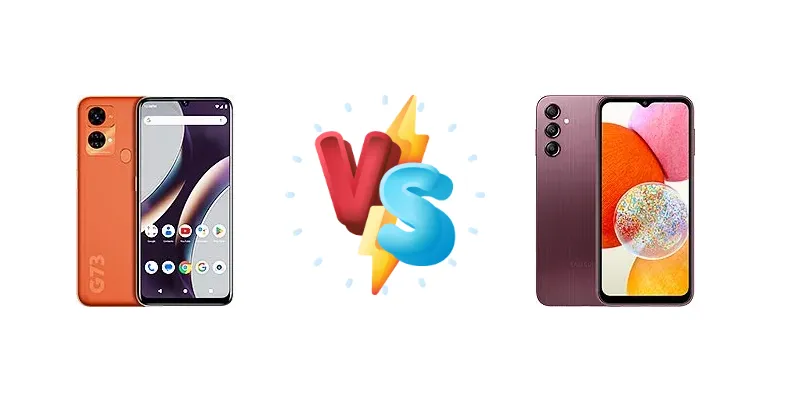
The BLU G73 and Samsung Galaxy A14 represent compelling options in the sub-$200 smartphone market. While both aim to deliver essential features at an accessible price, they take different approaches to performance and overall user experience. The G73 focuses on a streamlined experience with a specific processor, while the A14 offers a choice between a Mediatek Helio G80 and an Exynos 850, creating a more complex buying decision.
🏆 Quick Verdict
For most users, the Samsung Galaxy A14 (specifically the Exynos 850 version) offers a slightly more refined experience due to its potentially more efficient processor and broader software support. However, the BLU G73 presents a strong value proposition for those prioritizing a consistent, known chipset and a simpler software experience.
| Network |
|---|
| 2G bands | GSM 850 / 900 / 1800 / 1900 | GSM 850 / 900 / 1800 / 1900 |
| 3G bands | HSDPA 850 / 900 / 1700(AWS) / 1900 / 2100 | HSDPA 850 / 900 / 2100 |
| 4G bands | 2, 3, 4, 5, 7, 12, 17, 28, 38, 66, 71 | 1, 3, 5, 7, 8, 20, 28, 38, 40, 41 |
| Speed | HSPA, LTE | HSPA, LTE |
| Technology | GSM / HSPA / LTE | GSM / HSPA / LTE |
| Launch |
|---|
| Announced | 2023, June | 2023, February 28 |
| Status | Available. Released 2023, June | Available. Released 2023, March 27 |
| Body |
|---|
| Build | Glass front, plastic frame, eco leather back | Glass front, plastic back, plastic frame |
| Dimensions | 168.3 x 78.8 x 9.9 mm (6.63 x 3.10 x 0.39 in) | 167.7 x 78 x 9.1 mm (6.60 x 3.07 x 0.36 in) |
| SIM | Nano-SIM + Nano-SIM | · Nano-SIM· Nano-SIM + Nano-SIM |
| Weight | 210 g (7.41 oz) | 201 g (7.09 oz) |
| Display |
|---|
| Resolution | 720 x 1600 pixels, 20:9 ratio (~258 ppi density) | 1080 x 2408 pixels, 20:9 ratio (~400 ppi density) |
| Size | 6.8 inches, 111.6 cm2 (~84.2% screen-to-body ratio) | 6.6 inches, 104.9 cm2 (~80.2% screen-to-body ratio) |
| Type | IPS LCD, 90Hz | PLS LCD |
| Platform |
|---|
| CPU | Octa-core (2x1.6 GHz Cortex-A75 & 6x1.6 GHz Cortex-A55) | Octa-core (2x2.0 GHz Cortex-A75 & 6x1.8 GHz Cortex-A55) - Version AOcta-core (4x2.0 GHz Cortex-A55 & 4x2.0 GHz Cortex-A55) - Version B |
| Chipset | - | Mediatek MT6769 Helio G80 (12 nm) - Version AExynos 850 (8 nm) - Version B |
| GPU | Mali-G57 MP1 | Mali-G52 MC2 |
| OS | Android 13 | Android 13, upgradable to Android 15, One UI 7 |
| Memory |
|---|
| Card slot | microSDXC | microSDXC (dedicated slot) |
| Internal | 128GB 6GB RAM | 64GB 4GB RAM, 128GB 4GB RAM, 128GB 6GB RAM |
| Main Camera |
|---|
| Features | LED flash, HDR, panorama | LED flash, panorama, HDR |
| Single | - | 13 MP, f/2.0, (wide) |
| Triple | 50 MP, f/2.0, (wide)
0.3 MP (macro)
Auxiliary lens | 50 MP, f/1.8, 26mm (wide), 1/2.75", 0.64µm, PDAF
5 MP, f/2.2, 17mm (ultrawide), 1/5.0", 1.12µm
2 MP (macro) |
| Video | 1080p@30fps | 1080p@30fps |
| Selfie camera |
|---|
| Single | 8 MP, f/2.0 | 13 MP, f/2.0, 26mm (wide), 1/3.1", 1.12µm |
| Video | 1080p@30fps | 1080p@30fps |
| Sound |
|---|
| 3.5mm jack | - | Yes |
| 35mm jack | Yes | Yes |
| Loudspeaker | Yes | Yes |
| Comms |
|---|
| Bluetooth | 5.0, A2DP, LE | 5.1 or 5.3, A2DP, LE |
| NFC | No | Yes (market/region dependent) |
| Positioning | GPS | GPS, GALILEO, GLONASS, BDS, QZSS |
| Radio | FM radio | Unspecified |
| USB | USB Type-C 2.0 | USB Type-C 2.0 |
| WLAN | Wi-Fi 802.11 b/g/n/ac, Wi-Fi Direct | Wi-Fi 802.11 a/b/g/n/ac, dual-band, Wi-Fi Direct |
| Features |
|---|
| Sensors | Fingerprint (rear-mounted), accelerometer | Fingerprint (side-mounted), accelerometer, proximity, compass |
| Battery |
|---|
| Charging | 18W wired | 15W wired |
| Type | Li-Po 5000 mAh | Li-Po 5000 mAh |
| Misc |
|---|
| Colors | Blue, Grey, Orange, Burgundy | Black, Dark Red, Silver, Green |
| Models | - | SM-A145F, SM-A145F/DSN, SM-A145M, SM-A145M/DS, SM-A145P, SM-A145R |
| Price | About 140 EUR | € 85.76 / $ 147.60 / £ 79.95 |
| SAR EU | - | 0.46 W/kg (head) 1.37 W/kg (body) |
BLU G73
- Faster charging (18W)
- Consistent processor configuration
- Simpler software experience
- Less established brand reputation
- Potentially less optimized software
Samsung Galaxy A14
- Samsung brand recognition and support
- Potential for better performance (Exynos version)
- More versatile software features
- Chipset variation (Helio G80 vs Exynos 850)
- Slower charging (15W)
Display Comparison
Neither device boasts a standout display. Both likely utilize LCD panels, common in this price bracket. The lack of specified screen details (resolution, brightness) suggests a focus on cost reduction. However, the A14's larger screen size (typically 6.6 inches vs. the G73's likely smaller size) may offer a more immersive viewing experience. The absence of high refresh rates on both devices indicates a prioritization of battery life over visual fluidity.
Camera Comparison
Camera performance is likely similar, with both phones targeting basic photography needs. The lack of detailed sensor information makes precise comparison difficult. Both will likely feature a primary camera and multiple secondary lenses, including a 2MP macro lens on the A14, which offers limited practical benefit. Image processing will likely favor Samsung’s more refined algorithms, potentially resulting in more pleasing images in various lighting conditions. The G73 will likely rely on more basic image processing.
Performance
The performance disparity is the most significant factor. The BLU G73’s Octa-core CPU (2x1.6 GHz Cortex-A75 & 6x1.6 GHz Cortex-A55) is a solid performer for everyday tasks. However, the Samsung Galaxy A14 presents a choice. Version A with the Mediatek Helio G80 (12 nm) offers a slight CPU clock speed advantage (2x2.0 GHz Cortex-A75 & 6x1.8 GHz Cortex-A55), but the 12nm process may lead to higher power consumption. Version B, with the Exynos 850 (8 nm), benefits from a more efficient manufacturing process, potentially offering better sustained performance and thermal management. The A75 cores in both chips handle demanding tasks, but the Exynos 850’s 8nm node gives it an edge in efficiency.
Battery Life
The Samsung Galaxy A14’s 15W charging is slower than the BLU G73’s 18W charging. However, the Exynos 850 version of the A14’s more efficient processor could offset this difference by consuming less power during use. Without knowing the battery capacity of the G73, it’s difficult to definitively declare a winner. The A14’s larger screen size will likely draw more power, but the Exynos version’s efficiency could mitigate this.
Buying Guide
Buy the BLU G73 if you need a straightforward, reliable device with a known processor configuration and prioritize simplicity over extensive features. It's ideal for users who primarily need calling, texting, and basic app usage. Buy the Samsung Galaxy A14 if you prefer a more versatile device with the potential for better performance (Exynos version) and benefit from Samsung's established ecosystem and software updates, even if it means navigating potential chipset variations.
Frequently Asked Questions
❓ Which version of the Samsung Galaxy A14 should I choose – the Helio G80 or the Exynos 850?
If available and within your budget, the Exynos 850 version is preferable. Its 8nm process offers better power efficiency, potentially leading to longer battery life and less thermal throttling during demanding tasks. However, the Helio G80 is still a capable chip for everyday use.
❓ Is the 2MP macro camera on the Samsung Galaxy A14 worth considering?
Generally, 2MP macro cameras on budget phones offer limited practical value. Image quality is often poor, and the fixed focus distance makes it difficult to capture truly detailed close-up shots. It's best not to base your purchasing decision on this feature.
❓ Will the BLU G73 receive regular software updates?
BLU’s update track record is less consistent than Samsung’s. While the G73 will likely receive security patches, major Android version updates are less guaranteed. If long-term software support is a priority, the Samsung Galaxy A14 is the better choice.
❓ Does the Samsung Galaxy A14 support 90fps gameplay in PUBG Mobile?
The Helio G80 version of the A14 may be able to achieve 60fps with reduced graphics settings, but consistently hitting 90fps is unlikely. The Exynos 850 version might offer slightly better performance, but still won't reliably reach 90fps in PUBG Mobile.