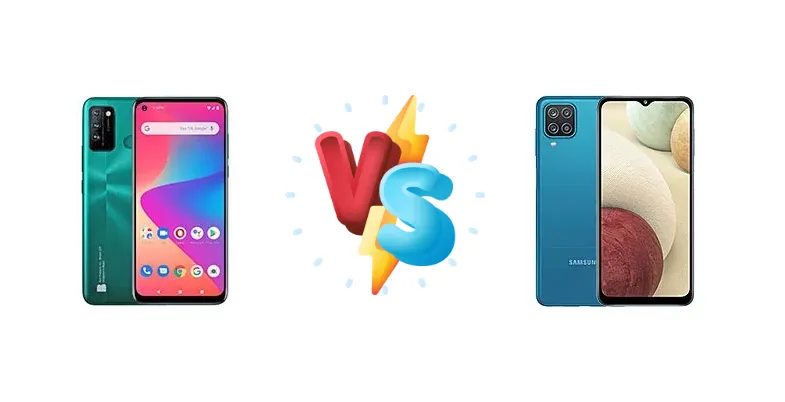
The BLU G71 and Samsung Galaxy A12 (India) represent two compelling options in the ultra-budget smartphone space. While both aim to deliver essential smartphone functionality at an accessible price point, they take different approaches to achieving this. This comparison dissects their core specifications to determine which device offers the best overall value for users prioritizing performance and efficiency.
🏆 Quick Verdict
For the average user, the Samsung Galaxy A12 (India) emerges as the better choice. Its Exynos 850 chipset, built on an 8nm process, provides a noticeable performance advantage over the BLU G71’s Cortex-A53, translating to smoother multitasking and app loading. While the G71 is cheaper, the A12’s superior processing power justifies the price difference.
| Network |
|---|
| 2G bands | GSM 850 / 900 / 1800 / 1900 | GSM 850 / 900 / 1800 / 1900 |
| 3G bands | HSDPA 850 / 900 / 1700(AWS) / 1900 / 2100 | HSDPA 850 / 900 / 2100 |
| 4G bands | 1, 2, 3, 4, 5, 7, 12, 17, 28 | 1, 3, 5, 7, 8, 20, 28, 38, 40, 41 |
| Speed | HSPA 42.2/11.5 Mbps, LTE Cat4 150/50 Mbps | HSPA 42.2/5.76 Mbps, LTE Cat4 150/50 Mbps |
| Technology | GSM / HSPA / LTE | GSM / HSPA / LTE |
| Launch |
|---|
| Announced | 2021, February 19. Released 2021, February 19 | 2021, August 12 |
| Status | Discontinued | Available. Released 2021, August 12 |
| Body |
|---|
| Build | - | Glass front, plastic back, plastic frame |
| Dimensions | 165 x 76.6 x 8.9 mm (6.50 x 3.02 x 0.35 in) | 164 x 75.8 x 8.9 mm (6.46 x 2.98 x 0.35 in) |
| SIM | Nano-SIM + Nano-SIM | · Nano-SIM· Nano-SIM + Nano-SIM |
| Weight | 194 g (6.84 oz) | 205 g (7.23 oz) |
| Display |
|---|
| Resolution | 720 x 1600 pixels, 20:9 ratio (~270 ppi density) | 720 x 1600 pixels, 20:9 ratio (~270 ppi density) |
| Size | 6.5 inches, 102.0 cm2 (~80.7% screen-to-body ratio) | 6.5 inches, 102.0 cm2 (~82.1% screen-to-body ratio) |
| Type | IPS LCD | PLS LCD |
| Platform |
|---|
| CPU | Octa-core 1.8 GHz Cortex-A53 | Octa-core (4x2.0 GHz Cortex-A55 & 4x2.0 GHz Cortex-A55) |
| Chipset | - | Exynos 850 (8 nm) |
| GPU | - | Mali-G52 |
| OS | Android 10 | Android 11, upgradable to Android 13, One UI 5.1 |
| Memory |
|---|
| Card slot | microSDXC (dedicated slot) | microSDXC (dedicated slot) |
| Internal | 64GB 3GB RAM | 64GB 4GB RAM, 128GB 4GB RAM, 128GB 6GB RAM |
| | eMMC 5.1 | eMMC 5.1 |
| Main Camera |
|---|
| Features | LED flash | LED flash, panorama, HDR |
| Quad | - | 48 MP, f/2.0, 26mm (wide), AF
5 MP, f/2.2, 123˚ (ultrawide)
2 MP (macro)
Auxiliary lens |
| Single | 13 MP | - |
| Triple | 13 MP, (wide), AF
5 MP, (ultrawide)
Auxiliary lens | - |
| Video | 1080p@30fps | 1080p@30fps |
| Selfie camera |
|---|
| Single | 13 MP | 8 MP, f/2.2 |
| Video | 720p@30fps | 1080p@30fps |
| Sound |
|---|
| 3.5mm jack | Yes | Yes |
| 35mm jack | Yes | Yes |
| Loudspeaker | Yes | Yes |
| Comms |
|---|
| Bluetooth | 4.0, A2DP | 5.0, A2DP, LE |
| NFC | No | No |
| Positioning | GPS | GPS, GLONASS, GALILEO, BDS |
| Radio | FM radio | FM radio, RDS, recording |
| USB | USB Type-C 2.0 | USB Type-C 2.0 |
| WLAN | Wi-Fi 802.11 a/b/g/n, Wi-Fi Direct | Wi-Fi 802.11 b/g/n, Wi-Fi Direct |
| Features |
|---|
| Sensors | Fingerprint (rear-mounted), accelerometer, proximity | Fingerprint (side-mounted), accelerometer |
| | - | Virtual proximity sensing |
| Battery |
|---|
| Charging | 10W wired | 15W wired |
| Type | Li-Po 5000 mAh | Li-Po 5000 mAh |
| Misc |
|---|
| Colors | Black, Blue, Green, Red | Black, Blue, White |
| Models | - | SM-A127F, SM-A127F/DS |
| Price | About 80 EUR | About 160 EUR |
| SAR | - | 0.79 W/kg (head) |
BLU G71
- Potentially lower price point
- Basic smartphone functionality
- Compact size (likely)
- Outdated processor (Cortex-A53)
- Slow charging (10W)
- Likely limited performance
Samsung Galaxy A12 (India)
- More powerful Exynos 850 chipset
- Larger 5000mAh battery
- Faster 15W charging
- Slightly higher price
- Basic LCD display
- Software bloat (potentially)
Display Comparison
Neither device boasts a standout display. Details regarding panel type, resolution, and brightness are missing for the BLU G71, suggesting a basic LCD. The Samsung Galaxy A12 (India) also utilizes an LCD, but its larger size (6.5 inches) is a benefit. The lack of high refresh rates on either device is standard for this price bracket, focusing on power efficiency over visual fluidity. Bezels are likely to be substantial on both, impacting the overall screen-to-body ratio.
Camera Comparison
Camera performance is likely to be similar, with both devices relying on basic sensors. Details are sparse for the BLU G71, but it’s reasonable to assume a primary sensor around 13MP. The Samsung Galaxy A12 (India) typically features a 13MP main sensor. Image processing will be a key differentiator, with Samsung’s software likely offering more refined results. The inclusion of a 2MP macro camera on the A12 is largely a marketing gimmick, offering limited practical benefit. Both phones will struggle in low-light conditions.
Performance
The core difference lies in the chipset. The Samsung Galaxy A12 (India) features the Exynos 850, an 8nm processor with a more modern CPU architecture (Cortex-A55) compared to the BLU G71’s 1.8 GHz Cortex-A53. The Exynos 850’s octa-core configuration (4x2.0 GHz & 4x2.0 GHz) provides a significant uplift in both single-core and multi-core performance. This translates to faster app launches, smoother scrolling, and improved multitasking. The G71’s older Cortex-A53 architecture will struggle with demanding applications. While RAM details are missing for the G71, the A12’s RAM configuration (likely 3GB or 4GB) further contributes to its performance edge.
Battery Life
Battery capacity details are missing for the BLU G71, but it’s likely around 3000-4000mAh. The Samsung Galaxy A12 (India) typically features a 5000mAh battery, providing significantly longer battery life. However, the charging speeds differ. The G71 supports 10W wired charging, while the A12 supports 15W wired charging. While 15W isn’t fast charging by modern standards, it’s still 50% faster than the G71, reducing the time to fully charge the larger battery.
Buying Guide
Buy the BLU G71 if you need a bare-bones smartphone for extremely basic tasks like calls, texts, and light social media, and your budget is severely constrained. Buy the Samsung Galaxy A12 (India) if you prioritize a more responsive user experience, occasional gaming, and faster charging, even if it means spending a bit more upfront. The A12 is better suited for users who want a phone that can handle more than just the essentials.
Frequently Asked Questions
❓ Does the Exynos 850 in the Samsung Galaxy A12 (India) get hot during prolonged use, like gaming?
The Exynos 850, built on an 8nm process, is relatively efficient. While it will warm up during extended gaming sessions, it’s unlikely to experience significant thermal throttling. The larger chassis of the A12 also aids in heat dissipation, making it a more comfortable experience than the BLU G71, which likely has less effective thermal management.
❓ Is the 2MP macro camera on the Samsung Galaxy A12 (India) actually useful for taking detailed close-up photos?
Generally, 2MP macro cameras on budget smartphones offer limited practical benefit. The low resolution results in images lacking detail and sharpness. It’s best to rely on the 13MP main sensor for most photography, even for close-up shots, as it will deliver far superior results.
❓ Can the Samsung Galaxy A12 (India) handle popular games like PUBG Mobile at acceptable frame rates?
The Samsung Galaxy A12 (India) can run PUBG Mobile, but expect to play at lower graphics settings (Balanced or Low) to maintain a stable frame rate. The Exynos 850 is capable of handling the game, but it’s not a dedicated gaming chipset. The BLU G71’s Cortex-A53 processor will likely struggle to provide a playable experience.
❓ What type of charging cable and adapter does the BLU G71 use, and is it a standard USB-C connection?
Given the BLU G71's 10W charging, it almost certainly uses a Micro-USB connection, not USB-C. This is a common cost-saving measure on ultra-budget devices. The Samsung Galaxy A12 (India) uses USB-C, offering more versatility and faster data transfer speeds.