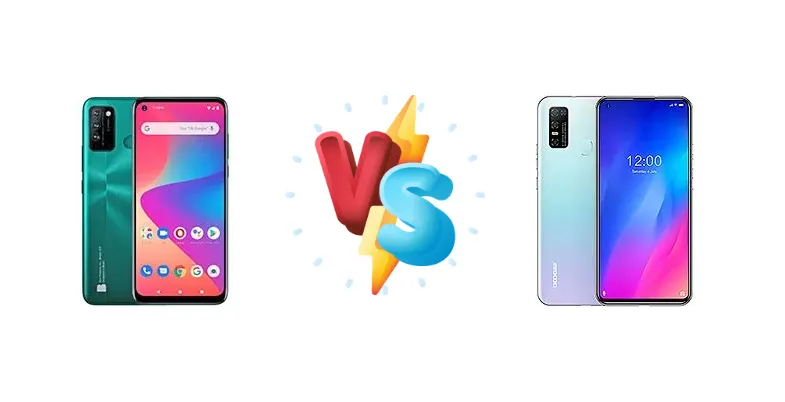
The BLU G71 and Doogee N30 represent the ultra-budget end of the Android spectrum. Both aim to deliver smartphone functionality at the lowest possible price point, but they achieve this with different approaches to internal hardware. This comparison dissects their specifications to determine which offers the best value for users prioritizing basic functionality and affordability.
🏆 Quick Verdict
For the average user needing a functional, if uninspiring, smartphone experience, the Doogee N30 edges out the BLU G71. The Helio A25 chipset, while still entry-level, offers a slight performance advantage over the G71’s Cortex-A53, thanks to its dual-cluster configuration. Both phones share the same slow 10W charging, making battery life the primary differentiator.
| Network |
|---|
| 2G bands | GSM 850 / 900 / 1800 / 1900 | GSM 850 / 900 / 1800 / 1900 |
| 3G bands | HSDPA 850 / 900 / 1700(AWS) / 1900 / 2100 | HSDPA 850 / 900 / 1700(AWS) / 1900 / 2100 |
| 4G bands | 1, 2, 3, 4, 5, 7, 12, 17, 28 | 1, 2, 3, 4, 5, 7, 8, 12, 17, 19, 20, 28, 34, 38, 39, 40, 41 |
| Speed | HSPA 42.2/11.5 Mbps, LTE Cat4 150/50 Mbps | HSPA, LTE |
| Technology | GSM / HSPA / LTE | GSM / HSPA / LTE |
| Launch |
|---|
| Announced | 2021, February 19. Released 2021, February 19 | 2020, September 18. Released 2020, October |
| Status | Discontinued | Discontinued |
| Body |
|---|
| Dimensions | 165 x 76.6 x 8.9 mm (6.50 x 3.02 x 0.35 in) | 167 x 77.4 x 8.9 mm (6.57 x 3.05 x 0.35 in) |
| SIM | Nano-SIM + Nano-SIM | Nano-SIM + Nano-SIM |
| Weight | 194 g (6.84 oz) | 190 g (6.70 oz) |
| Display |
|---|
| Resolution | 720 x 1600 pixels, 20:9 ratio (~270 ppi density) | 720 x 1600 pixels, 20:9 ratio (~268 ppi density) |
| Size | 6.5 inches, 102.0 cm2 (~80.7% screen-to-body ratio) | 6.55 inches, 103.6 cm2 (~80.1% screen-to-body ratio) |
| Type | IPS LCD | IPS LCD |
| Platform |
|---|
| CPU | Octa-core 1.8 GHz Cortex-A53 | Octa-core (4x1.8 GHz Cortex-A53 & 4x1.5 GHz Cortex-A53) |
| Chipset | - | Mediatek MT6762V/WD Helio A25 (12 nm) |
| GPU | - | PowerVR GE8320 |
| OS | Android 10 | Android 10 |
| Memory |
|---|
| Card slot | microSDXC (dedicated slot) | microSDXC (dedicated slot) |
| Internal | 64GB 3GB RAM | 128GB 4GB RAM |
| | eMMC 5.1 | - |
| Main Camera |
|---|
| Features | LED flash | LED flash |
| Quad | - | 16 MP, f/2.0, (wide), PDAF
8 MP, f/2.4, 130˚ (ultrawide)
2 MP (macro)
Auxiliary lens |
| Single | 13 MP | - |
| Triple | 13 MP, (wide), AF
5 MP, (ultrawide)
Auxiliary lens | - |
| Video | 1080p@30fps | 1080p |
| Selfie camera |
|---|
| Single | 13 MP | 8 MP, f/2.0, (wide) |
| Video | 720p@30fps | Yes |
| Sound |
|---|
| 3.5mm jack | Yes | - |
| 35mm jack | Yes | Yes |
| Loudspeaker | Yes | Yes |
| Comms |
|---|
| Bluetooth | 4.0, A2DP | 5.0, A2DP, LE |
| NFC | No | No |
| Positioning | GPS | GPS, GLONASS, BDS, GALILEO |
| Radio | FM radio | FM radio |
| USB | USB Type-C 2.0 | USB Type-C 2.0, OTG |
| WLAN | Wi-Fi 802.11 a/b/g/n, Wi-Fi Direct | Wi-Fi 802.11 a/b/g/n, dual-band |
| Features |
|---|
| Sensors | Fingerprint (rear-mounted), accelerometer, proximity | Fingerprint (rear-mounted), accelerometer, proximity |
| Battery |
|---|
| Charging | 10W wired | 10W wired |
| Type | Li-Po 5000 mAh | 4500 mAh |
| Misc |
|---|
| Colors | Black, Blue, Green, Red | Black, Blue, White, Green |
| Price | About 80 EUR | About 150 EUR |
BLU G71
- Potentially lower price point (depending on retailer)
- Simple and straightforward user experience
- Reliable brand reputation (BLU)
- Less powerful processor compared to Doogee N30
- Limited multitasking capabilities
- Likely lower build quality
Doogee N30
- Slightly more powerful Helio A25 chipset
- Dual-cluster CPU architecture for improved responsiveness
- Potentially better gaming performance (within limitations)
- Doogee's brand reputation is less established
- 10W charging is slow on both devices
- Camera performance will likely be similar to BLU G71
Display Comparison
Neither BLU nor Doogee provide display specifications beyond size. Given the price point, both likely utilize IPS LCD panels with 720p+ resolutions. Expect limited brightness and color accuracy. The absence of details like PWM dimming frequency makes it difficult to assess potential eye strain, but users sensitive to flicker should proceed with caution. Bezels are expected to be substantial on both devices, maximizing screen real estate within a compact form factor.
Camera Comparison
Camera performance on both devices will be limited. Without specific sensor details, it’s safe to assume both feature basic, low-resolution sensors. The focus should be on capturing usable images in good lighting conditions. Any marketing around 'AI' camera features should be viewed skeptically. The absence of Optical Image Stabilization (OIS) will result in blurry photos and videos, especially in low light. Expect significant compromises in image quality compared to even mid-range smartphones.
Performance
The Doogee N30’s Mediatek MT6762V/WD Helio A25 chipset is the key differentiator. While still based on the Cortex-A53 architecture, it employs a dual-cluster configuration – four cores clocked at 1.8 GHz and four at 1.5 GHz. This contrasts with the BLU G71’s single 1.8 GHz Cortex-A53 octa-core CPU. This architecture allows the Helio A25 to dynamically allocate resources, potentially improving multitasking and responsiveness. However, both CPUs are fundamentally limited by their age and core design, making them suitable only for basic tasks. Neither phone is expected to handle demanding games or applications smoothly.
Battery Life
Both the BLU G71 and Doogee N30 are equipped with 10W wired charging, indicating a slow charging experience. Actual 0-100% charge times will likely exceed 3 hours. Battery capacity is not specified for either device, but given the target market, expect capacities around 3000-4000 mAh. Battery life will depend heavily on usage patterns, but both phones should be able to last a full day with moderate use – primarily calls, texts, and light browsing.
Buying Guide
Buy the BLU G71 if you need a simple, no-frills device for essential communication tasks and are comfortable with minimal performance headroom. Buy the Doogee N30 if you prefer a slightly more responsive experience for basic multitasking and light app usage, and appreciate the potential for marginally better performance in less demanding games.
Frequently Asked Questions
❓ Will the Doogee N30 be able to run popular social media apps like Facebook and Instagram smoothly?
Yes, the Doogee N30’s Helio A25 chipset should be capable of running Facebook and Instagram without significant lag, although expect longer loading times compared to more powerful devices. However, multitasking between these apps and others may result in slowdowns.
❓ Is the 10W charging speed acceptable for daily use on either the BLU G71 or Doogee N30?
10W charging is quite slow by modern standards. Both phones will require several hours to fully charge. It’s best to charge them overnight to ensure they are ready for the next day. Consider investing in a portable power bank if you frequently find yourself away from a power outlet.
❓ Can either of these phones handle basic mobile gaming, like Candy Crush or Angry Birds?
Yes, both the BLU G71 and Doogee N30 can handle simple, less demanding mobile games like Candy Crush or Angry Birds. However, don't expect high frame rates or detailed graphics. More graphically intensive games will likely be unplayable or suffer from severe lag.
❓ What type of SIM card does the Doogee N30 support, and does it have dual SIM capability?
The Doogee N30 supports dual SIM functionality, allowing you to use two SIM cards simultaneously. It typically supports Nano-SIM cards, but it's best to confirm the specific SIM card requirements with the retailer or Doogee's official documentation.