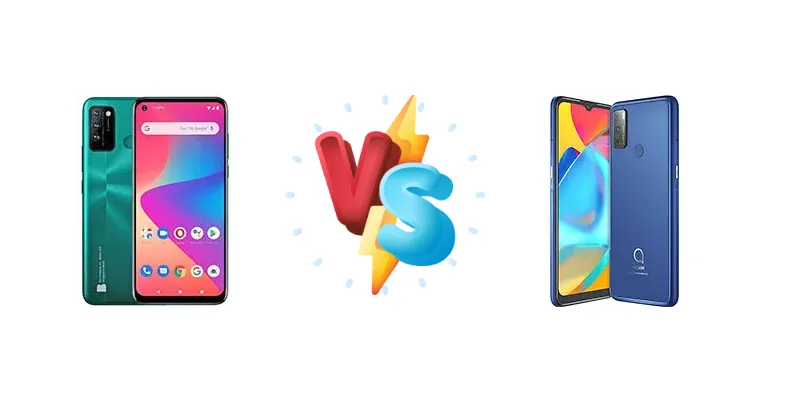
The BLU G71 and the alcatel 3L (2021) represent the extreme end of the smartphone price spectrum. Both aim to deliver essential smartphone functionality at a minimal cost, but they achieve this with different hardware approaches. This comparison dissects their specifications to determine which device offers the best value for users prioritizing affordability.
🏆 Quick Verdict
For the average user seeking a basic, functional smartphone, the alcatel 3L (2021) offers a slight advantage due to its Mediatek Helio P22 chipset. While both phones share 10W charging and similar core architectures, the alcatel's dual-cluster Cortex-A53 configuration provides a marginal performance boost in multitasking and app loading.
| Network |
|---|
| 2G bands | GSM 850 / 900 / 1800 / 1900 | GSM 850 / 900 / 1800 / 1900 |
| 3G bands | HSDPA 850 / 900 / 1700(AWS) / 1900 / 2100 | HSDPA 850 / 900 / 1900 / 2100 |
| 4G bands | 1, 2, 3, 4, 5, 7, 12, 17, 28 | 1, 3, 7, 8, 20, 28 |
| Speed | HSPA 42.2/11.5 Mbps, LTE Cat4 150/50 Mbps | HSPA 42.2/5.76 Mbps, LTE Cat4 150/50 Mbps |
| Technology | GSM / HSPA / LTE | GSM / HSPA / LTE |
| Launch |
|---|
| Announced | 2021, February 19. Released 2021, February 19 | 2021, January 12 |
| Status | Discontinued | Available. Released 2021, April 26 |
| Body |
|---|
| Build | - | Glass front, plastic back, plastic frame |
| Dimensions | 165 x 76.6 x 8.9 mm (6.50 x 3.02 x 0.35 in) | 165.6 x 75.6 x 8.7 mm (6.52 x 2.98 x 0.34 in) |
| SIM | Nano-SIM + Nano-SIM | · Nano-SIM· Nano-SIM + Nano-SIM |
| Weight | 194 g (6.84 oz) | 194 g (6.84 oz) |
| Display |
|---|
| Resolution | 720 x 1600 pixels, 20:9 ratio (~270 ppi density) | 720 x 1600 pixels, 20:9 ratio (~269 ppi density) |
| Size | 6.5 inches, 102.0 cm2 (~80.7% screen-to-body ratio) | 6.52 inches, 102.6 cm2 (~82.0% screen-to-body ratio) |
| Type | IPS LCD | IPS LCD |
| Platform |
|---|
| CPU | Octa-core 1.8 GHz Cortex-A53 | Octa-core (4x1.8 GHz Cortex-A53 & 4x1.5 GHz Cortex-A53) |
| Chipset | - | Mediatek MT6762D Helio P22 (12 nm) |
| GPU | - | PowerVR GE8320 |
| OS | Android 10 | Android 11 |
| Memory |
|---|
| Card slot | microSDXC (dedicated slot) | microSDXC (only single sim model) |
| Internal | 64GB 3GB RAM | 64GB 4GB RAM |
| | eMMC 5.1 | eMMC 5.1 |
| Main Camera |
|---|
| Features | LED flash | LED flash, HDR, panorama |
| Single | 13 MP | - |
| Triple | 13 MP, (wide), AF
5 MP, (ultrawide)
Auxiliary lens | 48 MP, f/1.8, 26mm (wide), 1/2.0", 0.8µm, PDAF
2 MP (macro)
Auxiliary lens |
| Video | 1080p@30fps | 1080p@30fps |
| Selfie camera |
|---|
| Features | - | HDR |
| Single | 13 MP | 8 MP, f/2.0, 26mm (wide), 1/4.0", 1.12µm |
| Video | 720p@30fps | 1080p@30fps |
| Sound |
|---|
| 3.5mm jack | Yes | Yes |
| 35mm jack | Yes | Yes |
| Loudspeaker | Yes | Yes |
| Comms |
|---|
| Bluetooth | 4.0, A2DP | 5.0, A2DP, LE |
| NFC | No | Yes |
| Positioning | GPS | GPS, GLONASS, GALILEO, BDS |
| Radio | FM radio | FM radio |
| USB | USB Type-C 2.0 | microUSB 2.0, OTG |
| WLAN | Wi-Fi 802.11 a/b/g/n, Wi-Fi Direct | Wi-Fi 802.11 b/g/n, Wi-Fi Direct |
| Features |
|---|
| Sensors | Fingerprint (rear-mounted), accelerometer, proximity | Fingerprint (rear-mounted), accelerometer, proximity, compass |
| Battery |
|---|
| Charging | 10W wired | 10W wired |
| Type | Li-Po 5000 mAh | Li-Po 4000 mAh |
| Misc |
|---|
| Colors | Black, Blue, Green, Red | Jewelry Blue, Jewelry Black |
| Models | - | 6056D |
| Price | About 80 EUR | About 330 EUR |
BLU G71
- Potentially better brand recognition in the US market.
- Simple and straightforward user experience.
- Reliable for basic communication tasks.
- Less efficient CPU architecture compared to the alcatel 3L.
- Likely lower performance in multitasking scenarios.
- Limited camera capabilities.
alcatel 3L (2021)
- More efficient dual-cluster CPU architecture.
- Potentially smoother performance in everyday tasks.
- Competitive pricing.
- Less well-known brand.
- Limited camera capabilities.
- May lack certain software features found on BLU devices.
Display Comparison
Neither device boasts a standout display. Both likely utilize LCD panels, typical for this price bracket. Specifics like resolution and brightness are not provided, but we can assume both offer a basic viewing experience suitable for casual use. Bezels are likely substantial on both, maximizing screen real estate within a compact form factor. Color accuracy is expected to be standard, prioritizing power efficiency over fidelity.
Camera Comparison
Camera performance on both devices will be limited. Details are scarce, but it’s safe to assume both feature basic sensors. The absence of Optical Image Stabilization (OIS) on either device means image quality will suffer in low-light conditions. Any secondary cameras (likely 2MP macro or depth sensors) are unlikely to provide significant value. Image processing will likely prioritize speed over detail, resulting in soft images with limited dynamic range. The alcatel 3L may have a slight edge if it utilizes a larger primary sensor, but this is unconfirmed.
Performance
The alcatel 3L (2021) utilizes the Mediatek MT6762D Helio P22 (12 nm), featuring an octa-core CPU comprised of four 1.8 GHz Cortex-A53 cores and four 1.5 GHz Cortex-A53 cores. This dual-cluster design allows for more efficient task allocation, dedicating the faster cores to demanding applications and the slower cores to background processes. The BLU G71, conversely, employs a single cluster of eight 1.8 GHz Cortex-A53 cores. While core count is the same, the alcatel’s architecture offers a slight advantage in multitasking. Both devices will struggle with graphically intensive games, but the alcatel may exhibit marginally smoother performance in less demanding titles. Neither device specifies RAM, but expect 2-3GB, impacting app retention.
Battery Life
Both the BLU G71 and the alcatel 3L (2021) support 10W wired charging, indicating similar charging speeds. A full 0-100% charge will likely take over two hours. Battery capacity is not specified for either device, but given their price point, expect capacities around 3000-4000 mAh. Real-world battery life will depend heavily on usage patterns, but both should provide a full day of light use (calls, texts, basic browsing). The alcatel’s slightly more efficient chipset may translate to marginally longer battery life under similar workloads.
Buying Guide
Buy the BLU G71 if you need a simple, no-frills device for basic communication and light tasks, and are prioritizing brand recognition within the US market. Buy the alcatel 3L (2021) if you prefer a slightly more responsive experience for everyday use, and are comfortable with a less well-known brand, potentially benefiting from a lower price point.
Frequently Asked Questions
❓ Will the alcatel 3L (2021) struggle with popular social media apps like Facebook and Instagram?
While the alcatel 3L (2021) can run these apps, expect some lag and slower loading times, especially with multiple apps open simultaneously. The Helio P22 chipset is designed for basic tasks, and these apps can be resource-intensive. Closing unused apps will help improve performance.
❓ Is the 10W charging speed on either phone sufficient for emergency top-ups throughout the day?
10W charging is quite slow by modern standards. While it will provide some charge during a short period, it's not ideal for quick top-ups. Expect to leave the phone plugged in for a significant amount of time to see a substantial increase in battery percentage. Plan to charge overnight for optimal results.
❓ Can either of these phones handle basic mobile gaming, like Candy Crush or Angry Birds?
Yes, both phones can handle less demanding mobile games like Candy Crush or Angry Birds. However, expect lower graphics settings and potential frame rate drops. More graphically intensive games will likely be unplayable or provide a very poor experience.