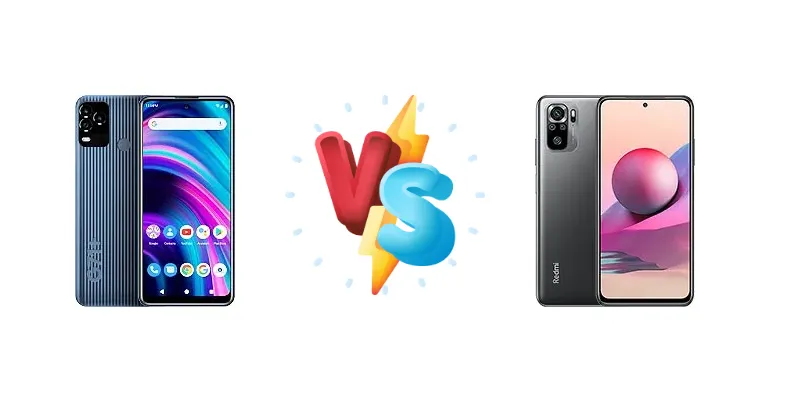
The sub-$200 smartphone market is fiercely competitive. The BLU G71+ and the Xiaomi Redmi Note 11 SE (India) both aim to deliver a solid experience without breaking the bank. However, they take different approaches to achieving this, with the Redmi Note 11 SE leveraging a more modern chipset while the BLU G71+ focuses on a streamlined experience. This comparison dives deep into the specifics to determine which device offers the best value.
🏆 Quick Verdict
For the average user prioritizing gaming and faster charging, the Xiaomi Redmi Note 11 SE (India) is the better choice. Its Helio G95 chipset, with its Cortex-A76 cores, provides a noticeable performance edge over the BLU G71+'s Cortex-A75. While the BLU G71+ is a capable device, the Redmi Note 11 SE’s 33W charging and more powerful processor make it the winner.
| Network |
|---|
| 2G bands | GSM 850 / 900 / 1800 / 1900 - SIM 1 & SIM 2 | GSM 850 / 900 / 1800 / 1900 |
| 3G bands | HSDPA 850 / 900 / 1700(AWS) / 1900 / 2100 | HSDPA 850 / 900 / 1700(AWS) / 1900 / 2100 |
| 4G bands | 2, 3, 4, 5, 7, 12, 17, 28, 66 | 1, 2, 3, 4, 5, 7, 8, 20, 28, 38, 40, 41 |
| Speed | HSPA, LTE | HSPA, LTE |
| Technology | GSM / HSPA / LTE | GSM / HSPA / LTE |
| Launch |
|---|
| Announced | 2022, January | 2022, August 24 |
| Status | Available. Released 2022, January | Available. Released 2022, August 31 |
| Body |
|---|
| Dimensions | 160.2 x 76.7 x 9 mm (6.31 x 3.02 x 0.35 in) | 160.5 x 74.5 x 8.3 mm (6.32 x 2.93 x 0.33 in) |
| SIM | Dual SIM (Nano-SIM, dual stand-by) | Nano-SIM + Nano-SIM |
| Weight | 175 g (6.17 oz) | 178.8 g (6.31 oz) |
| | - | IP53, dust and splash resistant |
| Display |
|---|
| Protection | - | Corning Gorilla Glass 3 |
| Resolution | 720 x 1600 pixels, 20:9 ratio (~270 ppi density) | 1080 x 2400 pixels, 20:9 ratio (~409 ppi density) |
| Size | 6.5 inches, 102.0 cm2 (~83.0% screen-to-body ratio) | 6.43 inches, 99.8 cm2 (~83.5% screen-to-body ratio) |
| Type | IPS LCD | Super AMOLED, 450 nits (typ), 700 nits (HBM), 1100 nits (peak) |
| Platform |
|---|
| CPU | Octa-core 1.8 GHz Cortex-A75 | Octa-core (2x2.05 GHz Cortex-A76 & 6x2.0 GHz Cortex-A55) |
| Chipset | - | Mediatek MT6785V/CD Helio G95 (12 nm) |
| GPU | - | Mali-G76 MC4 |
| OS | Android 11 | Android 11, MIUI 12.5 |
| Memory |
|---|
| Card slot | microSDXC | microSDXC (dedicated slot) |
| Internal | 64GB 4GB RAM, 128GB 4GB RAM | 64GB 6GB RAM, 128GB 6GB RAM, 128GB 8GB RAM |
| | eMMC 5.1 | UFS 2.2 |
| Main Camera |
|---|
| Features | LED flash | LED flash, HDR, panorama |
| Quad | - | 64 MP, f/1.9, 26mm (wide), 1/1.97", 0.7µm, PDAF
8 MP, f/2.2, 118˚ (ultrawide), 1/4.0", 1.12µm
2 MP (macro)
Auxiliary lens |
| Single | 13 MP | - |
| Triple | 13 MP, (wide)
2 MP, (macro)
2 MP, (depth) | - |
| Video | 1080p@30fps | 4K@30fps, 1080p@30/60fps |
| Selfie camera |
|---|
| Features | - | HDR |
| Single | 13 MP | 13 MP, f/2.5, (wide), 1/3.06", 1.12µm |
| Video | 1080p@30fps | 1080p@30fps |
| Sound |
|---|
| 3.5mm jack | Yes | Yes |
| 35mm jack | - | Yes |
| Loudspeaker | Yes | Yes, with stereo speakers |
| | - | 24-bit/192kHz audio |
| Comms |
|---|
| Bluetooth | 4.2, A2DP, LE | 5.0, A2DP, LE |
| Infrared port | - | Yes |
| NFC | No | Yes (market/region dependent) |
| Positioning | GPS | GPS, GLONASS, GALILEO, BDS |
| Radio | FM radio | FM radio |
| USB | USB Type-C 2.0 | USB Type-C 2.0 |
| WLAN | Wi-Fi 802.11 b/g/n, Wi-Fi Direct | Wi-Fi 802.11 a/b/g/n/ac, dual-band, Wi-Fi Direct |
| Features |
|---|
| Sensors | Fingerprint (rear-mounted), accelerometer, proximity | Fingerprint (side-mounted), accelerometer, gyro, compass |
| | - | Virtual proximity sensing |
| Battery |
|---|
| Charging | - | 33W wired, 54% in 30 min |
| Type | Li-Po 4900 mAh, non-removable | Li-Po 5000 mAh |
| Misc |
|---|
| Colors | Bronze, Blue, Green, White | Thunder Purple, Cosmic White, Shadow Black, Bifrost Blue |
| Models | - | 22087RA4DI |
| Price | - | About 300 EUR |
BLU G71+
- Potentially cleaner software experience (BLU typically uses minimal customization)
- May be more readily available in certain regions
- Likely a more affordable price point
- Inferior CPU performance compared to the Redmi Note 11 SE
- Lacks fast charging capabilities
- Limited information available on display and camera specs
Xiaomi Redmi Note 11 SE (India)
- More powerful Helio G95 chipset for better gaming and multitasking
- 33W fast charging for quicker top-ups
- Likely better image processing capabilities
- MIUI software can be resource-intensive and include bloatware
- May not be available in all regions
- Potentially slightly higher price
Display Comparison
Neither device boasts a standout display. The context data lacks specifics on panel type, resolution, or refresh rate for the BLU G71+. Given its price point, it likely utilizes an IPS LCD panel. The Redmi Note 11 SE (India) is also expected to have an IPS LCD. The key difference lies in processing power; the Redmi Note 11 SE’s Helio G95 is more capable of handling graphically intensive tasks displayed on the screen. Without detailed display specs for the BLU G71+, it’s difficult to assess color accuracy or brightness, but the Redmi Note 11 SE likely offers a slightly better visual experience due to its more powerful GPU.
Camera Comparison
Without detailed camera specifications for the BLU G71+, a direct comparison is challenging. However, given the price bracket, both phones likely feature a primary camera around 13-50MP. The Redmi Note 11 SE’s image processing capabilities, powered by the Helio G95’s ISP, are likely more refined. The presence of a dedicated ISP within the Helio G95 allows for faster image processing and potentially better low-light performance. It’s safe to assume the Redmi Note 11 SE will deliver more consistent and detailed photos, especially in challenging lighting conditions. The inclusion of a 2MP macro camera on either device is largely a marketing gimmick and offers limited practical benefit.
Performance
The performance gap is the most significant differentiator. The Xiaomi Redmi Note 11 SE (India) features the Mediatek Helio G95, a 12nm chipset with a CPU configuration of 2x2.05 GHz Cortex-A76 and 6x2.0 GHz Cortex-A55 cores. This is a clear upgrade over the BLU G71+'s Octa-core 1.8 GHz Cortex-A75 CPU. The Cortex-A76 cores in the Helio G95 offer superior single-core performance, crucial for responsive app loading and smoother multitasking. While both are octa-core CPUs, the architectural differences translate to a tangible performance advantage for the Redmi Note 11 SE, particularly in gaming and demanding applications. The Redmi Note 11 SE will likely exhibit less stuttering and faster frame rates in titles like PUBG Mobile.
Battery Life
The Redmi Note 11 SE (India) boasts 33W wired charging, capable of reaching 54% charge in 30 minutes. This is a significant advantage over the BLU G71+, which lacks fast charging specifications. While the BLU G71+'s battery capacity is unknown, the Redmi Note 11 SE’s faster charging mitigates concerns about battery life. Users can quickly top up their device, minimizing downtime. The 33W charging is a practical benefit for users who frequently use their phones throughout the day.
Buying Guide
Buy the BLU G71+ if you need a simple, reliable smartphone for everyday tasks and prioritize a clean software experience. It's a good option for users who don't heavily game or require fast charging. Buy the Xiaomi Redmi Note 11 SE (India) if you prefer a phone capable of handling more demanding games, appreciate faster charging speeds, and are comfortable with Xiaomi’s MIUI software.
Frequently Asked Questions
❓ Does the Redmi Note 11 SE (India) overheat during prolonged gaming sessions?
The Helio G95 is a relatively efficient chipset. While some heat generation is inevitable during extended gaming, the Redmi Note 11 SE (India) is unlikely to experience significant thermal throttling due to its efficient design and adequate cooling solutions for its price range. However, performance may slightly decrease after very long gaming sessions.
❓ Is the software on the BLU G71+ significantly less bloated than on the Redmi Note 11 SE?
BLU phones generally ship with a near-stock Android experience, minimizing pre-installed bloatware. Xiaomi’s MIUI, on the other hand, includes a variety of pre-installed apps and customizations. Users who prefer a cleaner, more streamlined software experience will likely find the BLU G71+ more appealing.
❓ Can the Redmi Note 11 SE (India) run graphically demanding games like Genshin Impact?
The Redmi Note 11 SE (India) can run Genshin Impact, but you'll likely need to lower the graphics settings to medium or low to achieve a playable frame rate. The Helio G95 is capable, but it's not a flagship-level chipset, so compromises are necessary for demanding titles.