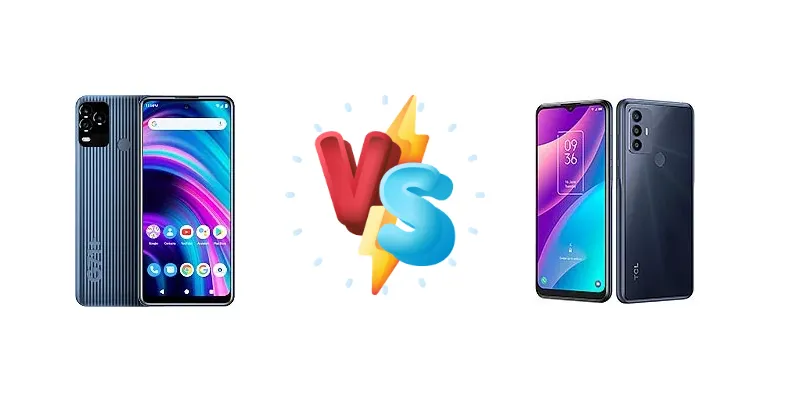
The BLU G71+ and TCL 30 SE represent two compelling options in the ultra-budget smartphone space. While both aim to deliver essential smartphone functionality at a low price point, they take different approaches to achieving this. The G71+ focuses on a more powerful, though older, CPU architecture, while the 30 SE leverages a newer, if less potent, chipset with a focus on efficiency. This comparison will dissect their key differences to determine which device offers the best value.
🏆 Quick Verdict
For the average user prioritizing responsiveness and occasional multitasking, the BLU G71+ emerges as the better choice. Its Cortex-A75 based CPU provides a noticeable performance advantage over the TCL 30 SE’s Helio G25, despite the latter’s newer manufacturing process. However, the TCL 30 SE’s 15W charging is a welcome addition.
| Network |
|---|
| 2G bands | GSM 850 / 900 / 1800 / 1900 - SIM 1 & SIM 2 | GSM 850 / 900 / 1800 / 1900 |
| 3G bands | HSDPA 850 / 900 / 1700(AWS) / 1900 / 2100 | HSDPA 850 / 900 / 1900 / 2100 - EMEA/APAC |
| 4G bands | 2, 3, 4, 5, 7, 12, 17, 28, 66 | 1, 3, 5, 7, 8, 20, 28, 38, 40, 41 - EMEA |
| Speed | HSPA, LTE | HSPA 42.2/11.5 Mbps, LTE Cat4 150/50 Mbps |
| Technology | GSM / HSPA / LTE | GSM / HSPA / LTE |
| | - | 2, 3, 4, 5, 7, 8, 12, 13, 17, 26, 28, 66 - LATAM |
| Launch |
|---|
| Announced | 2022, January | 2022, February 27 |
| Status | Available. Released 2022, January | Available. Released 2022, April 20 |
| Body |
|---|
| Build | - | Glass front, plastic frame, plastic back |
| Dimensions | 160.2 x 76.7 x 9 mm (6.31 x 3.02 x 0.35 in) | 165.2 x 75.5 x 8.9 mm (6.50 x 2.97 x 0.35 in) |
| SIM | Dual SIM (Nano-SIM, dual stand-by) | · Nano-SIM· Nano-SIM + Nano-SIM |
| Weight | 175 g (6.17 oz) | 190 g (6.70 oz) |
| Display |
|---|
| Resolution | 720 x 1600 pixels, 20:9 ratio (~270 ppi density) | 720 x 1600 pixels, 20:9 ratio (~269 ppi density) |
| Size | 6.5 inches, 102.0 cm2 (~83.0% screen-to-body ratio) | 6.52 inches, 102.6 cm2 (~82.3% screen-to-body ratio) |
| Type | IPS LCD | IPS LCD, 450 nits (typ) |
| Platform |
|---|
| CPU | Octa-core 1.8 GHz Cortex-A75 | Octa-core (4x2.0 GHz Cortex-A53 & 4x1.5 GHz Cortex-A53) |
| Chipset | - | Mediatek MT6762G Helio G25 (12 nm) |
| GPU | - | PowerVR GE8320 |
| OS | Android 11 | Android 12, TCL UI 4.0 |
| Memory |
|---|
| Card slot | microSDXC | microSDXC (dedicated slot) |
| Internal | 64GB 4GB RAM, 128GB 4GB RAM | 64GB 4GB RAM, 128GB 4GB RAM |
| | eMMC 5.1 | eMMC 5.1 |
| Main Camera |
|---|
| Features | LED flash | LED flash, HDR, panorama |
| Single | 13 MP | 8 MP, f/2.0, 26mm (wide), 1/4", 1.12µm |
| Triple | 13 MP, (wide)
2 MP, (macro)
2 MP, (depth) | 50 MP, f/1.9, 28mm (wide), 1/2.76", 0.64µm, PDAF
2 MP (macro)
Auxiliary lens |
| Video | 1080p@30fps | 1080p@30fps |
| Selfie camera |
|---|
| Features | - | HDR |
| Single | 13 MP | 8 MP, f/2.0, 26mm (wide), 1/4.0", 1.12µm |
| Video | 1080p@30fps | 1080p@30fps |
| Sound |
|---|
| 3.5mm jack | Yes | Yes |
| 35mm jack | - | Yes |
| Loudspeaker | Yes | Yes |
| Comms |
|---|
| Bluetooth | 4.2, A2DP, LE | 5.0, A2DP, LE |
| NFC | No | Yes (6165H/6165H1 only) |
| Positioning | GPS | GPS, GLONASS, GALILEO, BDS |
| Radio | FM radio | Unspecified |
| USB | USB Type-C 2.0 | USB Type-C 2.0 |
| WLAN | Wi-Fi 802.11 b/g/n, Wi-Fi Direct | Wi-Fi 802.11 b/g/n, Wi-Fi Direct |
| Features |
|---|
| Sensors | Fingerprint (rear-mounted), accelerometer, proximity | Fingerprint (rear-mounted), accelerometer, proximity, compass |
| Battery |
|---|
| Charging | - | 15W wired |
| Type | Li-Po 4900 mAh, non-removable | Li-Po 5000 mAh |
| Misc |
|---|
| Colors | Bronze, Blue, Green, White | Atlantic Blue, Space Gray, Glacial Blue |
| Models | - | 6165H, 6156H1, 6165A, 6165A1, 6165S |
BLU G71+
- More powerful CPU for smoother performance
- Cortex-A75 architecture handles multitasking better
- Potentially better gaming experience (though limited)
- Likely lacks fast charging
- May have shorter battery life under heavy load
TCL 30 SE
- 15W wired charging for faster top-ups
- More efficient chipset for potentially longer standby
- Newer manufacturing process (12nm)
- Significantly weaker CPU performance
- May struggle with demanding apps and multitasking
Display Comparison
Neither BLU nor TCL provide detailed display specifications in the provided data. Given their price points, it’s safe to assume both utilize LCD panels with 720p+ resolutions. The absence of information regarding refresh rates suggests both are likely capped at 60Hz. Without knowing peak brightness or color gamut coverage, it’s difficult to definitively declare a winner; however, TCL’s broader manufacturing experience in display technology *could* translate to slightly better color accuracy, though this is speculative.
Camera Comparison
Both devices likely feature basic camera setups geared towards casual photography. Without sensor size or aperture information, a direct comparison is challenging. It’s reasonable to assume both phones include a primary camera and potentially a depth or macro sensor. Given the market segment, image processing will likely prioritize speed over detail. The absence of Optical Image Stabilization (OIS) on either device suggests low-light performance will be limited. The TCL 30 SE’s camera system is unlikely to offer a substantial advantage over the BLU G71+’s.
Performance
The core difference lies in the CPU architecture. The BLU G71+’s octa-core 1.8 GHz Cortex-A75 CPU represents a significant step up in performance compared to the TCL 30 SE’s MediaTek Helio G25. The G25 utilizes four Cortex-A53 cores clocked at 2.0 GHz and another four at 1.5 GHz. While the G25 benefits from a more modern 12nm process, the Cortex-A75 architecture is fundamentally more powerful per clock cycle. This means the G71+ will handle demanding apps and multitasking with greater ease. The G25’s architecture is geared towards efficiency, but at the cost of raw processing power. The G71+ will likely exhibit less lag when switching between apps or loading heavier web pages.
Battery Life
Battery capacity is not specified for either device. However, the TCL 30 SE’s inclusion of 15W wired charging is a notable advantage. While neither phone is likely to offer exceptional battery life, the faster charging speed will reduce downtime. The BLU G71+’s more powerful CPU will likely consume more power during intensive tasks, potentially offsetting any gains from a larger battery capacity (if present). The Helio G25’s efficiency could lead to longer standby times, but the G71+’s faster processing will complete tasks quicker, potentially reducing overall energy expenditure.
Buying Guide
Buy the BLU G71+ if you need a phone that feels snappier for everyday tasks like browsing, social media, and light app usage. Its CPU architecture will handle these workloads more efficiently. Buy the TCL 30 SE if you prioritize battery life and are a very light user who primarily makes calls, sends texts, and occasionally checks email. The Helio G25’s efficiency may translate to slightly longer standby times, and the 15W charging is a plus for topping up.
Frequently Asked Questions
❓ Will the TCL 30 SE struggle with popular social media apps like TikTok or Instagram?
The TCL 30 SE’s MediaTek Helio G25 chipset is designed for basic tasks. While it can run social media apps, you may experience occasional lag or slowdowns when scrolling through feeds or recording videos, especially if multiple apps are open in the background. The BLU G71+ will offer a smoother experience in these scenarios.
❓ Is the BLU G71+ suitable for playing mobile games?
The BLU G71+ is capable of running some mobile games, but don’t expect a high-end gaming experience. The Cortex-A75 CPU provides a performance boost over the TCL 30 SE, allowing for playable frame rates in less demanding titles. However, graphically intensive games will likely require reduced settings and may still exhibit stuttering. The Helio G25 in the TCL 30 SE is even less suited for gaming.
❓ How long will it take to fully charge the TCL 30 SE with the 15W charger?
While the exact 0-100% charge time isn't specified, 15W charging on a budget device like the TCL 30 SE will likely take between 2.5 to 3.5 hours, depending on battery capacity. This is significantly faster than the charging speed likely offered by the BLU G71+.