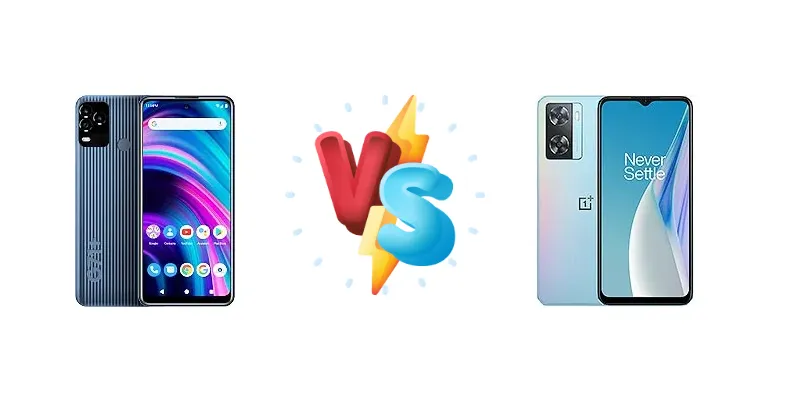
The BLU G71+ and OnePlus Nord N20 SE represent compelling options in the ultra-budget smartphone space. While both aim to deliver essential smartphone functionality at a low price point, they take different approaches to achieving this. The G71+ relies on a Cortex-A75 based octa-core CPU, while the Nord N20 SE utilizes the Mediatek Helio G35 chipset. This comparison will dissect their key differences to determine which device offers the best value.
🏆 Quick Verdict
For the average user prioritizing quick top-ups and a slightly more refined software experience, the OnePlus Nord N20 SE is the better choice. Its 33W charging capability, reaching 100% in 69 minutes, significantly outperforms the BLU G71+'s unknown charging speed. However, the G71+'s Cortex-A75 CPU may offer a slight edge in sustained performance.
| Network |
|---|
| 2G bands | GSM 850 / 900 / 1800 / 1900 - SIM 1 & SIM 2 | GSM 850 / 900 / 1800 / 1900 |
| 3G bands | HSDPA 850 / 900 / 1700(AWS) / 1900 / 2100 | HSDPA 850 / 900 / 2100 - Global |
| 4G bands | 2, 3, 4, 5, 7, 12, 17, 28, 66 | 1, 3, 5, 7, 8, 20, 28, 38, 40, 41 - Global |
| Speed | HSPA, LTE | HSPA, LTE |
| Technology | GSM / HSPA / LTE | GSM / HSPA / LTE |
| | - | 1, 2, 3, 4, 5, 7, 8, 12, 13, 17, 18, 19, 26, 28, 38, 41, 66 - LATAM |
| Launch |
|---|
| Announced | 2022, January | 2022, August 05 |
| Status | Available. Released 2022, January | Available. Released 2022, August 08 |
| Body |
|---|
| Build | - | Glass front, plastic frame, plastic back |
| Dimensions | 160.2 x 76.7 x 9 mm (6.31 x 3.02 x 0.35 in) | 163.8 x 75 x 8 mm (6.45 x 2.95 x 0.31 in) |
| SIM | Dual SIM (Nano-SIM, dual stand-by) | Nano-SIM + Nano-SIM |
| Weight | 175 g (6.17 oz) | 187 g (6.60 oz) |
| Display |
|---|
| Resolution | 720 x 1600 pixels, 20:9 ratio (~270 ppi density) | 720 x 1612 pixels, 20:9 ratio (~269 ppi density) |
| Size | 6.5 inches, 102.0 cm2 (~83.0% screen-to-body ratio) | 6.56 inches, 103.4 cm2 (~84.2% screen-to-body ratio) |
| Type | IPS LCD | IPS LCD, 480 nits (typ), 600 nits (HBM) |
| Platform |
|---|
| CPU | Octa-core 1.8 GHz Cortex-A75 | Octa-core (4x2.3 GHz Cortex-A53 & 4x1.8 GHz Cortex-A53) |
| Chipset | - | Mediatek MT6765G Helio G35 (12 nm) |
| GPU | - | PowerVR GE8320 |
| OS | Android 11 | Android 12, OxygenOS 12.1 |
| Memory |
|---|
| Card slot | microSDXC | microSDXC |
| Internal | 64GB 4GB RAM, 128GB 4GB RAM | 64GB 4GB RAM, 128GB 4GB RAM |
| | eMMC 5.1 | eMMC 5.1 |
| Main Camera |
|---|
| Dual | - | 50 MP, f/1.8, (wide), 1/2.76", 0.64µm, PDAF
Auxiliary lens |
| Features | LED flash | LED flash, HDR, panorama |
| Single | 13 MP | 8 MP, f/2.0, 26mm (wide), 1/4", 1.12µm |
| Triple | 13 MP, (wide)
2 MP, (macro)
2 MP, (depth) | - |
| Video | 1080p@30fps | 1080p@30fps |
| Selfie camera |
|---|
| Single | 13 MP | 8 MP, f/2.0, 26mm (wide), 1/4.0", 1.12µm |
| Video | 1080p@30fps | 1080p@30fps |
| Sound |
|---|
| 3.5mm jack | Yes | Yes |
| 35mm jack | - | Yes |
| Loudspeaker | Yes | Yes, with dual speakers |
| Comms |
|---|
| Bluetooth | 4.2, A2DP, LE | 5.3, A2DP, LE, aptX HD |
| NFC | No | No |
| Positioning | GPS | GPS, GLONASS, BDS, GALILEO, QZSS |
| Radio | FM radio | No |
| USB | USB Type-C 2.0 | USB Type-C 2.0, OTG |
| WLAN | Wi-Fi 802.11 b/g/n, Wi-Fi Direct | Wi-Fi 802.11 a/b/g/n/ac, dual-band, Wi-Fi Direct |
| Features |
|---|
| Sensors | Fingerprint (rear-mounted), accelerometer, proximity | Fingerprint (side-mounted), accelerometer, proximity, compass |
| Battery |
|---|
| Charging | - | 33W wired, 50% in 34 min, 100% in 69 min |
| Type | Li-Po 4900 mAh, non-removable | Li-Po 5000 mAh |
| Misc |
|---|
| Colors | Bronze, Blue, Green, White | Blue Oasis, Celestial Black |
| Models | - | CPH2469 |
| Price | - | About 190 EUR |
BLU G71+
- Potentially better sustained CPU performance with Cortex-A75 cores
- May offer a more unique design compared to OnePlus's standard aesthetic
- Potentially lower price point
- Unknown charging speed – likely significantly slower than the Nord N20 SE
- Less established brand reputation
- Potentially less refined software experience
OnePlus Nord N20 SE
- Fast 33W charging (50% in 34 min, 100% in 69 min)
- More recognizable and trusted brand (OnePlus)
- Likely smoother software experience
- Less powerful CPU core architecture (Cortex-A53)
- May be slightly more expensive than the BLU G71+
- Potentially less RAM for multitasking
Display Comparison
Neither device's display specifications are provided, so a direct comparison is limited. However, given the price bracket, both likely utilize LCD panels with 720p or 1080p resolution. The OnePlus brand generally prioritizes display quality, suggesting a potentially more color-accurate panel on the Nord N20 SE. Bezels are likely comparable, being relatively thick on both to maintain affordability.
Camera Comparison
Without detailed camera specifications, a meaningful comparison is difficult. Both devices likely feature a primary camera alongside depth or macro sensors. The absence of information regarding sensor size and aperture makes it impossible to assess image quality. Given the price point, image processing will likely be basic on both devices, relying heavily on software algorithms to enhance photos. The usefulness of any included 2MP macro camera is questionable on both phones.
Performance
The core architectural difference lies in the CPUs. The BLU G71+ features an octa-core processor with 1.8 GHz Cortex-A75 cores. The Nord N20 SE’s Helio G35 utilizes a combination of 2.3 GHz Cortex-A53 cores and 1.8 GHz Cortex-A53 cores. While the G35 boasts higher clock speeds on its A53 cores, the Cortex-A75 in the G71+ is a significantly more powerful core architecture, offering better single-core performance and improved efficiency. However, the G35’s four high-performance cores may provide a boost in multi-threaded tasks. The Helio G35's 12nm process node is also less efficient than more modern fabrication processes, potentially leading to more heat generation under sustained load.
Battery Life
Battery capacity is not specified for either device. However, the OnePlus Nord N20 SE’s 33W wired charging is a significant advantage. The ability to reach 50% charge in 34 minutes and 100% in 69 minutes provides a substantial convenience factor. The BLU G71+'s charging speed is unknown, but is likely considerably slower, potentially requiring several hours for a full charge. This difference in charging speed is a key differentiator for users who frequently need to top up their phones.
Buying Guide
Buy the BLU G71+ if you prioritize potentially better sustained CPU performance for tasks like light gaming or multitasking, and are comfortable with a potentially less polished software experience. Buy the OnePlus Nord N20 SE if you value faster charging speeds, a more recognizable brand, and a generally smoother user experience, even if it means a slightly less powerful CPU core architecture.
Frequently Asked Questions
❓ Is the Mediatek Helio G35 in the Nord N20 SE powerful enough for casual gaming?
The Helio G35 is an entry-level chipset, but it's capable of handling less demanding games like Candy Crush or Subway Surfers. More graphically intensive titles like PUBG Mobile will likely require significantly reduced graphics settings and may still experience frame drops. The G35 prioritizes efficiency over raw power.
❓ How does the BLU G71+'s Cortex-A75 CPU compare to the Nord N20 SE's Helio G35 in everyday tasks like browsing and social media?
The Cortex-A75 cores in the BLU G71+ offer a performance advantage in single-core tasks, meaning apps will likely launch slightly faster and feel more responsive. However, the difference in everyday usage will be minimal for most users. The Nord N20 SE’s software optimization may mitigate the CPU difference.
❓ Does the OnePlus Nord N20 SE support VoLTE and Wi-Fi calling?
Typically, OnePlus Nord N series devices support VoLTE (Voice over LTE) and Wi-Fi calling, but compatibility depends on your carrier. It's crucial to check with your mobile provider to ensure these features are supported on their network before purchasing.
❓ What type of charging port does the BLU G71+ use?
This information is not provided in the context data. However, given the price point and current industry standards, it is highly likely to use a USB-C port. Confirm this before purchase if it is a critical factor.