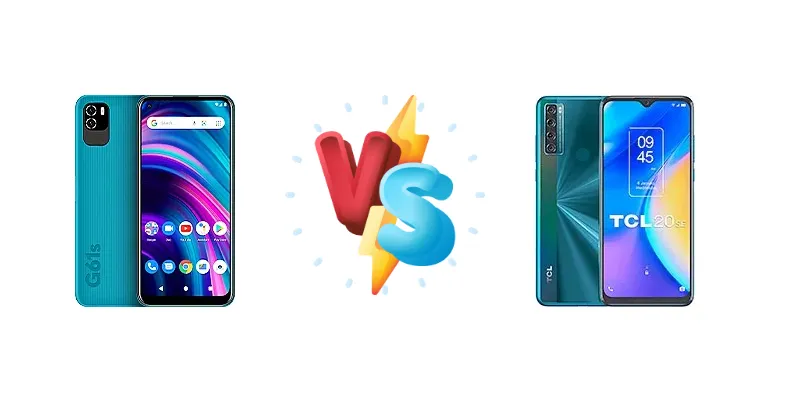
The BLU G61s and TCL 20 SE represent compelling options in the ultra-budget smartphone space. While both aim to deliver essential smartphone functionality at a low price, they take different approaches to achieving this. The G61s relies on a MediaTek octa-core processor, while the TCL 20 SE utilizes Qualcomm’s Snapdragon 460. This comparison will dissect the key differences to determine which device offers the best value for your money.
🏆 Quick Verdict
For the average user prioritizing consistent performance and a more modern chipset, the TCL 20 SE emerges as the better choice. Its Snapdragon 460, built on an 11nm process, offers a more refined experience than the BLU G61s’ Cortex-A75, despite the clock speed difference. The 18W charging is also a significant advantage.
| Network |
|---|
| 2G bands | GSM 850 / 900 / 1800 / 1900 | GSM 850 / 900 / 1800 / 1900 |
| 3G bands | HSDPA 850 / 900 / 1700(AWS) / 1900 / 2100 | HSDPA 850 / 900 / 1900 / 2100 - EMEA, SEA, APAC |
| 4G bands | 2, 3, 4, 5, 7, 12, 17, 28, 66 | 1, 3, 5, 7, 8, 20, 28, 38, 40, 41 - EMEA, SEA, APAC |
| Speed | HSPA, LTE | HSPA, LTE |
| Technology | GSM / HSPA / LTE | GSM / HSPA / LTE |
| | - | 1, 2, 3, 4, 5, 7, 8, 12, 13, 17, 26, 28, 66 - LATAM |
| Launch |
|---|
| Announced | 2022, April | 2021, January 11 |
| Status | Available. Released 2022, April | Available. Released 2021, April 26 |
| Body |
|---|
| Dimensions | 159.5 x 76.5 x 9.8 mm (6.28 x 3.01 x 0.39 in) | 172.1 x 77.1 x 9.1 mm (6.78 x 3.04 x 0.36 in) |
| SIM | Nano-SIM + Nano-SIM | · Nano-SIM· Nano-SIM + Nano-SIM |
| Weight | 164 g (5.78 oz) | 206 g (7.27 oz) |
| Display |
|---|
| Resolution | 720 x 1600 pixels, 20:9 ratio (~270 ppi density) | 720 x 1640 pixels (~263 ppi density) |
| Size | 6.5 inches, 102.0 cm2 (~83.6% screen-to-body ratio) | 6.82 inches, 110.5 cm2 (~83.2% screen-to-body ratio) |
| Type | IPS LCD | IPS LCD, 450 nits (typ) |
| Platform |
|---|
| CPU | Octa-core 2.0 GHz Cortex-A75 | Octa-core (4x1.8 GHz Kryo 240 & 4x1.6 GHz Kryo 240) |
| Chipset | - | Qualcomm SM4250 Snapdragon 460 (11 nm) |
| GPU | - | Adreno 610 |
| OS | Android 11 | Android 11, upgradable to Android 12, TCL UI |
| Memory |
|---|
| Card slot | microSDXC | microSDXC (uses shared SIM slot) |
| Internal | 64GB 4GB RAM | 64GB 4GB RAM, 128GB 4GB RAM |
| | eMMC 5.1 | UFS 2.1 (128GB only) |
| Main Camera |
|---|
| Dual | 13 MP
Auxiliary lens | - |
| Features | LED flash | Dual-LED flash, HDR, panorama |
| Quad | - | 16 MP, f/1.8, 27mm (wide), 1/2.0", 1.12µm, PDAF
5 MP, f/2.2, 14mm, 115˚ (ultrawide), 1/5.0", 1.12µm
Auxiliary lens
2 MP (macro)
or
48 MP, f/2.0, 27mm (wide), 1/2.0", 0.8µm, PDAF
5 MP, f/2.2, 14mm, 115˚ (ultrawide), 1/5.0", 1.12µm
Auxiliary lens
2 MP (macro) |
| Single | 8 MP | - |
| Video | 1080p@30fps | 1080p@30fps |
| Selfie camera |
|---|
| Features | - | HDR |
| Single | 8 MP | 8 MP, f/2.0, 26mm (wide), 1/4.0", 1.12µm
or
13 MP, f/2.2, 26mm (wide), 1/3.0", 1.12µm |
| Video | 1080p@30fps | 1080p@30fps |
| Sound |
|---|
| 3.5mm jack | Yes | Yes |
| 35mm jack | Yes | Yes |
| Loudspeaker | Yes | Yes, with dual speakers |
| | - | 24-bit/192kHz audio |
| Comms |
|---|
| Bluetooth | 4.2, A2DP, LE | 5.0, A2DP, LE, aptX |
| NFC | No | Yes |
| Positioning | GPS | GPS, GLONASS, GALILEO, BDS |
| Radio | FM radio | FM radio |
| USB | USB Type-C 2.0 | USB Type-C 2.0, OTG |
| WLAN | Wi-Fi 802.11 a/b/g/n, Wi-Fi Direct | Wi-Fi 802.11 b/g/n, Wi-Fi Direct |
| Features |
|---|
| Sensors | Fingerprint (side-mounted), accelerometer, proximity | Fingerprint (rear-mounted), accelerometer, proximity, compass |
| Battery |
|---|
| Charging | - | 18W wired |
| Type | Li-Po 5000 mAh | Li-Po 5000 mAh |
| Misc |
|---|
| Colors | Bronze, Red, Green, Cyan, Black | Aurora Green, Nuit Black |
| Models | - | T671H, T671F, T671O, T671E |
| Price | - | About 150 EUR |
BLU G61s
- Potentially higher peak CPU clock speed
- May offer a slightly larger battery (speculative)
- Lower price point (potentially)
- Older CPU architecture (Cortex-A75)
- Less efficient processor
- Likely inferior GPU performance
TCL 20 SE
- More efficient Snapdragon 460 chipset
- 18W fast charging
- Qualcomm’s optimized software and ISP
- Lower CPU clock speed
- May have a smaller battery (speculative)
- Potentially slightly higher price
Display Comparison
Neither device boasts a standout display. Given the context data, we can assume both likely feature 720p LCD panels, typical for this price bracket. The TCL 20 SE’s chipset may offer slightly better display processing capabilities, potentially resulting in smoother scrolling, but this is speculative. Bezels are likely comparable, and color accuracy will be standard for budget phones – adequate but not exceptional.
Camera Comparison
Without detailed camera specs, it’s difficult to make a definitive judgment. However, given the price point, both phones likely feature a primary sensor paired with basic auxiliary lenses. The TCL 20 SE’s image signal processor (ISP) within the Snapdragon 460 will likely offer superior image processing capabilities, resulting in better dynamic range and noise reduction. The G61s’ camera performance will likely be more reliant on software algorithms, which may not be as refined.
Performance
The core difference lies in the processors. The BLU G61s’ octa-core 2.0 GHz Cortex-A75 CPU appears powerful on paper, but the architecture is older. The TCL 20 SE’s Snapdragon 460, while clocked lower at 1.8 GHz and 1.6 GHz for its Kryo 240 cores, benefits from Qualcomm’s optimizations and a more efficient 11nm manufacturing process. This translates to better sustained performance and thermal management. The Snapdragon 460’s Adreno 610 GPU will also outperform the GPU found in the G61s, offering a smoother gaming experience, even at lower settings. The TCL 20 SE’s chipset is more likely to handle multitasking and demanding apps without significant slowdowns.
Battery Life
Battery capacity is not specified for either device. However, the TCL 20 SE’s 18W wired charging is a significant advantage. Faster charging reduces downtime and provides more flexibility. While the BLU G61s may have a slightly larger battery, the Snapdragon 460’s superior power efficiency will likely result in comparable, or even better, real-world battery life. The 11nm process node contributes significantly to this efficiency.
Buying Guide
Buy the BLU G61s if you prioritize raw clock speed and are comfortable with potentially less optimized software. It might appeal to users who occasionally need a burst of processing power for specific tasks. Buy the TCL 20 SE if you value a more balanced experience, better power efficiency, and the reliability of Qualcomm’s Snapdragon platform. This phone is ideal for everyday tasks, social media, and light gaming.
Frequently Asked Questions
❓ Will the Snapdragon 460 in the TCL 20 SE struggle with demanding games like PUBG Mobile?
While the Snapdragon 460 isn't a gaming powerhouse, it's capable of running PUBG Mobile at medium settings with acceptable frame rates. The Adreno 610 GPU provides a noticeable advantage over the GPU likely found in the BLU G61s, offering a smoother experience. Expect to adjust graphics settings for optimal performance.
❓ Does the BLU G61s’ higher clock speed translate to a noticeably faster experience in everyday tasks?
Not necessarily. The Cortex-A75 CPU in the BLU G61s has a higher clock speed, but the Snapdragon 460’s more modern architecture and efficient 11nm process provide better overall performance and responsiveness in real-world usage. Software optimization also plays a crucial role, and Qualcomm typically excels in this area.
❓ How much faster is the 18W charging on the TCL 20 SE compared to a standard 10W charger?
18W charging can significantly reduce charging times. While exact 0-100% times depend on battery capacity, you can expect the TCL 20 SE to charge considerably faster than a phone using a standard 10W charger. This means less time tethered to an outlet and more time using your device.