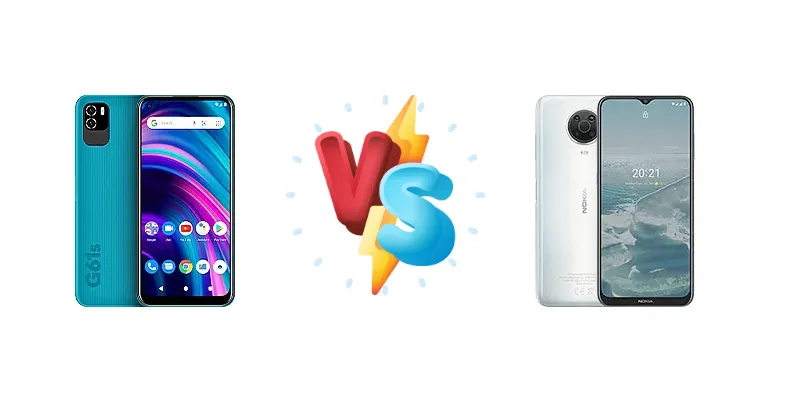
The BLU G61s and Nokia G20 represent two approaches to the ultra-budget smartphone market. The G61s aims for a performance edge with its Cortex-A75 based CPU, while the Nokia G20 prioritizes longevity and a familiar Android experience. This comparison dissects their key differences to determine which device delivers the best value.
🏆 Quick Verdict
For users prioritizing responsiveness and smoother multitasking, the BLU G61s is the better choice thanks to its significantly faster Cortex-A75 CPU. However, the Nokia G20 appeals to those seeking a longer-supported software experience and aren't as concerned with peak performance.
| Network |
|---|
| 2G bands | GSM 850 / 900 / 1800 / 1900 | GSM 850 / 900 / 1800 / 1900 |
| 3G bands | HSDPA 850 / 900 / 1700(AWS) / 1900 / 2100 | HSDPA 850 / 900 / 1900 / 2100 - International |
| 4G bands | 2, 3, 4, 5, 7, 12, 17, 28, 66 | 1, 3, 5, 7, 8, 20, 28, 38, 40, 41 - International |
| Speed | HSPA, LTE | HSPA 42.2/5.76 Mbps, LTE Cat4 150/50 Mbps |
| Technology | GSM / HSPA / LTE | GSM / HSPA / LTE |
| | - | 1, 2, 3, 4, 5, 7, 8, 12, 17, 28, 66 - LATAM |
| Launch |
|---|
| Announced | 2022, April | 2021, April 08 |
| Status | Available. Released 2022, April | Available. Released 2021, May 17 |
| Body |
|---|
| Dimensions | 159.5 x 76.5 x 9.8 mm (6.28 x 3.01 x 0.39 in) | 164.9 x 76 x 9.2 mm (6.49 x 2.99 x 0.36 in) |
| SIM | Nano-SIM + Nano-SIM | · Nano-SIM· Nano-SIM + Nano-SIM |
| Weight | 164 g (5.78 oz) | 197 g (6.95 oz) |
| | - | Splash protection |
| Display |
|---|
| Resolution | 720 x 1600 pixels, 20:9 ratio (~270 ppi density) | 720 x 1600 pixels, 20:9 ratio (~269 ppi density) |
| Size | 6.5 inches, 102.0 cm2 (~83.6% screen-to-body ratio) | 6.52 inches, 102.6 cm2 (~81.9% screen-to-body ratio) |
| Type | IPS LCD | IPS LCD |
| Platform |
|---|
| CPU | Octa-core 2.0 GHz Cortex-A75 | Octa-core (4x2.3 GHz Cortex-A53 & 4x1.8 GHz Cortex-A53) |
| Chipset | - | Mediatek MT6765G Helio G35 (12 nm) |
| GPU | - | PowerVR GE8320 |
| OS | Android 11 | Android 11, upgradable to Android 13 |
| Memory |
|---|
| Card slot | microSDXC | microSDXC (dedicated slot) |
| Internal | 64GB 4GB RAM | 64GB 4GB RAM, 128GB 4GB RAM |
| | eMMC 5.1 | - |
| Main Camera |
|---|
| Dual | 13 MP
Auxiliary lens | - |
| Features | LED flash | LED flash, HDR, panorama |
| Quad | - | 48 MP, f/1.8, (wide), PDAF
5 MP, (ultrawide)
2 MP (macro)
Auxiliary lens |
| Single | 8 MP | 8 MP, (wide) |
| Video | 1080p@30fps | 1080p@30fps |
| Selfie camera |
|---|
| Single | 8 MP | 8 MP, (wide) |
| Video | 1080p@30fps | 1080p@30fps |
| Sound |
|---|
| 3.5mm jack | Yes | Yes |
| 35mm jack | Yes | Yes |
| Loudspeaker | Yes | Yes |
| Comms |
|---|
| Bluetooth | 4.2, A2DP, LE | 5.0, A2DP, LE |
| NFC | No | Yes (market/region dependent) |
| Positioning | GPS | GPS, GLONASS, BDS |
| Radio | FM radio | FM radio |
| USB | USB Type-C 2.0 | USB Type-C 2.0, OTG |
| WLAN | Wi-Fi 802.11 a/b/g/n, Wi-Fi Direct | Wi-Fi 802.11 b/g/n |
| Features |
|---|
| Sensors | Fingerprint (side-mounted), accelerometer, proximity | Fingerprint (side-mounted), accelerometer, gyro, proximity |
| Battery |
|---|
| Charging | - | 10W wired |
| Type | Li-Po 5000 mAh | Li-Po 5050 mAh |
| Misc |
|---|
| Colors | Bronze, Red, Green, Cyan, Black | Glacier, Night |
| Models | - | TA-1336, TA-1343, TA-1347, TA-1372, TA-1365 |
| Price | - | About 90 EUR |
| SAR | - | 1.01 W/kg (head) 1.02 W/kg (body) |
| SAR EU | - | 0.49 W/kg (head) 1.13 W/kg (body) |
BLU G61s
- Faster processor for smoother performance
- More responsive user experience
- Potentially better app compatibility
- Battery life may be shorter than Nokia G20
- Software update support likely less extensive
Nokia G20
- Larger battery capacity for extended use
- Clean Android One software with guaranteed updates
- Potentially lower price point
- Significantly slower processor
- Laggy performance with multiple apps
- Slow 10W charging
Display Comparison
Neither device boasts a standout display. The context data lacks specifics on panel type or resolution for both, suggesting both utilize basic LCD panels common in this price bracket. The Nokia G20's larger size (likely 6.5 inches, based on typical G-series models) may offer a more immersive viewing experience, but without knowing the G61s' screen size, a direct comparison is difficult. Both will likely suffer from limited outdoor visibility and color accuracy.
Camera Comparison
Without detailed camera specifications, a thorough comparison is limited. Both phones likely feature basic camera setups geared towards casual photography. The Nokia G20’s likely inclusion of a 48MP main sensor (based on previous G-series models) *may* offer slightly more detail than the G61s, but image quality is heavily reliant on software processing. The G61s’ image processing algorithms could potentially outperform the G20’s, even with a lower resolution sensor. The presence of a 2MP macro lens on either device is largely inconsequential due to its limited resolution and fixed focus.
Performance
The performance gap is the most significant differentiator. The BLU G61s’ octa-core 2.0 GHz Cortex-A75 CPU represents a substantial leap over the Nokia G20’s MediaTek Helio G35. The Helio G35 utilizes four Cortex-A53 cores clocked at 2.3 GHz and another four at 1.8 GHz. While the G35’s higher clock speed on some cores might seem advantageous, the Cortex-A75 architecture is far more efficient and powerful per clock cycle. This translates to faster app loading times, smoother scrolling, and a more responsive user experience on the G61s. The G35 is designed for basic tasks, while the A75 can handle more demanding applications. The G61s will likely exhibit less lag when switching between apps.
Battery Life
The Nokia G20’s 5050 mAh battery (typical for the model) provides a significant capacity advantage. However, the BLU G61s’ more efficient processor could partially offset this difference. The Nokia G20’s 10W charging is notably slow, requiring a substantial amount of time to reach a full charge. The G61s’ charging speed is unknown, but even a modest increase over 10W would be a significant benefit. Users prioritizing all-day battery life will lean towards the Nokia G20, while those willing to top up more frequently might prefer the G61s’ faster performance.
Buying Guide
Buy the BLU G61s if you need a phone that feels snappy for everyday tasks like browsing, social media, and light gaming. Its more powerful processor will handle multiple apps with less lag. Buy the Nokia G20 if you prefer a clean Android One experience with guaranteed software updates and a focus on battery life, even if it means sacrificing some processing power.
Frequently Asked Questions
❓ Is the MediaTek Helio G35 in the Nokia G20 sufficient for playing modern mobile games?
The Helio G35 is an entry-level chipset and will struggle with demanding games. While it can run less intensive titles, expect low frame rates and significant graphical compromises. The BLU G61s, with its Cortex-A75 CPU, will offer a noticeably better gaming experience, though still limited by the phones' overall hardware.
❓ How long will the Nokia G20 likely receive software updates?
The Nokia G20 benefits from Nokia's Android One program, guaranteeing at least two years of Android OS upgrades and three years of security updates. This is a significant advantage over the BLU G61s, which likely has a shorter software support lifecycle. This ensures the G20 remains secure and compatible with newer apps for a longer period.
❓ Does the BLU G61s support fast charging, and if so, at what wattage?
The charging wattage for the BLU G61s is currently unknown. However, given its position in the budget market, it's unlikely to support significantly faster charging than the Nokia G20's 10W. Expect a full charge to take several hours.