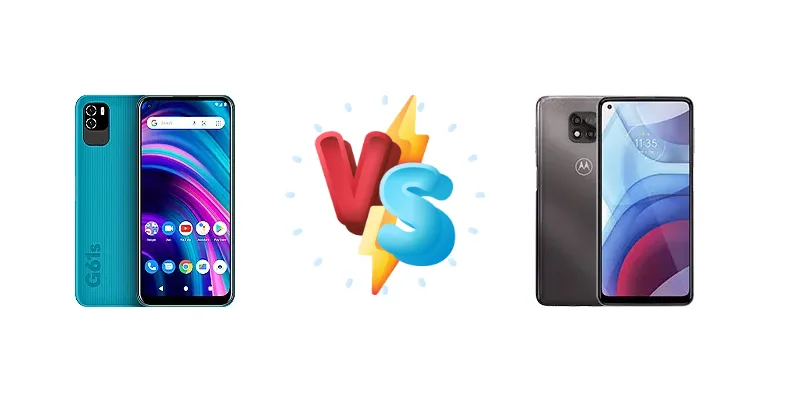
The sub-$200 smartphone market is fiercely competitive. The BLU G61s and Motorola Moto G Power (2021) both aim to deliver essential features at an accessible price point, but they take different approaches. The G61s emphasizes raw processing power with its Cortex-A75 CPU, while the Moto G Power prioritizes extended battery life and a well-established brand reputation. This comparison dissects their key differences to determine which phone best suits your needs.
🏆 Quick Verdict
For the average user prioritizing all-day battery life and a reliable software experience, the Motorola Moto G Power (2021) is the better choice. While the BLU G61s boasts a faster CPU clock speed, the Snapdragon 662’s efficiency and Motorola’s software optimization provide a smoother, more consistent experience, especially considering the G61s’s lack of detailed information regarding software support.
| Network |
|---|
| 2G bands | GSM 850 / 900 / 1800 / 1900 | GSM 850 / 900 / 1800 / 1900 |
| 3G bands | HSDPA 850 / 900 / 1700(AWS) / 1900 / 2100 | HSDPA 850 / 900 / 1700(AWS) / 1900 / 2100 |
| 4G bands | 2, 3, 4, 5, 7, 12, 17, 28, 66 | 1, 2, 3, 4, 5, 7, 8, 12, 13, 14, 17, 25, 26, 29, 30, 38, 41, 66, 71 |
| Speed | HSPA, LTE | HSPA, LTE |
| Technology | GSM / HSPA / LTE | GSM / CDMA / HSPA / EVDO / LTE |
| | - | CDMA2000 1xEV-DO |
| Launch |
|---|
| Announced | 2022, April | 2021, January 08 |
| Status | Available. Released 2022, April | Available. Released 2021, January 14 |
| Body |
|---|
| Build | - | Glass front, plastic back, plastic frame |
| Dimensions | 159.5 x 76.5 x 9.8 mm (6.28 x 3.01 x 0.39 in) | 165.3 x 75.9 x 9.5 mm (6.51 x 2.99 x 0.37 in) |
| SIM | Nano-SIM + Nano-SIM | Nano-SIM |
| Weight | 164 g (5.78 oz) | 206.5 g (7.30 oz) |
| | - | Water-repellent coating |
| Display |
|---|
| Resolution | 720 x 1600 pixels, 20:9 ratio (~270 ppi density) | 720 x 1600 pixels, 20:9 ratio (~266 ppi density) |
| Size | 6.5 inches, 102.0 cm2 (~83.6% screen-to-body ratio) | 6.6 inches, 105.2 cm2 (~83.8% screen-to-body ratio) |
| Type | IPS LCD | IPS LCD |
| Platform |
|---|
| CPU | Octa-core 2.0 GHz Cortex-A75 | Octa-core (4x2.0 GHz Kryo 260 Gold & 4x1.8 GHz Kryo 260 Silver) |
| Chipset | - | Qualcomm SM6115 Snapdragon 662 (11 nm) |
| GPU | - | Adreno 610 |
| OS | Android 11 | Android 10 |
| Memory |
|---|
| Card slot | microSDXC | microSDXC (dedicated slot) |
| Internal | 64GB 4GB RAM | 32GB 3GB RAM, 64GB 4GB RAM |
| | eMMC 5.1 | eMMC 5.1 |
| Main Camera |
|---|
| Dual | 13 MP
Auxiliary lens | - |
| Features | LED flash | LED flash, HDR, panorama |
| Single | 8 MP | - |
| Triple | - | 48 MP, f/1.7, (wide), 1/2.0", 0.8µm, PDAF
2 MP (macro)
Auxiliary lens |
| Video | 1080p@30fps | 1080p@30/60fps, gyro-EIS |
| Selfie camera |
|---|
| Features | - | HDR |
| Single | 8 MP | 8 MP, f/2.0, 1.12µm |
| Video | 1080p@30fps | 1080p@30fps, gyro-EIS |
| Sound |
|---|
| 3.5mm jack | Yes | Yes |
| 35mm jack | Yes | Yes |
| Loudspeaker | Yes | Yes |
| Comms |
|---|
| Bluetooth | 4.2, A2DP, LE | 5.0, A2DP, LE |
| NFC | No | No |
| Positioning | GPS | GPS, GLONASS, GALILEO |
| Radio | FM radio | FM radio |
| USB | USB Type-C 2.0 | USB Type-C 2.0 |
| WLAN | Wi-Fi 802.11 a/b/g/n, Wi-Fi Direct | Wi-Fi 802.11 a/b/g/n/ac, dual-band, Wi-Fi Direct |
| Features |
|---|
| Sensors | Fingerprint (side-mounted), accelerometer, proximity | Fingerprint (side-mounted), accelerometer, gyro, proximity, compass, barometer |
| Battery |
|---|
| Charging | - | 15W wired |
| Type | Li-Po 5000 mAh | Li-Po 5000 mAh |
| Misc |
|---|
| Colors | Bronze, Red, Green, Cyan, Black | Flash Gray, Polar Silver |
| Price | - | About 60 EUR |
BLU G61s
- Potentially faster CPU performance for demanding tasks
- Competitive price point
- May offer more storage options (depending on configuration)
- Unknown software update policy
- Battery life likely inferior to Moto G Power
- Limited brand recognition and support
Motorola Moto G Power (2021)
- Exceptional battery life with 5000 mAh capacity
- Reliable Snapdragon 662 chipset
- Established brand reputation and software support
- Lower CPU clock speed compared to BLU G61s
- 720p display resolution
- Slower charging speed (15W)
Display Comparison
Neither device is expected to deliver a flagship-level display experience. Specifics regarding panel technology (IPS, TFT) and resolution are missing for the BLU G61s, but given the price point, it’s likely a standard LCD. The Moto G Power (2021) also utilizes an LCD, but its larger 6.6-inch size and 720 x 1600 resolution offer a reasonable viewing area. The absence of high refresh rates on both devices is typical for this segment. Bezels are likely comparable, prioritizing cost savings over premium aesthetics.
Camera Comparison
Camera performance is likely to be similar on both devices, leaning towards adequate rather than exceptional. Details regarding sensor sizes and apertures are unavailable for the BLU G61s. The Moto G Power (2021) features a 13MP main sensor, which is standard for this price range. Both phones likely include multiple rear cameras, but the inclusion of low-resolution macro or depth sensors adds little practical value. Image processing will be a key differentiator, and Motorola’s software typically provides a more refined and consistent experience.
Performance
The core difference lies in the chipset. The BLU G61s features an Octa-core 2.0 GHz Cortex-A75 CPU, which, on paper, suggests strong performance. However, the Snapdragon 662 in the Moto G Power (2021) benefits from Qualcomm’s optimizations and a more balanced core configuration (4x2.0 GHz Kryo 260 Gold & 4x1.8 GHz Kryo 260 Silver). The Snapdragon 662’s 11nm process node also contributes to better power efficiency. While the G61s may win in single-core benchmarks, the Snapdragon 662’s sustained performance and integrated modem are likely superior for real-world usage. RAM configurations are unknown for the BLU G61s, but the Moto G Power (2021) typically ships with 3GB or 4GB, which is adequate for basic multitasking.
Battery Life
The Motorola Moto G Power (2021) truly shines with its massive 5000 mAh battery. Coupled with the efficient Snapdragon 662 and 15W wired charging, it consistently delivers multi-day battery life. The BLU G61s’s battery capacity is unknown, but given the focus on CPU performance, it’s likely smaller. While the G61s might charge slightly faster due to the CPU’s power draw, the Moto G Power’s larger battery provides a significant advantage in overall endurance.
Buying Guide
Buy the BLU G61s if you need maximum CPU performance for demanding tasks like emulation or running resource-intensive apps, and are comfortable with potentially less frequent software updates. Buy the Motorola Moto G Power (2021) if you prioritize exceptional battery life, a dependable user experience, and a brand known for consistent software support, even if it means sacrificing some peak processing speed.
Frequently Asked Questions
❓ Is the Snapdragon 662 in the Moto G Power (2021) powerful enough for modern mobile games?
The Snapdragon 662 is capable of running many popular mobile games at medium settings. While it won’t deliver a flagship gaming experience, it provides a smooth and enjoyable experience for titles like PUBG Mobile and Call of Duty Mobile, especially when paired with the phone’s efficient thermal management.
❓ How long does the Motorola Moto G Power (2021) typically last on a single charge with moderate use?
With moderate use – including browsing, social media, and occasional video streaming – the Motorola Moto G Power (2021) can easily last two full days, and often even three, on a single charge thanks to its large 5000 mAh battery and efficient chipset.
❓ What kind of software updates can I expect on the BLU G61s?
BLU’s software update track record is less consistent than Motorola’s. While the G61s likely ships with a recent version of Android, major OS updates and security patches may be infrequent or unavailable. This is a key consideration for users who prioritize long-term software support.
❓ Does the Moto G Power (2021) support fast charging?
The Moto G Power (2021) supports 15W wired charging. While not the fastest charging available, it’s sufficient to top up the large battery in a reasonable timeframe. Expect a full charge to take around 3-4 hours.