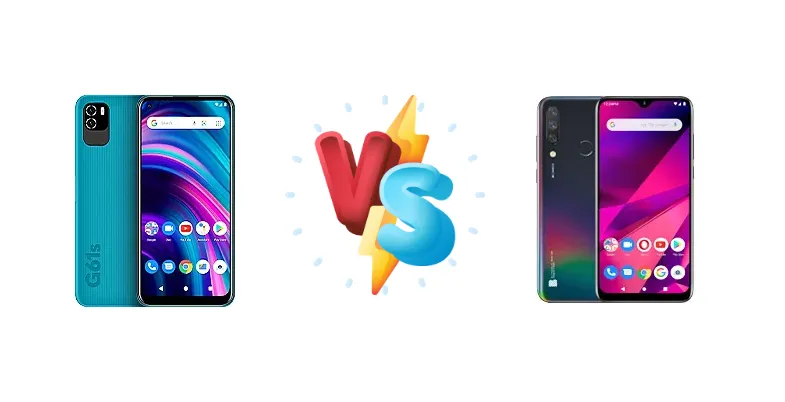
BLU offers compelling budget options, but choosing between the G61s and G80 requires understanding their core differences. The G61s boasts a newer Cortex-A75 based CPU, while the G80 relies on the older, but still capable, Mediatek Helio P23. This comparison dives deep into the architectural implications of these choices, helping you determine which phone delivers the best experience for your needs.
🏆 Quick Verdict
For users prioritizing responsiveness and potential for future software support, the BLU G61s is the better choice. Its Cortex-A75 CPU offers a significant architectural advantage over the G80’s Helio P23, despite the G80’s eight cores. The G80’s 10W charging is a notable drawback in today’s fast-charging landscape.
| Network |
|---|
| 2G bands | GSM 850 / 900 / 1800 / 1900 | GSM 850 / 900 / 1800 / 1900 |
| 3G bands | HSDPA 850 / 900 / 1700(AWS) / 1900 / 2100 | HSDPA 850 / 900 / 1700(AWS) / 1900 / 2100 |
| 4G bands | 2, 3, 4, 5, 7, 12, 17, 28, 66 | 1, 2, 3, 4, 5, 7, 12, 17, 28 |
| Speed | HSPA, LTE | HSPA, LTE |
| Technology | GSM / HSPA / LTE | GSM / HSPA / LTE |
| Launch |
|---|
| Announced | 2022, April | 2020, June 24. Released 2020, June 24 |
| Status | Available. Released 2022, April | Discontinued |
| Body |
|---|
| Dimensions | 159.5 x 76.5 x 9.8 mm (6.28 x 3.01 x 0.39 in) | 163.9 x 75.5 x 8.4 mm (6.45 x 2.97 x 0.33 in) |
| SIM | Nano-SIM + Nano-SIM | Nano-SIM + Nano-SIM |
| Weight | 164 g (5.78 oz) | 185 g (6.53 oz) |
| Display |
|---|
| Resolution | 720 x 1600 pixels, 20:9 ratio (~270 ppi density) | 720 x 1600 pixels, 20:9 ratio (~270 ppi density) |
| Size | 6.5 inches, 102.0 cm2 (~83.6% screen-to-body ratio) | 6.5 inches, 102.0 cm2 (~82.4% screen-to-body ratio) |
| Type | IPS LCD | IPS LCD |
| Platform |
|---|
| CPU | Octa-core 2.0 GHz Cortex-A75 | Octa-core (4x2.0 GHz Cortex-A53 & 4x1.5 GHz Cortex-A53) |
| Chipset | - | Mediatek MT6763 Helio P23 (16 nm) |
| GPU | - | Mali-G71 MP2 |
| OS | Android 11 | Android 10 |
| Memory |
|---|
| Card slot | microSDXC | microSDXC |
| Internal | 64GB 4GB RAM | 64GB 3GB RAM |
| | eMMC 5.1 | eMMC 5.1 |
| Main Camera |
|---|
| Dual | 13 MP
Auxiliary lens | - |
| Features | LED flash | LED flash, panorama, HDR |
| Single | 8 MP | - |
| Triple | - | 13 MP, f/1.8, (wide), 1/3.06", 1.12µm, PDAF
8 MP, f/2.2, (ultrawide), 1/4.0", 1.12µm
Auxiliary lens |
| Video | 1080p@30fps | 1080p@30fps |
| Selfie camera |
|---|
| Single | 8 MP | 13 MP, f/2.9 |
| Video | 1080p@30fps | 720p@30fps |
| Sound |
|---|
| 3.5mm jack | Yes | Yes |
| 35mm jack | Yes | Yes |
| Loudspeaker | Yes | Yes |
| Comms |
|---|
| Bluetooth | 4.2, A2DP, LE | 4.1, A2DP, LE |
| NFC | No | No |
| Positioning | GPS | GPS |
| Radio | FM radio | FM radio |
| USB | USB Type-C 2.0 | microUSB 2.0, OTG |
| WLAN | Wi-Fi 802.11 a/b/g/n, Wi-Fi Direct | Wi-Fi 802.11 a/b/g/n, Wi-Fi Direct |
| Features |
|---|
| Sensors | Fingerprint (side-mounted), accelerometer, proximity | Fingerprint (rear-mounted), accelerometer, proximity |
| Battery |
|---|
| Charging | - | 10W wired |
| Type | Li-Po 5000 mAh | Li-Po 4000 mAh, removable |
| Misc |
|---|
| Colors | Bronze, Red, Green, Cyan, Black | Black, Green |
| Price | - | About 90 EUR |
BLU G61s
- More powerful Cortex-A75 CPU for faster performance
- Potentially better power efficiency with the A75 architecture
- Likely to receive more software updates due to newer processor
- Lack of detailed specifications makes a full assessment difficult
- Potential for thermal throttling under sustained load (unconfirmed)
BLU G80
- Eight CPU cores offer potential for multitasking
- Established Mediatek platform with wide software compatibility
- Potentially lower price point (depending on retailer)
- Older and less efficient Cortex-A53 CPU architecture
- Slow 10W charging is a significant drawback
- 16nm process node leads to higher power consumption
Display Comparison
Display specifications are not provided for either device. However, given their price points, it’s reasonable to assume both utilize IPS LCD panels. The absence of details like resolution, refresh rate, or peak brightness makes a direct comparison impossible. Users should research independent reviews for display quality assessments.
Camera Comparison
Camera specifications are not detailed beyond the presence of cameras on both devices. Without sensor size, aperture, or image processing details, a meaningful comparison is impossible. It’s likely both phones feature basic camera setups geared towards casual photography. Users should consult independent reviews for image quality assessments.
Performance
The core difference lies in the CPU architecture. The BLU G61s features an Octa-core 2.0 GHz Cortex-A75, a mid-range processor known for its strong single-core performance. This translates to faster app launch times and smoother multitasking compared to the BLU G80’s Mediatek MT6763 Helio P23. The Helio P23 utilizes an octa-core configuration (4x2.0 GHz Cortex-A53 & 4x1.5 GHz Cortex-A53), but the Cortex-A53 is an older, less efficient architecture. While the G80 has more cores, the G61s’ A75 cores are significantly more powerful individually. The Helio P23’s 16nm process node is also less efficient than a more modern node, potentially leading to higher power consumption under load.
Battery Life
The BLU G80’s 10W wired charging is a significant disadvantage. In a market increasingly dominated by 18W, 33W, or even faster charging solutions, 10W feels slow and inconvenient. While battery capacity isn’t specified for either device, the Helio P23’s less efficient architecture in the G80 likely means it will require more frequent charging than a device powered by the more efficient Cortex-A75 in the G61s, even with similar battery capacities.
Buying Guide
Buy the BLU G61s if you need a phone that feels snappier in everyday tasks and can handle moderately demanding apps without significant slowdown. It’s ideal for users who value a more modern processor architecture. Buy the BLU G80 if you prioritize a slightly more established platform (though older) and are less concerned with peak performance or fast charging; it’s a viable option for basic smartphone use like calls, texts, and light social media.
Frequently Asked Questions
❓ Will the BLU G80 struggle with modern mobile games?
The Mediatek Helio P23 in the G80 is capable of running some mobile games, but it will likely require lower graphics settings and may experience frame drops in more demanding titles. The Cortex-A75 in the G61s offers a significantly better gaming experience.
❓ Is the 10W charging on the BLU G80 a dealbreaker?
For users accustomed to faster charging speeds, the 10W charging on the G80 is a significant drawback. It will take considerably longer to fully charge the device compared to phones with 18W or higher charging capabilities. This impacts convenience and overall usability.
❓ How does the Cortex-A75 in the G61s compare to the Cortex-A53 in the G80 for everyday tasks?
The Cortex-A75 is a much more modern and powerful CPU core than the Cortex-A53. This translates to noticeably faster app launch times, smoother scrolling, and a more responsive overall user experience on the BLU G61s when performing everyday tasks like browsing the web or using social media.