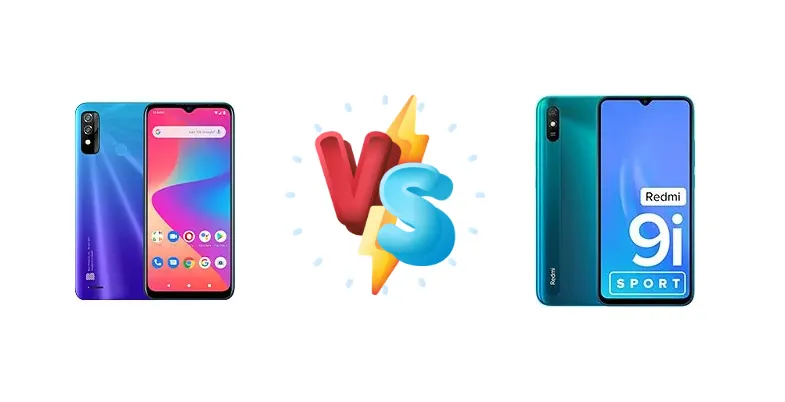
The BLU G61 and Xiaomi Redmi 9i Sport represent the fiercely competitive sub-$150 smartphone market. Both aim to deliver essential functionality at an accessible price, but they take different approaches to achieving this. This comparison dissects their core components to determine which device offers the best value for budget-conscious consumers.
🏆 Quick Verdict
For the average user prioritizing slightly better CPU performance and a potentially smoother experience with moderately demanding apps, the Xiaomi Redmi 9i Sport is the better choice. Its Helio G25 chipset, while not a powerhouse, offers a clock speed advantage over the BLU G61’s Cortex-A55 cores. However, the difference is likely subtle in everyday tasks.
| Network |
|---|
| 2G bands | GSM 850 / 900 / 1800 / 1900 | GSM 850 / 900 / 1800 / 1900 |
| 3G bands | HSDPA 850 / 900 / 1700(AWS) / 1900 / 2100 | HSDPA 850 / 900 / 2100 |
| 4G bands | 1, 2, 3, 4, 5, 7, 12, 17, 28 | 1, 3, 5, 8, 40, 41 |
| Speed | HSPA, LTE | HSPA, LTE |
| Technology | GSM / HSPA / LTE | GSM / HSPA / LTE |
| Launch |
|---|
| Announced | 2021, February 09. Released 2021, February 09 | 2021, September 28 |
| Status | Discontinued | Available. Released 2021, September 28 |
| Body |
|---|
| Dimensions | 164.6 x 75.8 x 9.3 mm (6.48 x 2.98 x 0.37 in) | 164.9 x 77.1 x 9 mm (6.49 x 3.04 x 0.35 in) |
| SIM | Nano-SIM + Nano-SIM | Nano-SIM + Nano-SIM |
| Weight | 196 g (6.91 oz) | 194 g (6.84 oz) |
| | - | Water-repellent coating |
| Display |
|---|
| Resolution | 720 x 1600 pixels, 20:9 ratio (~270 ppi density) | 720 x 1600 pixels, 20:9 ratio (~269 ppi density) |
| Size | 6.5 inches, 102.0 cm2 (~81.8% screen-to-body ratio) | 6.53 inches, 102.9 cm2 (~81.0% screen-to-body ratio) |
| Type | IPS LCD | IPS LCD, 400 nits (typ) |
| Platform |
|---|
| CPU | Octa-core 1.6 GHz Cortex-A55 | Octa-core (4x2.0 GHz Cortex-A53 & 4x1.5 GHz Cortex-A53) |
| Chipset | - | Mediatek MT6762G Helio G25 (12 nm) |
| GPU | - | PowerVR GE8320 |
| OS | Android 10 | Android 10, MIUI 12 |
| Memory |
|---|
| Card slot | microSDXC | microSDXC (dedicated slot) |
| Internal | 64GB 3GB RAM | 64GB 4GB RAM, 128GB 4GB RAM |
| | eMMC 5.1 | eMMC 5.1 |
| Main Camera |
|---|
| Dual | 13 MP
Auxiliary lens | - |
| Features | LED flash, panorama, HDR | LED flash, HDR |
| Single | 8 MP | 13 MP, f/2.2, 28mm (wide), 1.0µm, PDAF |
| Video | 1080p@30fps | 1080p@30fps |
| Selfie camera |
|---|
| Features | - | HDR |
| Single | 8 MP | 5 MP, f/2.2, (wide), 1.12µm |
| Video | 720p@30fps | 1080p@30fps |
| Sound |
|---|
| 3.5mm jack | Yes | Yes |
| 35mm jack | Yes | Yes |
| Loudspeaker | Yes | Yes |
| Comms |
|---|
| Bluetooth | 4.1, A2DP, LE | 5.0, A2DP, LE |
| NFC | No | No |
| Positioning | GPS | GPS, GLONASS, BDS |
| Radio | FM radio | FM radio |
| USB | microUSB 2.0 | microUSB 2.0, OTG |
| WLAN | Wi-Fi 802.11 b/g/n, Wi-Fi Direct | Wi-Fi 802.11 а/b/g/n, Wi-Fi Direct |
| Features |
|---|
| Sensors | Fingerprint (rear-mounted), accelerometer, proximity | Accelerometer, proximity, compass |
| Battery |
|---|
| Charging | 10W wired | 10W wired |
| Type | Li-Po 5000 mAh | Li-Po 5000 mAh |
| Misc |
|---|
| Colors | Black, Blue, Green, Red | Carbon Black, Coral Green, Metallic Blue |
| Price | About 110 EUR | About 100 EUR |
BLU G61
- Potentially cleaner software experience (depending on BLU's Android version)
- Slightly more modern CPU architecture (Cortex-A55)
- Competitive price point
- Lower CPU clock speed compared to Redmi 9i Sport
- Unspecified CPU manufacturing process (potentially less efficient)
- Likely limited software updates
Xiaomi Redmi 9i Sport
- Higher CPU clock speeds (Helio G25)
- More efficient CPU manufacturing process (12nm)
- Xiaomi's MIUI offers more features and customization
- Older CPU architecture (Cortex-A53)
- MIUI can be resource-intensive and include bloatware
- Potential for delayed software updates
Display Comparison
Neither device boasts a standout display. Both likely utilize LCD panels, a common trait in this price bracket. Specifics like resolution and brightness are not provided, but we can assume they are similar – likely 720p+ and adequate for indoor use. The absence of features like high refresh rates or Gorilla Glass is expected. The focus here is purely functional.
Camera Comparison
Camera performance is likely to be similar on both devices, leaning towards basic functionality. Without sensor size or aperture information, it’s difficult to make definitive claims. Both will likely feature a primary camera and potentially a depth or macro sensor, but image quality will be heavily reliant on software processing. Expect acceptable results in good lighting conditions, but struggles in low light. The absence of Optical Image Stabilization (OIS) is a given at this price point.
Performance
The core difference lies in the chipset. The Xiaomi Redmi 9i Sport’s MediaTek Helio G25 (12nm) features an octa-core configuration with a split design: four cores clocked at 2.0 GHz (Cortex-A53) and four at 1.5 GHz (Cortex-A53). This contrasts with the BLU G61’s octa-core 1.6 GHz Cortex-A55 CPU. While both are based on ARM’s Cortex architecture, the Helio G25’s higher clock speeds on its primary cores suggest a performance edge, particularly in CPU-bound tasks. The 12nm process node of the Helio G25 also indicates potentially better power efficiency compared to an unspecified node for the BLU G61’s CPU. However, the Cortex-A53 cores in the Redmi 9i Sport are older architecture than the A55 cores in the BLU G61, meaning the A55 cores are more efficient per clock cycle.
Battery Life
Both the BLU G61 and Xiaomi Redmi 9i Sport support 10W wired charging, indicating similar charging speeds. Battery capacity is not specified for either device, but typical capacities for phones in this segment range from 4000mAh to 5000mAh. The Helio G25’s potentially better power efficiency could translate to slightly longer battery life on the Redmi 9i Sport, but real-world usage will be the deciding factor. Expect a full charge to take around 2-3 hours with the included charger.
Buying Guide
Buy the BLU G61 if you need a simple, reliable device for basic communication and light tasks, and prioritize a minimal software experience. Buy the Xiaomi Redmi 9i Sport if you prefer a slightly more capable processor for occasional gaming or multitasking, and don't mind Xiaomi's MIUI software customization. Both are suitable for first-time smartphone users or as backup devices.
Frequently Asked Questions
❓ Will the Redmi 9i Sport struggle with popular apps like WhatsApp and Facebook?
The Redmi 9i Sport’s Helio G25 chipset should handle basic apps like WhatsApp and Facebook without significant issues. However, multitasking with several apps open simultaneously might lead to some slowdown. It's designed for light to moderate usage, not intensive tasks.
❓ Is the BLU G61 a good option for someone upgrading from a feature phone?
Yes, the BLU G61 is a suitable choice for a first-time smartphone user. Its simplicity and affordability make it an accessible entry point into the world of Android. It provides essential features like calling, texting, and basic internet access without overwhelming the user with complex options.
❓ Does the Xiaomi Redmi 9i Sport support fast charging?
No, the Xiaomi Redmi 9i Sport only supports 10W wired charging. While not 'fast' by modern standards, it's typical for phones in this price range. Expect a full charge to take approximately 2-3 hours.