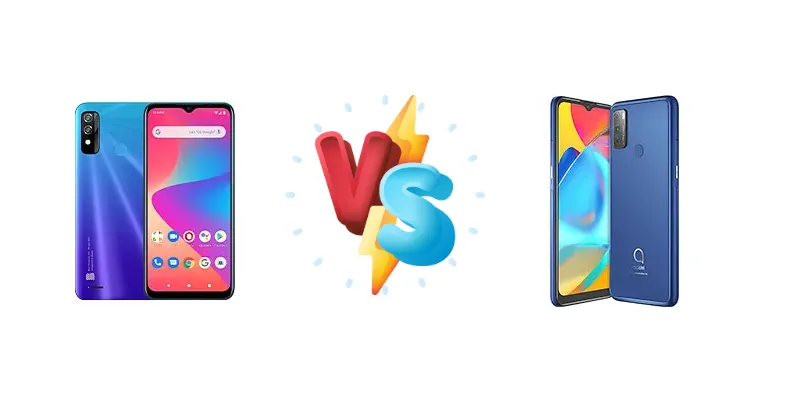
The BLU G61 and the alcatel 3L (2021) represent the ultra-budget end of the smartphone spectrum. Both aim to deliver essential smartphone functionality at the lowest possible price point, but they achieve this with different hardware approaches. This comparison dissects those differences, focusing on performance, efficiency, and real-world usability.
🏆 Quick Verdict
For the average user prioritizing basic tasks like calling, texting, and light social media, the alcatel 3L (2021) offers a slight edge due to its more efficient Mediatek Helio P22 chipset. While the BLU G61's Cortex-A55 is capable, the P22's architecture provides a more balanced experience for everyday use.
| Network |
|---|
| 2G bands | GSM 850 / 900 / 1800 / 1900 | GSM 850 / 900 / 1800 / 1900 |
| 3G bands | HSDPA 850 / 900 / 1700(AWS) / 1900 / 2100 | HSDPA 850 / 900 / 1900 / 2100 |
| 4G bands | 1, 2, 3, 4, 5, 7, 12, 17, 28 | 1, 3, 7, 8, 20, 28 |
| Speed | HSPA, LTE | HSPA 42.2/5.76 Mbps, LTE Cat4 150/50 Mbps |
| Technology | GSM / HSPA / LTE | GSM / HSPA / LTE |
| Launch |
|---|
| Announced | 2021, February 09. Released 2021, February 09 | 2021, January 12 |
| Status | Discontinued | Available. Released 2021, April 26 |
| Body |
|---|
| Build | - | Glass front, plastic back, plastic frame |
| Dimensions | 164.6 x 75.8 x 9.3 mm (6.48 x 2.98 x 0.37 in) | 165.6 x 75.6 x 8.7 mm (6.52 x 2.98 x 0.34 in) |
| SIM | Nano-SIM + Nano-SIM | · Nano-SIM· Nano-SIM + Nano-SIM |
| Weight | 196 g (6.91 oz) | 194 g (6.84 oz) |
| Display |
|---|
| Resolution | 720 x 1600 pixels, 20:9 ratio (~270 ppi density) | 720 x 1600 pixels, 20:9 ratio (~269 ppi density) |
| Size | 6.5 inches, 102.0 cm2 (~81.8% screen-to-body ratio) | 6.52 inches, 102.6 cm2 (~82.0% screen-to-body ratio) |
| Type | IPS LCD | IPS LCD |
| Platform |
|---|
| CPU | Octa-core 1.6 GHz Cortex-A55 | Octa-core (4x1.8 GHz Cortex-A53 & 4x1.5 GHz Cortex-A53) |
| Chipset | - | Mediatek MT6762D Helio P22 (12 nm) |
| GPU | - | PowerVR GE8320 |
| OS | Android 10 | Android 11 |
| Memory |
|---|
| Card slot | microSDXC | microSDXC (only single sim model) |
| Internal | 64GB 3GB RAM | 64GB 4GB RAM |
| | eMMC 5.1 | eMMC 5.1 |
| Main Camera |
|---|
| Dual | 13 MP
Auxiliary lens | - |
| Features | LED flash, panorama, HDR | LED flash, HDR, panorama |
| Single | 8 MP | - |
| Triple | - | 48 MP, f/1.8, 26mm (wide), 1/2.0", 0.8µm, PDAF
2 MP (macro)
Auxiliary lens |
| Video | 1080p@30fps | 1080p@30fps |
| Selfie camera |
|---|
| Features | - | HDR |
| Single | 8 MP | 8 MP, f/2.0, 26mm (wide), 1/4.0", 1.12µm |
| Video | 720p@30fps | 1080p@30fps |
| Sound |
|---|
| 3.5mm jack | Yes | Yes |
| 35mm jack | Yes | Yes |
| Loudspeaker | Yes | Yes |
| Comms |
|---|
| Bluetooth | 4.1, A2DP, LE | 5.0, A2DP, LE |
| NFC | No | Yes |
| Positioning | GPS | GPS, GLONASS, GALILEO, BDS |
| Radio | FM radio | FM radio |
| USB | microUSB 2.0 | microUSB 2.0, OTG |
| WLAN | Wi-Fi 802.11 b/g/n, Wi-Fi Direct | Wi-Fi 802.11 b/g/n, Wi-Fi Direct |
| Features |
|---|
| Sensors | Fingerprint (rear-mounted), accelerometer, proximity | Fingerprint (rear-mounted), accelerometer, proximity, compass |
| Battery |
|---|
| Charging | 10W wired | 10W wired |
| Type | Li-Po 5000 mAh | Li-Po 4000 mAh |
| Misc |
|---|
| Colors | Black, Blue, Green, Red | Jewelry Blue, Jewelry Black |
| Models | - | 6056D |
| Price | About 110 EUR | About 330 EUR |
BLU G61
- Potentially lower price point.
- Modern Cortex-A55 architecture.
- Simplicity for basic users.
- Lower CPU clock speed.
- Likely less efficient manufacturing process.
- Potential for more throttling under load.
alcatel 3L (2021)
- More efficient Mediatek Helio P22 chipset.
- Balanced core configuration for multitasking.
- 12nm fabrication process for better thermal management.
- Older Cortex-A53 cores.
- May be slightly more expensive.
- Basic camera capabilities.
Display Comparison
Neither device boasts a standout display. Given the lack of display specifications, we can assume both utilize basic IPS LCD panels common in this price bracket. The absence of features like high refresh rates or even Full HD+ resolution suggests a focus on cost reduction. Bezels are likely to be substantial on both, impacting the overall screen-to-body ratio. Color accuracy will likely be standard for the segment, prioritizing power efficiency over vibrant visuals.
Camera Comparison
Camera performance is expected to be similar on both devices, leaning towards basic functionality. Without specific sensor details, it’s safe to assume both feature a primary camera and potentially a depth or macro sensor of limited utility. Image processing will likely be minimal, resulting in photos that are acceptable in good lighting conditions but struggle in low light. The aperture size is likely small on both, further limiting low-light performance. The focus here isn't on photography, but on providing a functional camera for casual snapshots.
Performance
The core difference lies in the chipset. The alcatel 3L (2021) utilizes the Mediatek MT6762D Helio P22, a 12nm process chip with an octa-core configuration split between 4x1.8 GHz Cortex-A53 and 4x1.5 GHz Cortex-A53 cores. This split allows for a balance between performance and power efficiency. The BLU G61, conversely, features an octa-core 1.6 GHz Cortex-A55 processor. While also octa-core, the Cortex-A55 is a newer, more efficient core, but clocked lower. The P22’s 12nm fabrication process also contributes to better thermal management compared to the likely larger node process used for the G61’s CPU. This translates to potentially less throttling during sustained tasks. Users engaging in light gaming or multitasking will likely find the alcatel 3L more responsive.
Battery Life
Both devices feature 10W wired charging, indicating a similar charging experience – slow by modern standards. Battery capacity isn't specified, but given the target market, both are likely to house batteries in the 3000-4000 mAh range. The alcatel 3L’s more efficient Helio P22 chipset will likely translate to slightly better battery life, allowing it to last a bit longer on a single charge, especially with moderate usage. The BLU G61’s Cortex-A55 processor will also be efficient, but the lower clock speeds may not fully offset the potential inefficiencies of its manufacturing process.
Buying Guide
Buy the BLU G61 if you need a phone primarily for static tasks and are comfortable with potentially slower app loading times. Its simplicity and affordability make it a viable option for first-time smartphone users or as a backup device. Buy the alcatel 3L (2021) if you prefer a slightly more responsive experience for multitasking and light gaming, benefiting from the Helio P22's more mature architecture and optimized power consumption.
Frequently Asked Questions
❓ Will the alcatel 3L (2021) struggle with popular apps like Facebook or WhatsApp?
The alcatel 3L (2021)'s Mediatek Helio P22 chipset is capable of running these apps smoothly, though multitasking with several apps open simultaneously might lead to some slowdown. It's designed for basic social media and communication tasks.
❓ Is the BLU G61 a good option for someone upgrading from a feature phone?
Yes, the BLU G61 is a viable option for first-time smartphone users. Its simplicity and affordability make it an accessible entry point into the smartphone world, allowing users to learn the basics without a significant investment.
❓ Can either of these phones handle basic mobile games like Candy Crush or Subway Surfers?
Both phones can handle casual games like Candy Crush or Subway Surfers, but don't expect high frame rates or detailed graphics. The alcatel 3L (2021) will likely provide a slightly smoother experience due to its more efficient chipset.