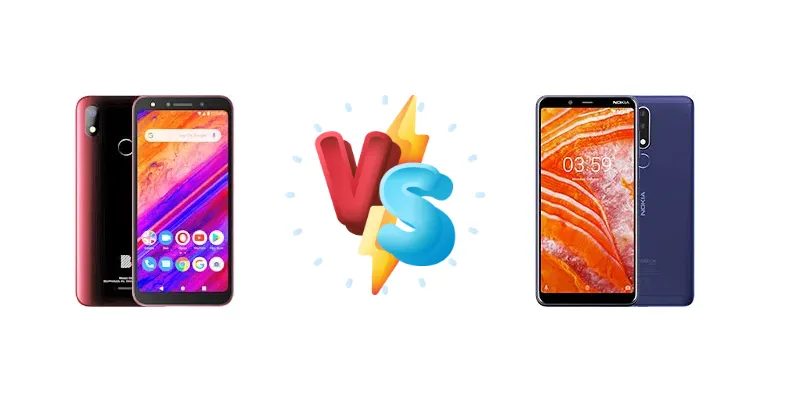
The BLU G6 and Nokia 3.1 Plus represent the fiercely competitive sub-$150 smartphone market. Both aim to deliver essential smartphone functionality at an accessible price point, but they take different approaches to achieving this. The BLU G6 relies on a Hummingbird chipset, while the Nokia 3.1 Plus offers a Mediatek Helio P22 (globally) or a Qualcomm Snapdragon 439 (in the USA), creating a key distinction in performance and efficiency.
🏆 Quick Verdict
For the average user prioritizing a slightly smoother experience, the Nokia 3.1 Plus is the better choice. Its Mediatek Helio P22 or Snapdragon 439 chipset, built on a 12nm process, provides a performance advantage over the BLU G6’s Hummingbird. However, the G6 remains a viable option for basic tasks.
| Network |
|---|
| 2G bands | GSM 850 / 900 / 1800 / 1900 | GSM 850 / 900 / 1800 / 1900 |
| 3G bands | HSDPA 850 / 1700(AWS) / 1900 - G0210UU | HSDPA 850 / 900 / 1900 / 2100 |
| 4G bands | 1, 3, 4, 5, 7, 28 - G0210LL | 2, 4, 5, 12, 14, 29, 30 - USA |
| Speed | HSPA 42.2/11.5 Mbps, LTE Cat4 150/50 Mbps | HSPA 42.2/5.76 Mbps, LTE Cat4 150/50 Mbps |
| Technology | GSM / HSPA / LTE | GSM / HSPA / LTE |
| | 2, 4, 5, 12, 17 - G0210UU | HSDPA 850 / 1700(AWS) / 1900 - USA |
| Launch |
|---|
| Announced | 2019, July. Released 2019, July | 2018, October. Released 2018, October |
| Status | Discontinued | Discontinued |
| Body |
|---|
| Build | - | Glass front, aluminum back, aluminum frame |
| Dimensions | 153 x 73.4 x 9.1 mm (6.02 x 2.89 x 0.36 in) | 156.9 x 76.4 x 8.2 mm (6.18 x 3.01 x 0.32 in) |
| SIM | Nano-SIM + Nano-SIM | Nano-SIM + Nano-SIM |
| Weight | 160 g (5.64 oz) | 180 g (6.35 oz) |
| Display |
|---|
| Protection | Corning Gorilla Glass | - |
| Resolution | 720 x 1440 pixels, 18:9 ratio (~282 ppi density) | 720 x 1440 pixels, 18:9 ratio (~268 ppi density) |
| Size | 5.7 inches, 83.8 cm2 (~74.7% screen-to-body ratio) | 6.0 inches, 92.9 cm2 (~77.5% screen-to-body ratio) |
| Type | IPS LCD | IPS LCD |
| Platform |
|---|
| CPU | Octa-core 1.6 GHz Cortex-A55 | Octa-core 2.0 GHz Cortex-A53 - GlobalOcta-core (4x1.95 GHz Cortex-A53 & 4x1.45 GHz Cortex A53) - USA |
| Chipset | Hummingbird | Mediatek MT6762 Helio P22 (12 nm) - GlobalQualcomm SDM439 Snapdragon 439 (12 nm) - USA |
| GPU | IMG8322 | PowerVR GE8320 - GlobalAdreno 505 - USA |
| OS | Android 9.0 (Pie) | Android 8.1 (Oreo), upgradable to Android 10, Android One |
| Memory |
|---|
| Card slot | microSDXC | microSDXC (dedicated slot) |
| Internal | 64GB 3GB RAM | 16GB 2GB RAM, 32GB 2GB RAM, 32GB 3GB RAM |
| | - | eMMC 5.1 |
| Main Camera |
|---|
| Dual | - | 13 MP, f/2.0, AF
Auxiliary lens |
| Features | LED flash | LED flash, HDR, panorama |
| Single | 13 MP, AF | - |
| Video | 1080p@30fps | 1080p@30fps |
| Selfie camera |
|---|
| Features | LED flash | LED flash, HDR |
| Single | 8 MP | 8 MP, f/2.2 |
| Video | 1080p@30fps | 720p@30fps |
| Sound |
|---|
| 3.5mm jack | Yes | Yes |
| 35mm jack | Yes | Yes |
| Loudspeaker | Yes | Yes |
| Comms |
|---|
| Bluetooth | 4.1, A2DP | 4.1, A2DP, LE |
| NFC | No | Yes (USA, APAC & EMEA) |
| Positioning | GPS | GPS, GLONASS, BDS, GALILEO |
| Radio | FM radio | FM radio |
| USB | microUSB 2.0 | microUSB 2.0, OTG |
| WLAN | Wi-Fi 802.11 b/g/n, Wi-Fi Direct | Wi-Fi 802.11 b/g/n, Wi-Fi Direct |
| Features |
|---|
| Browser | HTML, Adobe Flash | - |
| Sensors | Fingerprint (rear-mounted), accelerometer, proximity | Fingerprint (rear-mounted), accelerometer, gyro, proximity, compass |
| Battery |
|---|
| Charging | - | 10W wired |
| Stand-by | Up to 550 h (2G) / Up to 500 h (3G) | - |
| Talk time | Up to 20 h (2G) / Up to 15 h (3G) | - |
| Type | Li-Po 2800 mAh, removable | Li-Ion 3500 mAh, non-removable |
| Misc |
|---|
| Colors | Black, Red | Blue, White, Gray |
| Models | - | TA-1118, TA-1125, TA-1113, TA-1117, TA-1124, TA-1125 |
| Price | About 280 EUR | About 120 EUR |
| SAR | 0.61 W/kg (head) 0.49 W/kg (body) | - |
| SAR EU | 0.51 W/kg (head) | 0.41 W/kg (head) 1.58 W/kg (body) |
| Tests |
|---|
| Audio quality |
Noise -90.6dB / Crosstalk -92.5dB | - |
| Camera |
Photo | - |
| Loudspeaker |
Voice 64dB / Noise 66dB / Ring 75dB | - |
BLU G6
- Potentially lower price point
- Functional for basic smartphone tasks
- Simple user experience
- Less powerful chipset
- Unknown charging speed
- Limited performance for demanding apps
Nokia 3.1 Plus
- More powerful Mediatek Helio P22/Snapdragon 439 chipset
- 10W wired charging
- Potentially better software support (Nokia)
- May be slightly more expensive
- Performance still limited for high-end gaming
- Camera quality likely similar to BLU G6
Display Comparison
Neither device’s display specifications are provided, so a direct comparison is difficult. However, given their price point, both likely utilize IPS LCD panels with 720p+ resolutions. The Nokia 3.1 Plus’s potential for a slightly larger display (based on typical Nokia designs) could offer a more immersive viewing experience. Without knowing the peak brightness or color gamut coverage, it’s safe to assume both displays are adequate for indoor use but may struggle in direct sunlight.
Camera Comparison
Both devices are listed as having a 'Photo' camera, which is insufficient for a meaningful comparison. Without knowing megapixel counts, sensor sizes, or aperture values, it’s impossible to determine which device offers superior image quality. However, given the market segment, both cameras likely prioritize affordability over advanced features. It’s reasonable to expect both to perform adequately in well-lit conditions but struggle in low light. The absence of details suggests neither phone will be a standout performer in the camera department.
Performance
The Nokia 3.1 Plus holds a clear advantage in processing power. The Mediatek Helio P22 (global) features an octa-core Cortex-A53 CPU clocked at 2.0 GHz, while the Snapdragon 439 (USA) has an octa-core CPU with a mixed clock speed configuration (1.95 GHz & 1.45 GHz). This contrasts with the BLU G6’s Hummingbird chipset and its octa-core 1.6 GHz Cortex-A55 CPU. The Cortex-A53, while older, generally offers higher single-core performance than the A55 at the same clock speed. Furthermore, the 12nm process node used in both the Helio P22 and Snapdragon 439 contributes to better power efficiency compared to the Hummingbird, potentially leading to longer battery life and less thermal throttling during sustained use. The Nokia 3.1 Plus will handle multitasking and app loading more smoothly.
Battery Life
Battery capacity isn’t specified for either device. However, the Nokia 3.1 Plus includes 10W wired charging, a feature absent from the BLU G6’s specifications. While 10W isn’t fast charging by modern standards, it provides a defined charging speed, whereas the G6’s charging rate is unknown. The more efficient chipset in the Nokia 3.1 Plus, combined with the known charging capability, suggests it will likely offer a more predictable and potentially longer-lasting battery experience.
Buying Guide
Buy the BLU G6 if you need a basic, functional smartphone for essential tasks like calls, texts, and light social media use, and are prioritizing the absolute lowest price. Buy the Nokia 3.1 Plus if you prefer a more responsive user experience, potentially benefit from slightly better gaming performance, and value the brand recognition and software support Nokia typically provides.
Frequently Asked Questions
❓ Is the Mediatek Helio P22/Snapdragon 439 in the Nokia 3.1 Plus capable of playing popular games like PUBG Mobile?
The Mediatek Helio P22 or Snapdragon 439 can run PUBG Mobile, but likely at lower graphics settings and frame rates to maintain a playable experience. Expect to adjust settings to prioritize smoothness over visual fidelity. The Hummingbird in the BLU G6 will struggle more with this task.
❓ Does the Nokia 3.1 Plus receive regular software updates and security patches?
Nokia is known for providing relatively clean Android experiences and timely software updates, even on their budget devices. While the frequency of updates can vary, the Nokia 3.1 Plus is more likely to receive security patches and Android version upgrades compared to the BLU G6, which typically has limited software support.
❓ What is the real-world battery life difference between the BLU G6 and Nokia 3.1 Plus?
Due to the lack of battery capacity information, a precise estimate is difficult. However, the Nokia 3.1 Plus’s more efficient chipset (Helio P22/Snapdragon 439) and known 10W charging suggest it will likely offer longer battery life and more predictable charging times than the BLU G6.