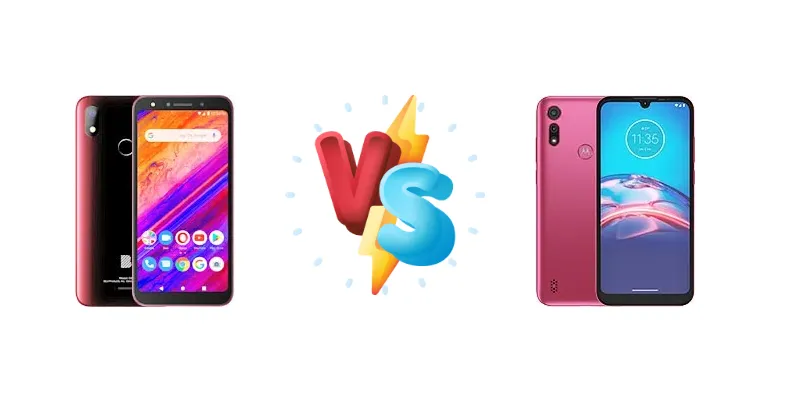
The BLU G6 and Motorola Moto E6i represent the extreme end of the smartphone price spectrum. Both aim to deliver essential functionality at a minimal cost, but they achieve this with different hardware approaches. This comparison dissects their core components to determine which offers the best value for users prioritizing affordability.
🏆 Quick Verdict
For the average user seeking a slightly more responsive experience, the BLU G6 edges out the Moto E6i. Its Hummingbird chipset, while still entry-level, offers a consistent octa-core Cortex-A55 configuration, potentially leading to smoother multitasking compared to the E6i’s mixed core setup. However, the E6i’s 10W charging is a welcome addition.
| Network |
|---|
| 2G bands | GSM 850 / 900 / 1800 / 1900 | GSM 850 / 900 / 1800 / 1900 |
| 3G bands | HSDPA 850 / 1700(AWS) / 1900 - G0210UU | HSDPA 850 / 900 / 1700(AWS) / 1900 / 2100 |
| 4G bands | 1, 3, 4, 5, 7, 28 - G0210LL | 1, 2, 3, 4, 5, 7, 8, 19, 28, 66 |
| Speed | HSPA 42.2/11.5 Mbps, LTE Cat4 150/50 Mbps | HSPA, LTE |
| Technology | GSM / HSPA / LTE | GSM / HSPA / LTE |
| | 2, 4, 5, 12, 17 - G0210UU | - |
| Launch |
|---|
| Announced | 2019, July. Released 2019, July | 2021, February 11 |
| Status | Discontinued | Available. Released 2021, February 11 |
| Body |
|---|
| Build | - | Glass front, plastic back, plastic frame |
| Dimensions | 153 x 73.4 x 9.1 mm (6.02 x 2.89 x 0.36 in) | 155.6 x 73 x 8.5 mm (6.13 x 2.87 x 0.33 in) |
| SIM | Nano-SIM + Nano-SIM | Nano-SIM + Nano-SIM |
| Weight | 160 g (5.64 oz) | 160 g (5.64 oz) |
| Display |
|---|
| Protection | Corning Gorilla Glass | - |
| Resolution | 720 x 1440 pixels, 18:9 ratio (~282 ppi density) | 720 x 1560 pixels, 19.5:9 ratio (~282 ppi density) |
| Size | 5.7 inches, 83.8 cm2 (~74.7% screen-to-body ratio) | 6.1 inches, 91.3 cm2 (~80.4% screen-to-body ratio) |
| Type | IPS LCD | IPS LCD |
| Platform |
|---|
| CPU | Octa-core 1.6 GHz Cortex-A55 | Octa-core (4x1.6 GHz Cortex-A55 & 4x1.2 GHz Cortex-A55) |
| Chipset | Hummingbird | Unisoc SC9863A (28 nm) |
| GPU | IMG8322 | IMG8322 |
| OS | Android 9.0 (Pie) | Android 10 (Go edition) |
| Memory |
|---|
| Card slot | microSDXC | microSDXC (uses shared SIM slot) |
| Internal | 64GB 3GB RAM | 32GB 2GB RAM |
| | - | eMMC 5.1 |
| Main Camera |
|---|
| Dual | - | 13 MP, f/2.2, 26mm (wide), 1/3.1", 1.12µm, PDAF
Auxiliary lens |
| Features | LED flash | LED flash, HDR, panorama |
| Single | 13 MP, AF | - |
| Video | 1080p@30fps | 1080p@30fps |
| Selfie camera |
|---|
| Features | LED flash | - |
| Single | 8 MP | 5 MP, f/2.2, 27mm (wide), 1.12µm |
| Video | 1080p@30fps | 1080p@30fps |
| Sound |
|---|
| 3.5mm jack | Yes | Yes |
| 35mm jack | Yes | Yes |
| Loudspeaker | Yes | Yes |
| Comms |
|---|
| Bluetooth | 4.1, A2DP | 4.2, A2DP, LE |
| NFC | No | No |
| Positioning | GPS | GPS, GLONASS |
| Radio | FM radio | Unspecified |
| USB | microUSB 2.0 | microUSB 2.0, OTG |
| WLAN | Wi-Fi 802.11 b/g/n, Wi-Fi Direct | Wi-Fi 802.11 b/g/n |
| Features |
|---|
| Browser | HTML, Adobe Flash | - |
| Sensors | Fingerprint (rear-mounted), accelerometer, proximity | Fingerprint (rear-mounted), accelerometer, proximity |
| Battery |
|---|
| Charging | - | 10W wired |
| Stand-by | Up to 550 h (2G) / Up to 500 h (3G) | - |
| Talk time | Up to 20 h (2G) / Up to 15 h (3G) | - |
| Type | Li-Po 2800 mAh, removable | Li-Ion 3000 mAh |
| Misc |
|---|
| Colors | Black, Red | Titanium Gray, Pink |
| Models | - | XT2053-5 |
| Price | About 280 EUR | About 170 EUR |
| SAR | 0.61 W/kg (head) 0.49 W/kg (body) | - |
| SAR EU | 0.51 W/kg (head) | - |
| Tests |
|---|
| Audio quality |
Noise -90.6dB / Crosstalk -92.5dB | - |
| Camera |
Photo | - |
| Loudspeaker |
Voice 64dB / Noise 66dB / Ring 75dB | - |
BLU G6
- Consistent Octa-Core Performance
- Potentially smoother multitasking
- Simpler CPU architecture
- No charging specification provided
- Likely basic camera system
Motorola Moto E6i
- 10W Wired Charging
- Motorola Brand Recognition
- Potentially better software support
- Heterogeneous CPU core configuration
- Less power-efficient chipset (28nm)
Display Comparison
Neither device provides display specifications, so a direct comparison is limited. However, given their price points, both likely utilize LCD panels with 720p+ resolutions. Expect noticeable bezels and limited color accuracy. The absence of details like peak brightness or refresh rates suggests neither phone is geared towards media consumption.
Camera Comparison
Both devices list 'Photo' as their camera capability, which is unhelpful. Given the market segment, expect basic 5-8MP main sensors with limited dynamic range and low-light performance. The Moto E6i likely includes a basic depth sensor or macro lens, but these are typically of low quality and offer minimal benefit. Without specific sensor details, it’s difficult to declare a clear winner; image quality will likely be similar, relying heavily on software processing.
Performance
The core difference lies in the chipsets. The BLU G6’s Hummingbird features an octa-core 1.6 GHz Cortex-A55 CPU, offering consistent performance across all cores. The Motorola Moto E6i utilizes the Unisoc SC9863A, a 28nm chip with a heterogeneous octa-core setup – four Cortex-A55 cores at 1.6 GHz paired with four slower 1.2 GHz cores. While both have eight cores, the E6i’s split configuration may result in performance inconsistencies, particularly when demanding tasks utilize the slower cores. The Hummingbird’s uniform architecture should provide a more predictable user experience. The 28nm process node of the Unisoc chip also suggests it will be less power efficient than a more modern fabrication process.
Battery Life
Battery capacity is not specified for either device. However, the Moto E6i includes 10W wired charging, a feature absent from the BLU G6’s specifications. While 10W is slow by modern standards, it’s still preferable to relying solely on micro-USB for charging. The Unisoc SC9863A’s 28nm process may also contribute to slightly higher power consumption, potentially offsetting any battery capacity advantage.
Buying Guide
Buy the BLU G6 if you prioritize consistent performance for basic tasks like social media, messaging, and light web browsing. Its uniform octa-core CPU is better suited for handling multiple apps simultaneously. Buy the Motorola Moto E6i if you value a brand with a stronger reputation for software updates and a slightly more convenient charging experience, even if it means sacrificing some raw processing power.
Frequently Asked Questions
❓ Will the Unisoc SC9863A in the Moto E6i struggle with modern mobile games?
Yes, the Unisoc SC9863A is an entry-level chipset. While it can handle basic games, demanding titles will likely require significant graphics settings reductions and may still experience lag or stuttering. The BLU G6’s Hummingbird chipset offers a slight advantage, but neither phone is designed for serious gaming.
❓ Does the BLU G6 receive regular software updates?
BLU is not known for providing extensive software support. Expect limited updates, potentially only security patches. Motorola, while still not on par with flagship brands, generally offers a more consistent update schedule for its budget devices, making the Moto E6i a potentially safer choice for long-term software support.
❓ Is the 10W charging on the Moto E6i significantly slower than faster charging standards?
Yes, 10W charging is considerably slower than the 18W, 25W, or higher charging speeds found on many modern smartphones. Expect a full charge to take several hours. However, for overnight charging or topping up during the day, it’s still functional, and preferable to having no specified charging capability like the BLU G6.