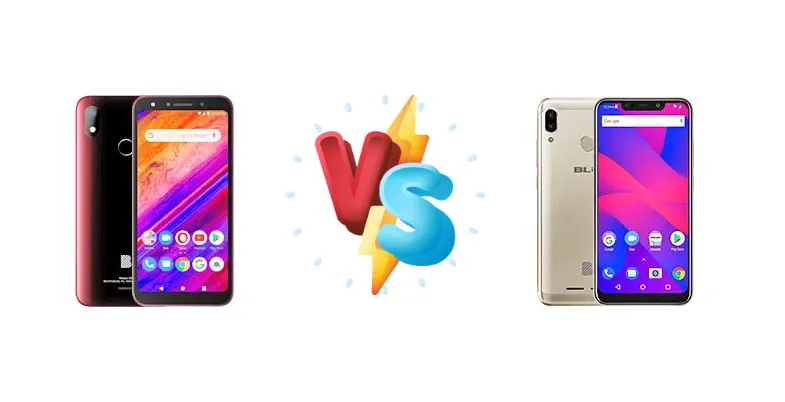
The BLU G6 and BLU Vivo XL4 represent two distinct approaches to the ultra-budget smartphone market. The G6 utilizes a Hummingbird chipset, while the Vivo XL4 opts for the Mediatek Helio P22. This comparison dissects the core differences between these devices, focusing on performance, efficiency, and real-world usability for cost-conscious consumers.
🏆 Quick Verdict
For most users, the BLU Vivo XL4 offers a more compelling package. Its Helio P22 chipset, built on a 12nm process, delivers a noticeable performance advantage over the G6’s Hummingbird, despite the slightly lower clock speed. While both phones are entry-level, the XL4 provides a smoother experience for everyday tasks.
| Network |
|---|
| 2G bands | GSM 850 / 900 / 1800 / 1900 | GSM 850 / 900 / 1800 / 1900 |
| 3G bands | HSDPA 850 / 1700(AWS) / 1900 - G0210UU | HSDPA 850 / 900 / 1700(AWS) / 1900 / 2100 |
| 4G bands | 1, 3, 4, 5, 7, 28 - G0210LL | 1, 2, 3, 4, 5, 7, 8, 12, 17, 28, 66 |
| Speed | HSPA 42.2/11.5 Mbps, LTE Cat4 150/50 Mbps | HSPA 42.2/11.5 Mbps, LTE (2CA) Cat6 300/50 Mbps |
| Technology | GSM / HSPA / LTE | GSM / HSPA / LTE |
| | 2, 4, 5, 12, 17 - G0210UU | - |
| Launch |
|---|
| Announced | 2019, July. Released 2019, July | 2018, December. Released 2018, December |
| Status | Discontinued | Discontinued |
| Body |
|---|
| Dimensions | 153 x 73.4 x 9.1 mm (6.02 x 2.89 x 0.36 in) | 157.2 x 76.2 x 8 mm (6.19 x 3.00 x 0.31 in) |
| SIM | Nano-SIM + Nano-SIM | Nano-SIM + Micro-SIM |
| Weight | 160 g (5.64 oz) | 178 g (6.28 oz) |
| Display |
|---|
| Protection | Corning Gorilla Glass | - |
| Resolution | 720 x 1440 pixels, 18:9 ratio (~282 ppi density) | 720 x 1520 pixels, 19:9 ratio (~271 ppi density) |
| Size | 5.7 inches, 83.8 cm2 (~74.7% screen-to-body ratio) | 6.2 inches, 95.9 cm2 (~80.1% screen-to-body ratio) |
| Type | IPS LCD | IPS LCD |
| Platform |
|---|
| CPU | Octa-core 1.6 GHz Cortex-A55 | Octa-core 2.0 GHz Cortex-A53 |
| Chipset | Hummingbird | Mediatek MT6762 Helio P22 (12 nm) |
| GPU | IMG8322 | PowerVR GE8320 |
| OS | Android 9.0 (Pie) | Android 8.1 (Oreo) |
| Memory |
|---|
| Card slot | microSDXC | microSDXC |
| Internal | 64GB 3GB RAM | 32GB 3GB RAM |
| | - | eMMC 5.1 |
| Main Camera |
|---|
| Dual | - | 13 MP, f/2.0, 1/3.0", PDAF
Auxiliary lens |
| Features | LED flash | LED flash |
| Single | 13 MP, AF | - |
| Video | 1080p@30fps | 1080p@30fps |
| Selfie camera |
|---|
| Features | LED flash | LED flash |
| Single | 8 MP | 13 MP, f/2.2, 1/4.0" |
| Video | 1080p@30fps | 1080p@30fps |
| Sound |
|---|
| 3.5mm jack | Yes | Yes |
| 35mm jack | Yes | Yes |
| Loudspeaker | Yes | Yes |
| Comms |
|---|
| Bluetooth | 4.1, A2DP | 4.0, A2DP |
| NFC | No | No |
| Positioning | GPS | GPS |
| Radio | FM radio | FM radio |
| USB | microUSB 2.0 | microUSB 2.0 |
| WLAN | Wi-Fi 802.11 b/g/n, Wi-Fi Direct | Wi-Fi 802.11 а/b/g/n, Wi-Fi Direct |
| Features |
|---|
| Browser | HTML, Adobe Flash | - |
| Sensors | Fingerprint (rear-mounted), accelerometer, proximity | Fingerprint (rear-mounted), accelerometer, proximity, compass |
| Battery |
|---|
| Stand-by | Up to 550 h (2G) / Up to 500 h (3G) | Up to 750 h (2G) / Up to 650 h (3G) |
| Talk time | Up to 20 h (2G) / Up to 15 h (3G) | Up to 30 h (2G) / Up to 24 h (3G) |
| Type | Li-Po 2800 mAh, removable | Li-Po 4000 mAh, non-removable |
| Misc |
|---|
| Colors | Black, Red | Black, Gold |
| Price | About 280 EUR | About 130 EUR |
| SAR | 0.61 W/kg (head) 0.49 W/kg (body) | - |
| SAR EU | 0.51 W/kg (head) | - |
| Tests |
|---|
| Audio quality |
Noise -90.6dB / Crosstalk -92.5dB | - |
| Camera |
Photo | - |
| Loudspeaker |
Voice 64dB / Noise 66dB / Ring 75dB | - |
BLU G6
- Potentially lower price point
- Simpler user experience
- Octa-core CPU for basic multitasking
- Less powerful chipset
- Likely less efficient power consumption
- Inferior performance for demanding tasks
BLU Vivo XL4
- More powerful Mediatek Helio P22 chipset
- More efficient 12nm manufacturing process
- Smoother multitasking and app loading
- Potentially higher price
- Cortex-A53 architecture is older than A55
- Camera specifications are unknown
Display Comparison
Display specifications are not provided for either device. However, given their price point, it's reasonable to assume both utilize 720p LCD panels. The lack of information prevents a detailed comparison of brightness, color accuracy, or refresh rates. Users should expect a basic viewing experience on both devices.
Camera Comparison
Both devices are listed as having a 'Photo' camera, which is insufficient for a meaningful comparison. Without sensor size, aperture, or megapixel information, it’s impossible to assess image quality. It’s likely both phones feature basic camera setups geared towards casual snapshots. The absence of detail suggests neither device will excel in low-light photography or offer advanced features.
Performance
The core difference lies in the chipsets. The BLU Vivo XL4’s Mediatek Helio P22 (MT6762), fabricated on a 12nm process, offers a significant architectural advantage over the BLU G6’s Hummingbird. While the G6 boasts an octa-core 1.6 GHz Cortex-A55 CPU, the XL4’s 2.0 GHz Cortex-A53 cores, combined with the more efficient manufacturing process, translate to faster application loading times and smoother multitasking. The 12nm process of the Helio P22 also implies better thermal efficiency, potentially reducing throttling during sustained workloads. The Cortex-A53, while an older architecture, benefits from the process node advantage.
Battery Life
Battery capacity and charging wattage are not specified. However, the more efficient Helio P22 in the Vivo XL4 suggests potentially better battery life, even with a similar capacity battery to the G6. The 12nm process contributes to lower power consumption, extending usage time between charges. Without concrete numbers, it’s difficult to determine which device offers superior endurance, but the XL4 has a theoretical advantage.
Buying Guide
Buy the BLU G6 if your primary need is a basic, functional smartphone for minimal usage – calls, texts, and light app browsing. Its simplicity and potentially lower price point make it suitable for first-time smartphone users or those on an extremely tight budget. Buy the BLU Vivo XL4 if you prioritize a more responsive user experience, occasional gaming, or running multiple apps simultaneously. The Helio P22 chipset provides a tangible performance boost that justifies the potential price difference.
Frequently Asked Questions
❓ Will the BLU Vivo XL4 struggle with popular games like PUBG Mobile?
While the Helio P22 isn't a gaming powerhouse, it's capable of running PUBG Mobile at lower settings. Expect frame rate drops during intense action, but it should be playable for casual gaming sessions. The Hummingbird in the G6 will likely offer a significantly less enjoyable gaming experience.
❓ Is the difference in CPU architecture (Cortex-A53 vs A55) significant in real-world use?
The Cortex-A55 is a more modern and efficient architecture, but the 12nm process of the Helio P22 largely mitigates the architectural advantage. The higher clock speed and process node of the XL4’s chipset result in a more noticeable performance improvement than the CPU architecture alone.
❓ Given the lack of camera details, should I assume both phones have equally poor camera performance?
Yes, it's reasonable to assume similar camera performance. The absence of specific details suggests both phones feature basic camera setups intended for casual use. Don't expect high-quality photos or advanced features from either device.