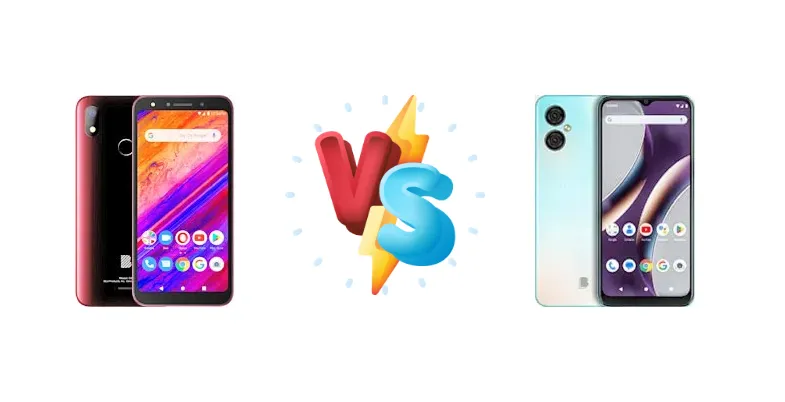
BLU consistently targets the ultra-budget smartphone market, and the G6 and G53 represent two recent contenders. While both aim to deliver affordability, they diverge significantly in their core processing power. The G6 utilizes a Hummingbird octa-core, while the G53 opts for a quad-core configuration featuring a Cortex-A75. This comparison will dissect these differences to determine which device provides the best user experience.
🏆 Quick Verdict
For the average user prioritizing consistent responsiveness in everyday tasks, the BLU G53 emerges as the better choice. Its Cortex-A75 core, despite being fewer in number, offers a substantial performance uplift over the G6’s Cortex-A55 based Hummingbird chipset, resulting in smoother multitasking and app loading.
| Network |
|---|
| 2G bands | GSM 850 / 900 / 1800 / 1900 | GSM 850 / 900 / 1800 / 1900 |
| 3G bands | HSDPA 850 / 1700(AWS) / 1900 - G0210UU | HSDPA 850 / 900 / 1700(AWS) / 1900 / 2100 |
| 4G bands | 1, 3, 4, 5, 7, 28 - G0210LL | 2, 3, 4, 5, 7, 12, 17, 28, 66, 71 |
| Speed | HSPA 42.2/11.5 Mbps, LTE Cat4 150/50 Mbps | HSPA, LTE |
| Technology | GSM / HSPA / LTE | GSM / HSPA / LTE |
| | 2, 4, 5, 12, 17 - G0210UU | - |
| Launch |
|---|
| Announced | 2019, July. Released 2019, July | 2023, June |
| Status | Discontinued | Available. Released 2023, July |
| Body |
|---|
| Build | - | Glass front, plastic frame, plastic back |
| Dimensions | 153 x 73.4 x 9.1 mm (6.02 x 2.89 x 0.36 in) | 164.8 x 75.8 x 8.9 mm (6.49 x 2.98 x 0.35 in) |
| SIM | Nano-SIM + Nano-SIM | Nano-SIM + Nano-SIM |
| Weight | 160 g (5.64 oz) | 200 g (7.05 oz) |
| Display |
|---|
| Protection | Corning Gorilla Glass | - |
| Resolution | 720 x 1440 pixels, 18:9 ratio (~282 ppi density) | 720 x 1600 pixels, 20:9 ratio (~270 ppi density) |
| Size | 5.7 inches, 83.8 cm2 (~74.7% screen-to-body ratio) | 6.5 inches, 102.0 cm2 (~81.7% screen-to-body ratio) |
| Type | IPS LCD | IPS LCD |
| Platform |
|---|
| CPU | Octa-core 1.6 GHz Cortex-A55 | Quad-core (1x2.0 GHz Cortex-A75 & 3x1.8 GHz Cortex-A55) |
| Chipset | Hummingbird | - |
| GPU | IMG8322 | IMG8322 |
| OS | Android 9.0 (Pie) | Android 13 |
| Memory |
|---|
| Card slot | microSDXC | microSDXC |
| Internal | 64GB 3GB RAM | 64GB 4GB RAM |
| Main Camera |
|---|
| Dual | - | 13 MP, f/2.0, (wide)
Auxiliary lens |
| Features | LED flash | LED flash, HDR, panorama |
| Single | 13 MP, AF | - |
| Video | 1080p@30fps | 1080p@30fps |
| Selfie camera |
|---|
| Features | LED flash | - |
| Single | 8 MP | 8 MP, f/2.0 |
| Video | 1080p@30fps | 1080p@30fps |
| Sound |
|---|
| 3.5mm jack | Yes | - |
| 35mm jack | Yes | Yes |
| Loudspeaker | Yes | Yes |
| Comms |
|---|
| Bluetooth | 4.1, A2DP | 5.0, A2DP, LE |
| NFC | No | No |
| Positioning | GPS | GPS |
| Radio | FM radio | FM radio |
| USB | microUSB 2.0 | USB Type-C 2.0 |
| WLAN | Wi-Fi 802.11 b/g/n, Wi-Fi Direct | Wi-Fi 802.11 b/g/n/ac, Wi-Fi Direct |
| Features |
|---|
| Browser | HTML, Adobe Flash | - |
| Sensors | Fingerprint (rear-mounted), accelerometer, proximity | Fingerprint (side-mounted), accelerometer |
| Battery |
|---|
| Stand-by | Up to 550 h (2G) / Up to 500 h (3G) | - |
| Talk time | Up to 20 h (2G) / Up to 15 h (3G) | - |
| Type | Li-Po 2800 mAh, removable | Li-Po 5000 mAh |
| Misc |
|---|
| Colors | Black, Red | Pearl, Black, Green, Violet, White |
| Price | About 280 EUR | About 100 EUR |
| SAR | 0.61 W/kg (head) 0.49 W/kg (body) | - |
| SAR EU | 0.51 W/kg (head) | - |
| Tests |
|---|
| Audio quality |
Noise -90.6dB / Crosstalk -92.5dB | - |
| Camera |
Photo | - |
| Loudspeaker |
Voice 64dB / Noise 66dB / Ring 75dB | - |
BLU G6
- Potentially better battery life due to efficient chipset
- Octa-core configuration may handle specific multi-threaded tasks slightly better
- Likely lower price point
- Slower overall performance compared to the G53
- Less responsive user experience
- Limited multitasking capabilities
BLU G53
- Significantly faster CPU performance thanks to the Cortex-A75 core
- Smoother app launches and UI navigation
- More responsive multitasking
- Potentially shorter battery life
- May be slightly more expensive
- Fewer cores overall
Display Comparison
Display specifications are absent from the provided data, making a direct comparison impossible. However, given the price point of both devices, it’s reasonable to assume both utilize LCD panels with 720p+ resolution. The absence of details like refresh rate or peak brightness suggests neither phone will excel in display quality, focusing instead on affordability. Users should expect standard viewing experiences.
Camera Comparison
Both devices are listed as having a 'Photo' camera, which is insufficient for a meaningful comparison. Without sensor size, aperture, or megapixel count information, it’s impossible to assess image quality. It’s safe to assume both cameras are entry-level and geared towards casual photography. The lack of detail suggests neither phone will be a standout performer in the camera department.
Performance
The core difference lies in the CPU architecture. The BLU G6’s Hummingbird chipset features an octa-core configuration of Cortex-A55 cores clocked at 1.6 GHz. While eight cores sound impressive, the A55 is an efficiency-focused core, prioritizing power savings over raw performance. Conversely, the BLU G53 employs a quad-core setup with a single high-performance Cortex-A75 core running at 2.0 GHz, alongside three Cortex-A55 cores at 1.8 GHz. The A75 core represents a significant architectural leap over the A55, offering substantially higher single-core performance – crucial for responsive app launches and UI navigation. This means the G53 will likely feel snappier in daily use, despite having fewer cores overall. The G6’s octa-core setup may show marginal gains in heavily multi-threaded tasks, but these scenarios are unlikely to be common on these devices.
Battery Life
Battery capacity and charging wattage are not provided. However, the G6’s less powerful, more efficient Hummingbird chipset *could* translate to slightly better battery life, assuming both devices have similarly sized batteries. The G53’s more powerful CPU will draw more power, potentially reducing endurance. Without concrete data, this remains speculative. Charging speeds are also unknown, making it difficult to assess the overall user experience.
Buying Guide
Buy the BLU G6 if you prioritize a potentially longer battery life due to the less power-hungry chipset and are primarily focused on very basic smartphone functions like calls, texts, and light social media. Buy the BLU G53 if you value a more responsive user experience, smoother app transitions, and the ability to handle moderately demanding tasks without significant lag, even if it means slightly reduced battery endurance.
Frequently Asked Questions
❓ Will the BLU G53 be able to run popular social media apps like TikTok and Instagram smoothly?
Yes, the BLU G53’s Cortex-A75 core provides enough processing power to run popular social media apps like TikTok and Instagram with a noticeably smoother experience than the BLU G6. The A75’s architecture is designed for responsive performance in everyday applications.
❓ Is the difference in CPU cores (octa-core vs. quad-core) significant in real-world usage?
While the BLU G6 has more cores, the architectural difference is more important. The Cortex-A75 core in the G53 is significantly more powerful than the Cortex-A55 cores in the G6. This means the G53 will feel faster and more responsive in most tasks, even with fewer cores. The G6’s extra cores will only be beneficial in very specific, heavily multi-threaded scenarios.
❓ If I play mobile games casually, which phone should I choose?
The BLU G53 is the better choice for even casual gaming. The Cortex-A75 core will provide a more stable frame rate and smoother gameplay experience compared to the G6’s Hummingbird chipset, which may struggle with more demanding titles.