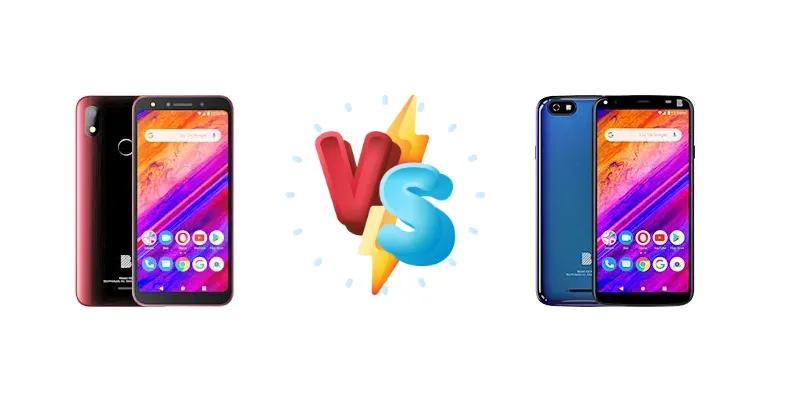
BLU consistently targets the ultra-budget smartphone market, and the G6 and G5 Plus represent their attempts to deliver the most features for the least amount of money. While both phones share a similar price point and target audience, key differences in their specifications, particularly the G6's 'Photo' camera and the Hummingbird chipset, warrant a detailed comparison to determine which device offers the best overall experience.
🏆 Quick Verdict
For the average user prioritizing basic functionality and a slightly more modern chipset, the BLU G6 emerges as the better choice. While the G5 Plus remains a viable option, the G6's Hummingbird chipset offers a marginal performance advantage, and the 'Photo' camera suggests a focus on image quality, even if details are limited.
| Network |
|---|
| 2G bands | GSM 850 / 900 / 1800 / 1900 | GSM 850 / 900 / 1800 / 1900 |
| 3G bands | HSDPA 850 / 1700(AWS) / 1900 - G0210UU | HSDPA 850 / 1700(AWS) / 1900 - G0190UU |
| 4G bands | 1, 3, 4, 5, 7, 28 - G0210LL | 1, 3, 4, 5, 7, 28 - G0190LL, G0190VV |
| Speed | HSPA 42.2/11.5 Mbps, LTE Cat4 150/50 Mbps | HSPA 42.2/11.5 Mbps, LTE Cat4 150/50 Mbps |
| Technology | GSM / HSPA / LTE | GSM / HSPA / LTE |
| | 2, 4, 5, 12, 17 - G0210UU | 2, 4, 5, 12, 17 - G0190UU |
| Launch |
|---|
| Announced | 2019, July. Released 2019, July | 2019, July. Released 2019, July |
| Status | Discontinued | Discontinued |
| Body |
|---|
| Dimensions | 153 x 73.4 x 9.1 mm (6.02 x 2.89 x 0.36 in) | 161.4 x 78 x 9.6 mm (6.35 x 3.07 x 0.38 in) |
| SIM | Nano-SIM + Nano-SIM | Nano-SIM + Nano-SIM |
| Weight | 160 g (5.64 oz) | 181 g (6.38 oz) |
| Display |
|---|
| Protection | Corning Gorilla Glass | - |
| Resolution | 720 x 1440 pixels, 18:9 ratio (~282 ppi density) | 720 x 1440 pixels, 18:9 ratio (~268 ppi density) |
| Size | 5.7 inches, 83.8 cm2 (~74.7% screen-to-body ratio) | 6.0 inches, 92.9 cm2 (~73.8% screen-to-body ratio) |
| Type | IPS LCD | IPS LCD |
| Platform |
|---|
| CPU | Octa-core 1.6 GHz Cortex-A55 | Octa-core 1.6 GHz Cortex-A55 |
| Chipset | Hummingbird | - |
| GPU | IMG8322 | IMG8322 |
| OS | Android 9.0 (Pie) | Android 9.0 (Pie) |
| Memory |
|---|
| Card slot | microSDXC | microSDXC |
| Internal | 64GB 3GB RAM | 32GB 2GB RAM |
| Main Camera |
|---|
| Features | LED flash | LED flash |
| Single | 13 MP, AF | 13 MP, AF |
| Video | 1080p@30fps | 1080p@30fps |
| Selfie camera |
|---|
| Features | LED flash | LED flash |
| Single | 8 MP | 8 MP |
| Video | 1080p@30fps | 1080p@30fps |
| Sound |
|---|
| 3.5mm jack | Yes | Yes |
| 35mm jack | Yes | Yes |
| Loudspeaker | Yes | Yes |
| Comms |
|---|
| Bluetooth | 4.1, A2DP | 4.1, A2DP |
| NFC | No | No |
| Positioning | GPS | GPS |
| Radio | FM radio | FM radio |
| USB | microUSB 2.0 | microUSB 2.0 |
| WLAN | Wi-Fi 802.11 b/g/n, Wi-Fi Direct | Wi-Fi 802.11 b/g/n, Wi-Fi Direct |
| Features |
|---|
| Browser | HTML, Adobe Flash | - |
| Sensors | Fingerprint (rear-mounted), accelerometer, proximity | Accelerometer, proximity |
| Battery |
|---|
| Stand-by | Up to 550 h (2G) / Up to 500 h (3G) | Up to 575 h (2G) / Up to 525 h (3G) |
| Talk time | Up to 20 h (2G) / Up to 15 h (3G) | Up to 20 h (2G) / Up to 15 h (3G) |
| Type | Li-Po 2800 mAh, removable | Li-Po 3000 mAh, removable |
| Misc |
|---|
| Colors | Black, Red | Black, Red, Twilight, Chameleon Blue |
| Price | About 280 EUR | - |
| SAR | 0.61 W/kg (head) 0.49 W/kg (body) | - |
| SAR EU | 0.51 W/kg (head) | - |
| Tests |
|---|
| Audio quality |
Noise -90.6dB / Crosstalk -92.5dB | - |
| Camera |
Photo | - |
| Loudspeaker |
Voice 64dB / Noise 66dB / Ring 75dB | - |
BLU G6
- Potentially more efficient Hummingbird chipset
- Camera branded as 'Photo', suggesting image quality focus
- Likely to receive more software updates (being the newer model)
- Limited information available on specifications
- May be slightly more expensive than the G5 Plus
BLU G5 Plus
- Likely the most affordable option
- Proven reliability within the BLU G series
- Simple and straightforward user experience
- Older processor architecture
- Standard camera setup with no specific enhancements
- Potentially limited software support
Display Comparison
Unfortunately, display specifications are absent from the provided data. Given BLU's market segment, we can infer both devices likely utilize IPS LCD panels with 720p+ resolution. The absence of details like refresh rate or peak brightness suggests neither phone will excel in display quality. Users should expect standard viewing angles and color reproduction, typical of budget displays. Bezels are likely to be substantial on both models to minimize production costs.
Camera Comparison
The BLU G6 differentiates itself with a 'Photo' camera, implying a focus on image capture. While the resolution and sensor size are unknown, the designation suggests BLU prioritized camera performance to some degree. The G5 Plus lacks this specific branding, indicating a more standard camera setup. Without further details, it's difficult to assess image quality, but users should expect typical budget smartphone camera performance – adequate in good lighting conditions but struggling in low light. The absence of information regarding OIS or lens apertures further limits our ability to compare camera capabilities.
Performance
Both the BLU G6 and G5 Plus are powered by an octa-core 1.6 GHz Cortex-A55 CPU. However, the G6's inclusion of the Hummingbird chipset suggests a potentially more efficient architecture or manufacturing process. While the core count and clock speed are identical, the Hummingbird may offer slightly improved single-core performance and better thermal management. This difference, though likely small, could translate to smoother multitasking and a more responsive user experience on the G6. The lack of RAM specifications makes it difficult to assess overall performance, but both devices likely feature 2-4GB of RAM, sufficient for basic tasks.
Battery Life
Battery capacity and charging wattage are not provided for either device. Given the budget nature of these phones, we can anticipate battery sizes in the 3000-4000 mAh range. Charging speeds are likely to be slow, potentially utilizing Micro-USB connectivity. Real-world battery life will depend heavily on usage patterns, but users should expect a full day of light use from both devices. The Hummingbird chipset in the G6 *may* offer slightly improved power efficiency, potentially extending battery life marginally.
Buying Guide
Buy the BLU G6 if you need a phone for everyday tasks like calling, texting, and light social media browsing, and you value a potentially more responsive experience thanks to the Hummingbird chipset. Buy the BLU G5 Plus if you are looking for the absolute lowest price point and are comfortable with a slightly older processor, and your usage is extremely light, focusing primarily on essential communication.
Frequently Asked Questions
❓ What is the practical difference between the Cortex-A55 CPU in the G6 and G5 Plus, given they have the same clock speed?
While both phones use the same CPU core and clock speed, the Hummingbird chipset in the G6 may utilize a more advanced manufacturing process or architectural optimizations. This could result in slightly improved single-core performance, better power efficiency, and potentially reduced thermal throttling during sustained use. However, the difference is unlikely to be dramatic.
❓ Does the 'Photo' camera on the BLU G6 mean it takes significantly better pictures than the G5 Plus?
The 'Photo' designation suggests BLU prioritized camera performance on the G6, but without knowing the sensor size, aperture, or image processing algorithms, it's impossible to quantify the difference. Expect improvements in image quality, particularly in well-lit conditions, but don't anticipate flagship-level camera performance. The G5 Plus will still be capable of taking acceptable photos for casual use.
❓ Will either of these phones struggle with popular apps like Facebook or WhatsApp?
Both phones, with their likely 2-4GB of RAM and Cortex-A55 processors, may exhibit some lag when running multiple apps simultaneously. However, for basic usage like Facebook, WhatsApp, and web browsing, they should be adequate. Closing unused apps regularly will help maintain performance.