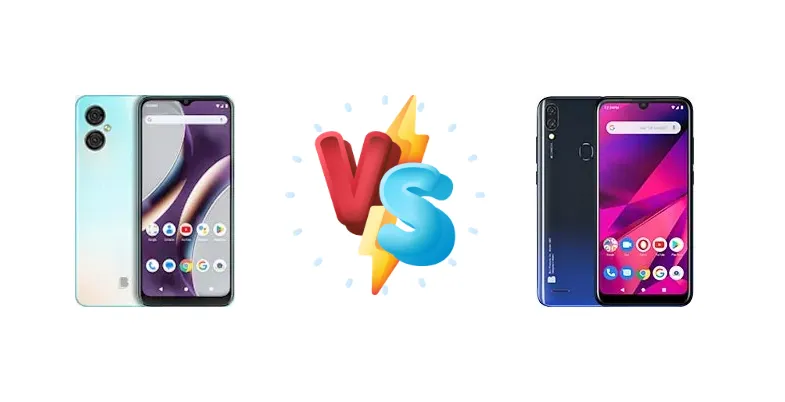
BLU consistently targets the ultra-budget smartphone market, and the G53 and G60 represent two recent contenders. While both aim to deliver affordability, they take different approaches to processing power. The G53 features a more powerful, albeit fewer-cored, CPU, while the G60 opts for a higher core count with a less potent architecture. This comparison dissects these differences to determine which phone best suits your needs.
🏆 Quick Verdict
For users prioritizing responsiveness in everyday tasks and occasional light gaming, the BLU G53 is the better choice. Its Cortex-A75 core provides a significant performance boost over the G60’s all-Cortex-A55 configuration, despite having fewer cores overall. The G60 may offer slightly better multi-tasking, but the performance gap in single-threaded applications is noticeable.
| Network |
|---|
| 2G bands | GSM 850 / 900 / 1800 / 1900 | GSM 850 / 900 / 1800 / 1900 |
| 3G bands | HSDPA 850 / 900 / 1700(AWS) / 1900 / 2100 | HSDPA 850 / 900 / 1700(AWS) / 1900 / 2100 |
| 4G bands | 2, 3, 4, 5, 7, 12, 17, 28, 66, 71 | 1, 2, 3, 4, 5, 7, 12, 17, 28 |
| Speed | HSPA, LTE | HSPA 42.2/11.5 Mbps, LTE Cat4 150/50 Mbps |
| Technology | GSM / HSPA / LTE | GSM / HSPA / LTE |
| Launch |
|---|
| Announced | 2023, June | 2020, January. Released 2020, January |
| Status | Available. Released 2023, July | Discontinued |
| Body |
|---|
| Build | Glass front, plastic frame, plastic back | - |
| Dimensions | 164.8 x 75.8 x 8.9 mm (6.49 x 2.98 x 0.35 in) | 156.5 x 73.6 x 9.5 mm (6.16 x 2.90 x 0.37 in) |
| SIM | Nano-SIM + Nano-SIM | Nano-SIM + Nano-SIM |
| Weight | 200 g (7.05 oz) | 170 g (6.00 oz) |
| Display |
|---|
| Resolution | 720 x 1600 pixels, 20:9 ratio (~270 ppi density) | 720 x 1520 pixels, 19:9 ratio (~276 ppi density) |
| Size | 6.5 inches, 102.0 cm2 (~81.7% screen-to-body ratio) | 6.1 inches, 92.9 cm2 (~80.6% screen-to-body ratio) |
| Type | IPS LCD | IPS LCD |
| Platform |
|---|
| CPU | Quad-core (1x2.0 GHz Cortex-A75 & 3x1.8 GHz Cortex-A55) | Octa-core 1.6 GHz Cortex-A55 |
| GPU | IMG8322 | IMG8322 |
| OS | Android 13 | Android 9.0 (Pie) |
| Memory |
|---|
| Card slot | microSDXC | microSDXC (dedicated slot) |
| Internal | 64GB 4GB RAM | 64GB 3GB RAM |
| | - | eMMC 5.1 |
| Main Camera |
|---|
| Dual | 13 MP, f/2.0, (wide)
Auxiliary lens | 13 MP, AF
Auxiliary lens |
| Features | LED flash, HDR, panorama | LED flash |
| Video | 1080p@30fps | 1080p@30fps |
| Selfie camera |
|---|
| Single | 8 MP, f/2.0 | 13 MP |
| Video | 1080p@30fps | 720p@30fps |
| Sound |
|---|
| 3.5mm jack | - | Yes |
| 35mm jack | Yes | Yes |
| Loudspeaker | Yes | Yes |
| Comms |
|---|
| Bluetooth | 5.0, A2DP, LE | 4.1, A2DP, LE |
| NFC | No | No |
| Positioning | GPS | GPS |
| Radio | FM radio | FM radio |
| USB | USB Type-C 2.0 | microUSB 2.0 |
| WLAN | Wi-Fi 802.11 b/g/n/ac, Wi-Fi Direct | Wi-Fi 802.11 b/g/n, Wi-Fi Direct |
| Features |
|---|
| Sensors | Fingerprint (side-mounted), accelerometer | Fingerprint (rear-mounted), accelerometer, proximity |
| Battery |
|---|
| Type | Li-Po 5000 mAh | Li-Po 4000 mAh, removable |
| Misc |
|---|
| Colors | Pearl, Black, Green, Violet, White | Black, Blue, Red |
| Price | About 100 EUR | About 90 EUR |
BLU G53
- Stronger single-core performance due to Cortex-A75 core.
- More responsive user experience for everyday tasks.
- Potentially better gaming performance in less demanding titles.
- Fewer cores may limit multi-tasking capabilities.
- Display and camera specs are likely basic.
BLU G60
- Octa-core processor may handle multi-tasking slightly better.
- Potentially longer battery life under light load.
- Likely similar display and camera quality to the G53.
- Weaker individual core performance leads to slower app launch times.
- Overall system responsiveness will be lower than the G53.
Display Comparison
Display specifications are not provided, so a direct comparison is impossible. However, given the price point, both devices likely utilize LCD panels with 720p+ resolution. Expect compromises in color accuracy and brightness compared to higher-end devices. Bezels are likely to be substantial on both models, maximizing screen real estate within a budget-friendly design.
Camera Comparison
Camera details are absent, making a meaningful comparison difficult. Given the price bracket, expect basic camera setups with limited features. Image quality will likely be acceptable in good lighting conditions but will struggle in low light. The presence of a 2MP macro camera on either device is largely a marketing tactic, as the image quality from such sensors is typically poor. Focusing on the main sensor’s megapixel count (if available) and aperture would be more indicative of real-world performance.
Performance
The core difference lies in the CPUs. The BLU G53’s quad-core processor, featuring one 2.0 GHz Cortex-A75 core and three 1.8 GHz Cortex-A55 cores, offers a significant architectural advantage. The Cortex-A75 is a performance-focused core, delivering substantially higher single-core performance than the Cortex-A55. The BLU G60, with its octa-core 1.6 GHz Cortex-A55 processor, relies on sheer core count. While eight cores can handle more concurrent tasks, each core is less powerful individually. This means the G53 will likely feel faster when launching apps or performing demanding single-threaded operations. The G60 might show an advantage in heavily multi-threaded workloads, but these are less common on budget devices. RAM specifications are not provided, but both likely utilize LPDDR4X to balance cost and performance.
Battery Life
Battery capacity and charging wattage are not specified. However, given the target market, both phones likely feature batteries in the 4000-5000 mAh range. The G60’s more efficient Cortex-A55 cores *could* translate to slightly longer battery life under light load, but the G53’s faster processing could offset this during more intensive use. Without knowing charging wattage, it’s impossible to assess charging speeds; expect both to take several hours for a full charge.
Buying Guide
Buy the BLU G53 if you need a phone that feels snappy for basic tasks like browsing, social media, and messaging, and you occasionally play less demanding mobile games. Its stronger single-core performance translates to a more fluid user experience. Buy the BLU G60 if your primary use case involves running multiple apps simultaneously for extended periods, and you prioritize sustained performance over peak responsiveness, understanding that individual app launch times will be slower.
Frequently Asked Questions
❓ Will the BLU G53 struggle with popular social media apps like TikTok and Instagram?
The BLU G53’s Cortex-A75 core should handle TikTok and Instagram reasonably well, though expect some occasional slowdowns when scrolling through feeds or recording videos. The G60 might exhibit more frequent lag due to its less powerful cores.
❓ Is the BLU G60 a good choice for playing graphically intensive games like PUBG Mobile?
Neither the G53 nor the G60 are ideal for demanding games like PUBG Mobile. Both will likely require significant graphics settings reductions to achieve playable frame rates. The G53 might offer slightly better performance, but don't expect a smooth experience.
❓ How much storage do these phones typically come with, and can it be expanded?
Storage capacity is not specified, but budget BLU phones typically start with 32GB of internal storage. MicroSD card support is highly likely, allowing you to expand storage for photos, videos, and apps.
❓ What version of Android do these phones run?
The Android version is not specified. However, given BLU’s target market, expect a relatively recent version of Android (likely Android 12 or 13) with a customized user interface. Software update support is typically limited on budget devices.