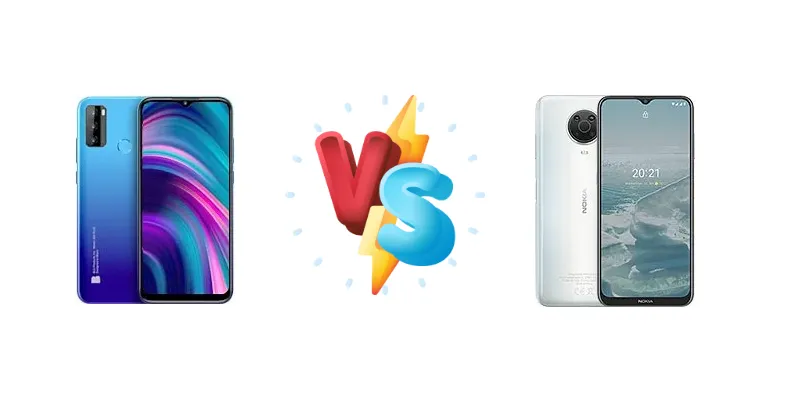
The BLU G51 Plus and Nokia G20 represent two approaches to the ultra-budget smartphone market. The G51 Plus focuses on a streamlined experience with a newer Cortex-A55 based processor, while the Nokia G20 aims for longevity and a more recognizable brand with the Mediatek Helio G35. This comparison dissects their key differences to determine which offers the best value.
🏆 Quick Verdict
For the average user prioritizing responsiveness and a slightly more modern processor architecture, the BLU G51 Plus emerges as the better choice. While the Nokia G20 benefits from Nokia’s software support promises, the G51 Plus’s Cortex-A55 CPU offers a performance edge in everyday tasks, despite the lack of detailed chipset information.
| Network |
|---|
| 2G bands | GSM 850 / 900 / 1800 / 1900 | GSM 850 / 900 / 1800 / 1900 |
| 3G bands | HSDPA 850 / 900 / 1700(AWS) / 1900 / 2100 | HSDPA 850 / 900 / 1900 / 2100 - International |
| 4G bands | 1, 2, 3, 4, 5, 7, 12, 17, 28 | 1, 3, 5, 7, 8, 20, 28, 38, 40, 41 - International |
| Speed | HSPA, LTE | HSPA 42.2/5.76 Mbps, LTE Cat4 150/50 Mbps |
| Technology | GSM / HSPA / LTE | GSM / HSPA / LTE |
| | - | 1, 2, 3, 4, 5, 7, 8, 12, 17, 28, 66 - LATAM |
| Launch |
|---|
| Announced | 2021, May 22. Released 2021, May 22 | 2021, April 08 |
| Status | Discontinued | Available. Released 2021, May 17 |
| Body |
|---|
| Dimensions | 165 x 76.5 x 9.3 mm (6.50 x 3.01 x 0.37 in) | 164.9 x 76 x 9.2 mm (6.49 x 2.99 x 0.36 in) |
| SIM | Nano-SIM + Nano-SIM | · Nano-SIM· Nano-SIM + Nano-SIM |
| Weight | 200 g (7.05 oz) | 197 g (6.95 oz) |
| | - | Splash protection |
| Display |
|---|
| Resolution | 720 x 1600 pixels, 20:9 ratio (~270 ppi density) | 720 x 1600 pixels, 20:9 ratio (~269 ppi density) |
| Size | 6.5 inches, 102.0 cm2 (~80.8% screen-to-body ratio) | 6.52 inches, 102.6 cm2 (~81.9% screen-to-body ratio) |
| Type | IPS LCD | IPS LCD |
| Platform |
|---|
| CPU | Octa-core 1.6 GHz Cortex-A55 | Octa-core (4x2.3 GHz Cortex-A53 & 4x1.8 GHz Cortex-A53) |
| Chipset | - | Mediatek MT6765G Helio G35 (12 nm) |
| GPU | - | PowerVR GE8320 |
| OS | Android 11 | Android 11, upgradable to Android 13 |
| Memory |
|---|
| Card slot | microSDXC | microSDXC (dedicated slot) |
| Internal | 64GB 3GB RAM | 64GB 4GB RAM, 128GB 4GB RAM |
| | eMMC 5.1 | - |
| Main Camera |
|---|
| Features | LED flash, HDR, panorama | LED flash, HDR, panorama |
| Quad | - | 48 MP, f/1.8, (wide), PDAF
5 MP, (ultrawide)
2 MP (macro)
Auxiliary lens |
| Single | 8 MP | 8 MP, (wide) |
| Triple | 13 MP
0.3 MP (macro)
Auxiliary lens | - |
| Video | 1080p@30fps | 1080p@30fps |
| Selfie camera |
|---|
| Single | 8 MP | 8 MP, (wide) |
| Video | 720p@30fps | 1080p@30fps |
| Sound |
|---|
| 3.5mm jack | Yes | Yes |
| 35mm jack | Yes | Yes |
| Loudspeaker | Yes | Yes |
| Comms |
|---|
| Bluetooth | 4.1, A2DP, LE | 5.0, A2DP, LE |
| NFC | No | Yes (market/region dependent) |
| Positioning | GPS | GPS, GLONASS, BDS |
| Radio | FM radio | FM radio |
| USB | microUSB 2.0 | USB Type-C 2.0, OTG |
| WLAN | Wi-Fi 802.11 b/g/n, Wi-Fi Direct | Wi-Fi 802.11 b/g/n |
| Features |
|---|
| Sensors | Fingerprint (rear-mounted), accelerometer, proximity | Fingerprint (side-mounted), accelerometer, gyro, proximity |
| Battery |
|---|
| Charging | - | 10W wired |
| Type | Li-Po 4000 mAh | Li-Po 5050 mAh |
| Misc |
|---|
| Colors | Black, Blue, Red, Green | Glacier, Night |
| Models | - | TA-1336, TA-1343, TA-1347, TA-1372, TA-1365 |
| Price | About 110 EUR | About 90 EUR |
| SAR | - | 1.01 W/kg (head) 1.02 W/kg (body) |
| SAR EU | - | 0.49 W/kg (head) 1.13 W/kg (body) |
BLU G51 Plus
- More modern Cortex-A55 CPU architecture
- Potentially more responsive user experience
- Likely lower price point
- Limited information available on specifications
- Unknown camera performance
Nokia G20
- Large 5000mAh battery for extended use
- 48MP main camera sensor
- Nokia’s brand reputation and software support
- Older Cortex-A53 CPU architecture
- Slower 10W charging
- Lower resolution display
Display Comparison
Neither device boasts a standout display. Without specific display specs for the BLU G51 Plus, we can assume it’s a standard LCD panel typical of this price range. The Nokia G20 features a large 6.5-inch LCD, but its resolution is only 720 x 1600. The Nokia G20’s larger screen size is offset by the lower pixel density, resulting in a less sharp image. Neither phone is expected to offer high brightness or wide color gamut coverage.
Camera Comparison
Camera performance is likely to be similar on both devices, leaning towards basic functionality. Without detailed camera specs for the BLU G51 Plus, it’s safe to assume a standard configuration. The Nokia G20 features a 48MP main sensor, which is a step up from the typical 13MP found in this segment, but image quality will still be heavily reliant on software processing. The presence of 2MP macro and depth sensors on both devices adds little practical value. The larger sensor on the Nokia G20 *could* offer better low-light performance, but the image processing pipeline will be the deciding factor.
Performance
The core difference lies in the processors. The Nokia G20’s Mediatek Helio G35, built on a 12nm process, utilizes a combination of Cortex-A53 cores clocked at 2.3 GHz and 1.8 GHz. The BLU G51 Plus, with its Octa-core 1.6 GHz Cortex-A55 CPU, benefits from a more modern architecture. While the clock speed is lower, the Cortex-A55 offers improved instructions per clock (IPC) compared to the A53, translating to better performance at the same clock speed. This means the G51 Plus is likely to feel more responsive in daily tasks, despite the lack of GPU details. The Nokia G20’s 12nm process is less efficient than newer nodes, potentially leading to slightly higher power consumption.
Battery Life
The Nokia G20 includes 10W wired charging, indicating a slower charging experience. Without battery capacity information for the BLU G51 Plus, it’s difficult to make a direct comparison. However, the Nokia G20’s 5000mAh battery provides a substantial capacity, suggesting all-day battery life for moderate users. The slower charging speed means topping up will take considerably longer. The G51 Plus will need a comparable or larger battery to compete on longevity.
Buying Guide
Buy the BLU G51 Plus if you need a phone for basic tasks like social media, messaging, and light web browsing, and value a slightly snappier experience. Buy the Nokia G20 if you prioritize brand recognition, potential for longer software support from Nokia, and are comfortable with a chipset that, while capable, is based on an older Cortex-A53 architecture and slower clock speeds.
Frequently Asked Questions
❓ Is the Mediatek Helio G35 in the Nokia G20 powerful enough for casual gaming?
The Helio G35 can handle casual games like Candy Crush or Subway Surfers without issue. However, demanding titles like PUBG Mobile will require significantly reduced graphics settings and may still experience frame drops. The G35 is designed for efficiency, not raw power.
❓ How does the Cortex-A55 CPU in the BLU G51 Plus compare to the Cortex-A53 in the Nokia G20 for everyday tasks?
The Cortex-A55 architecture is more efficient and offers improved performance per clock cycle compared to the older Cortex-A53. This translates to a snappier experience when opening apps, browsing the web, and multitasking on the BLU G51 Plus, even with a lower clock speed.
❓ Does the Nokia G20's 10W charging feel slow in 2024?
Yes, 10W charging is quite slow by today's standards. Expect a full charge to take over 3 hours. This is a significant drawback if you frequently need to top up your phone throughout the day. The BLU G51 Plus's charging speed is unknown, but anything above 10W would be a noticeable improvement.