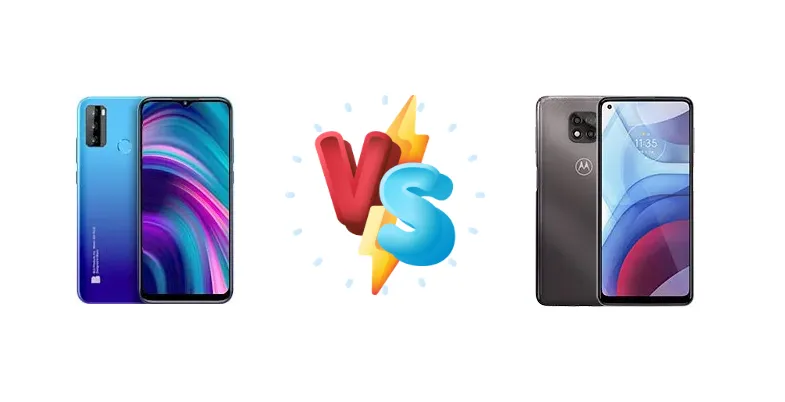
The sub-$200 smartphone market is fiercely competitive. The BLU G51 Plus and Motorola Moto G Power (2021) both aim to deliver essential smartphone functionality at an accessible price. However, they take different approaches to achieving this, with the Motorola prioritizing a more capable chipset while the BLU focuses on a basic, functional experience. This comparison dissects their key differences to help you choose the right device.
🏆 Quick Verdict
For the average user, the Motorola Moto G Power (2021) is the better choice. Its Qualcomm Snapdragon 662 chipset provides a significantly smoother and more responsive experience than the BLU G51 Plus’s Cortex-A55 processor, making it better suited for multitasking and app usage. While the BLU may offer slightly longer battery life due to its less powerful processor, the performance trade-off isn't worth it for most.
| Network |
|---|
| 2G bands | GSM 850 / 900 / 1800 / 1900 | GSM 850 / 900 / 1800 / 1900 |
| 3G bands | HSDPA 850 / 900 / 1700(AWS) / 1900 / 2100 | HSDPA 850 / 900 / 1700(AWS) / 1900 / 2100 |
| 4G bands | 1, 2, 3, 4, 5, 7, 12, 17, 28 | 1, 2, 3, 4, 5, 7, 8, 12, 13, 14, 17, 25, 26, 29, 30, 38, 41, 66, 71 |
| Speed | HSPA, LTE | HSPA, LTE |
| Technology | GSM / HSPA / LTE | GSM / CDMA / HSPA / EVDO / LTE |
| | - | CDMA2000 1xEV-DO |
| Launch |
|---|
| Announced | 2021, May 22. Released 2021, May 22 | 2021, January 08 |
| Status | Discontinued | Available. Released 2021, January 14 |
| Body |
|---|
| Build | - | Glass front, plastic back, plastic frame |
| Dimensions | 165 x 76.5 x 9.3 mm (6.50 x 3.01 x 0.37 in) | 165.3 x 75.9 x 9.5 mm (6.51 x 2.99 x 0.37 in) |
| SIM | Nano-SIM + Nano-SIM | Nano-SIM |
| Weight | 200 g (7.05 oz) | 206.5 g (7.30 oz) |
| | - | Water-repellent coating |
| Display |
|---|
| Resolution | 720 x 1600 pixels, 20:9 ratio (~270 ppi density) | 720 x 1600 pixels, 20:9 ratio (~266 ppi density) |
| Size | 6.5 inches, 102.0 cm2 (~80.8% screen-to-body ratio) | 6.6 inches, 105.2 cm2 (~83.8% screen-to-body ratio) |
| Type | IPS LCD | IPS LCD |
| Platform |
|---|
| CPU | Octa-core 1.6 GHz Cortex-A55 | Octa-core (4x2.0 GHz Kryo 260 Gold & 4x1.8 GHz Kryo 260 Silver) |
| Chipset | - | Qualcomm SM6115 Snapdragon 662 (11 nm) |
| GPU | - | Adreno 610 |
| OS | Android 11 | Android 10 |
| Memory |
|---|
| Card slot | microSDXC | microSDXC (dedicated slot) |
| Internal | 64GB 3GB RAM | 32GB 3GB RAM, 64GB 4GB RAM |
| | eMMC 5.1 | eMMC 5.1 |
| Main Camera |
|---|
| Features | LED flash, HDR, panorama | LED flash, HDR, panorama |
| Single | 8 MP | - |
| Triple | 13 MP
0.3 MP (macro)
Auxiliary lens | 48 MP, f/1.7, (wide), 1/2.0", 0.8µm, PDAF
2 MP (macro)
Auxiliary lens |
| Video | 1080p@30fps | 1080p@30/60fps, gyro-EIS |
| Selfie camera |
|---|
| Features | - | HDR |
| Single | 8 MP | 8 MP, f/2.0, 1.12µm |
| Video | 720p@30fps | 1080p@30fps, gyro-EIS |
| Sound |
|---|
| 3.5mm jack | Yes | Yes |
| 35mm jack | Yes | Yes |
| Loudspeaker | Yes | Yes |
| Comms |
|---|
| Bluetooth | 4.1, A2DP, LE | 5.0, A2DP, LE |
| NFC | No | No |
| Positioning | GPS | GPS, GLONASS, GALILEO |
| Radio | FM radio | FM radio |
| USB | microUSB 2.0 | USB Type-C 2.0 |
| WLAN | Wi-Fi 802.11 b/g/n, Wi-Fi Direct | Wi-Fi 802.11 a/b/g/n/ac, dual-band, Wi-Fi Direct |
| Features |
|---|
| Sensors | Fingerprint (rear-mounted), accelerometer, proximity | Fingerprint (side-mounted), accelerometer, gyro, proximity, compass, barometer |
| Battery |
|---|
| Charging | - | 15W wired |
| Type | Li-Po 4000 mAh | Li-Po 5000 mAh |
| Misc |
|---|
| Colors | Black, Blue, Red, Green | Flash Gray, Polar Silver |
| Price | About 110 EUR | About 60 EUR |
BLU G51 Plus
- Potentially longer battery life due to less powerful processor
- Lower price point (likely)
- Functional for basic smartphone tasks
- Significantly slower performance
- Likely lower-quality display
- Limited multitasking capabilities
Motorola Moto G Power (2021)
- Superior performance with Snapdragon 662
- More responsive user experience
- Better multitasking capabilities
- More efficient processor
- Slightly shorter battery life (potentially)
- 15W charging is not particularly fast
- Higher price than BLU G51 Plus
Display Comparison
Neither device is expected to deliver a premium display experience. Specifics regarding panel type (IPS vs. TFT) and resolution are missing for the BLU G51 Plus, but given its price point, it's likely a lower-tier panel. The Moto G Power (2021) also utilizes a standard LCD. The key difference lies in processing power impacting UI smoothness; a faster processor can render animations more effectively, even on a similar display. Bezels are likely comparable on both, reflecting their budget nature. Color accuracy is unlikely to be a strong suit for either.
Camera Comparison
Without detailed sensor information for the BLU G51 Plus, a direct comparison is difficult. However, both phones likely feature basic camera setups geared towards casual photography. The Moto G Power (2021) typically includes a 16MP main sensor, which is a reasonable starting point for this price range. Image processing will be a key differentiator; Motorola’s software aims for balanced results, while BLU’s processing is likely more basic. The inclusion of 2MP macro or depth sensors on either device should be viewed with skepticism, as their image quality is often subpar. The Snapdragon 662’s ISP (Image Signal Processor) provides a processing advantage for the Motorola.
Performance
The Motorola Moto G Power (2021) holds a substantial advantage in performance. Its Qualcomm Snapdragon 662, built on an 11nm process, features a combination of Kryo 260 Gold and Silver cores clocked up to 2.0 GHz. This contrasts sharply with the BLU G51 Plus’s Octa-core 1.6 GHz Cortex-A55 processor. The Snapdragon 662’s architecture is significantly more advanced, offering better multi-core performance and improved efficiency. This translates to faster app loading times, smoother multitasking, and a more responsive overall user experience. The 11nm process also contributes to better thermal management, potentially reducing throttling during sustained use. The BLU G51 Plus will likely struggle with demanding applications and may exhibit noticeable lag.
Battery Life
The Motorola Moto G Power (2021) features 15W wired charging. While not fast charging by today’s standards, it’s adequate for its 5000mAh battery. The BLU G51 Plus’s battery capacity is unknown, but its less powerful processor *could* result in slightly longer battery life between charges. However, the Snapdragon 662’s efficiency improvements may mitigate this difference. A full charge on the Moto G Power will likely take around 2-3 hours, while the BLU G51 Plus may take a similar amount of time, or potentially longer if its charging wattage is lower.
Buying Guide
Buy the BLU G51 Plus if you absolutely prioritize maximizing battery life above all else and only need a phone for very basic tasks like calls, texts, and light web browsing. Buy the Motorola Moto G Power (2021) if you value a more fluid user experience, enjoy occasional gaming, or frequently use multiple apps simultaneously. The Moto G Power’s superior processing power makes it the more versatile option.
Frequently Asked Questions
❓ Will the Motorola Moto G Power (2021) handle popular games like PUBG Mobile or Call of Duty Mobile?
The Snapdragon 662 in the Moto G Power (2021) can run PUBG Mobile and Call of Duty Mobile, but you’ll likely need to lower the graphics settings to medium or low to achieve a playable frame rate. Don't expect a flagship-level gaming experience, but it's capable of casual gaming.
❓ Is the BLU G51 Plus a good option for someone who primarily uses their phone for calls and texts?
Yes, the BLU G51 Plus is a suitable option for basic communication. Its Cortex-A55 processor is sufficient for making calls, sending texts, and using simple apps. However, if you anticipate using your phone for anything beyond these core functions, the Moto G Power (2021) offers a much better experience.
❓ How does the Snapdragon 662 handle multitasking compared to the BLU G51 Plus's processor?
The Snapdragon 662 excels at multitasking due to its more efficient architecture and higher clock speeds. You can comfortably switch between several apps without experiencing significant lag. The BLU G51 Plus’s processor will struggle with even moderate multitasking, leading to noticeable slowdowns.